 EN
EN DE
DE ES
ES FR
FR NL
NL PT
PT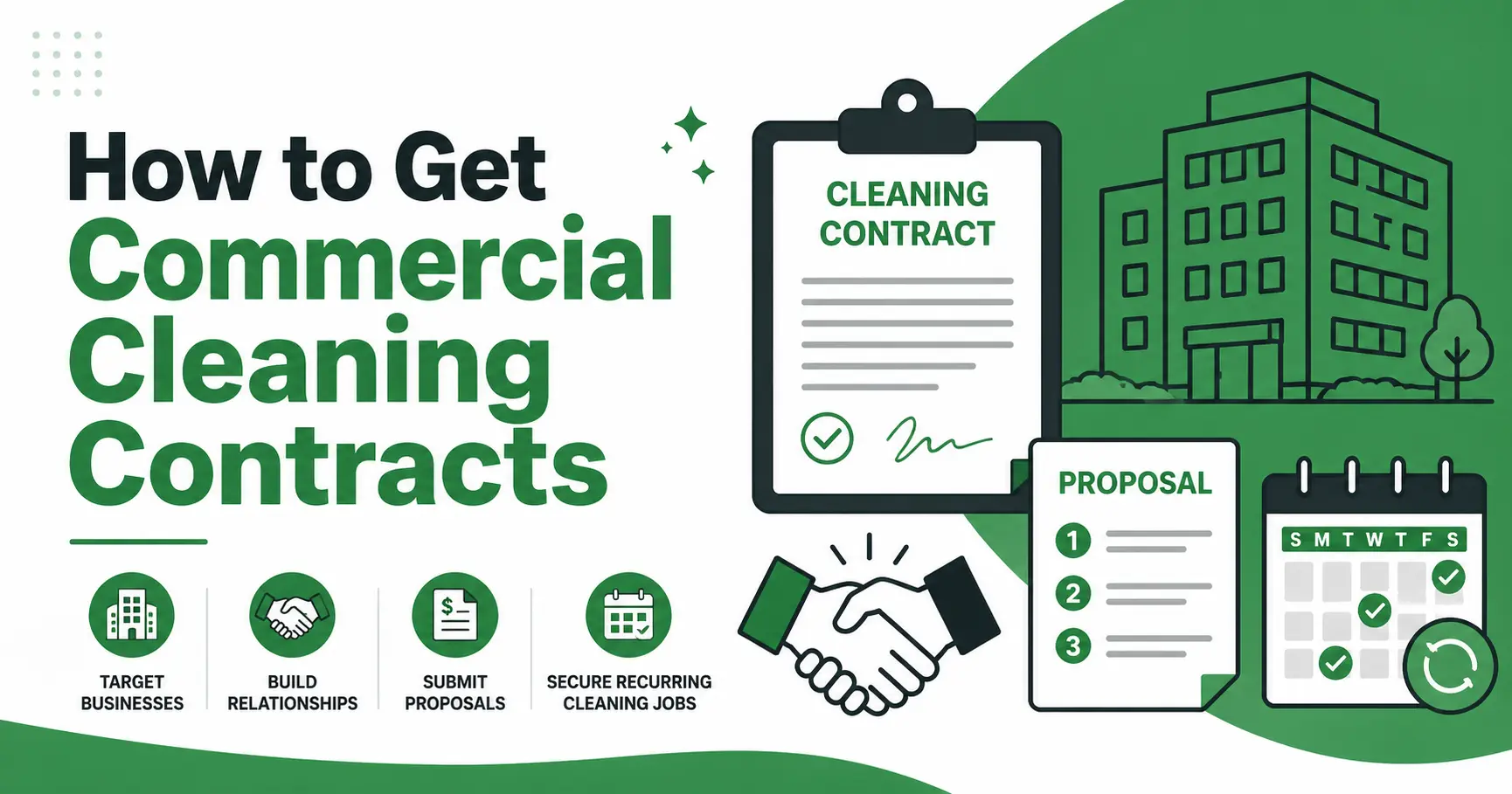





Quick Answer: How to Get Commercial Cleaning Contracts To win commercial cleaning contracts, identify target businesses in your area, submit a tailored proposal with a clear scope, pricing, and references, and follow up consistently. Commercial clients prioritize reliability and documentation over price alone. Once you land a contract, the operational side (scheduling crews, documenting each visit, and invoicing on time) is what keeps it.
The appeal of commercial cleaning is the recurring revenue. One office building on a five-night-per-week contract can anchor your schedule for years. But landing that first contract is where most small janitorial businesses stall. They treat commercial prospects like residential leads and wonder why nobody calls back.
This guide walks through how to get commercial cleaning contracts the right way: who to target, what commercial clients actually evaluate, how to build a proposal that wins, and how to price your bids without leaving money on the table.
Why Commercial Cleaning Contracts Are Harder to Win Than Residential Jobs
Residential cleaning is mostly word-of-mouth. A recommendation from a neighbor and a fair quote is often enough. Commercial clients work differently. A facilities manager responsible for a 10,000 sq ft office building is accountable to their employer for every vendor decision. That means they need documentation, not just a good conversation.
The most common reasons small janitorial businesses lose commercial bids:
- No proof of insurance or bonding: most commercial clients won’t even consider an uninsured vendor
- Vague scope of work: “we clean everything” doesn’t tell a client what they’re paying for
- No references from comparable sites: residential testimonials don’t count for commercial evaluators
- Pricing by the hour: commercial clients prefer a fixed monthly rate they can budget for
- No follow-up: a single email and silence reads as low commitment
The US janitorial services sector includes over 1.25 million businesses (IBISWorld, 2026). Most are small operators. The ones that consistently land commercial contracts do so because they show up prepared and follow through — not because they have the lowest price.
What Commercial Clients Actually Evaluate Before Signing
Before a facilities manager recommends your business to their leadership, they’re running a checklist. Understanding that checklist is the fastest way to position yourself ahead of competitors who don’t know it exists.
Here’s what commercial clients typically evaluate:
- General liability insurance (minimum $1M per occurrence is standard) and janitorial bonding
- References from comparable sites — another office building, a retail location, or a medical suite carries weight; a residential reference does not
- A written scope of work with specific tasks, areas, and cleaning frequencies defined
- A fixed monthly price or a per-visit rate — not an hourly quote with an unpredictable total
- A named supervisor or point of contact for issues, not just a general company phone number
- Background-checked staff, especially for facilities with after-hours access
You don’t need to be the cheapest bidder to win. You need to be the most credible one. A detailed proposal with clear documentation will beat a lower-priced competitor who shows up with a handshake and a verbal promise.
How to Find and Approach Commercial Cleaning Prospects
Not all commercial clients are equally accessible. Start with the ones most likely to say yes, then move up.
Small professional offices (easiest): Accounting firms, real estate agencies, insurance offices, and small law practices. Decision-maker is usually the office manager. Walk in, introduce yourself, and leave a one-page overview with your contact details. Follow up by email 3 to 5 days later.
Retail locations: Chain stores are handled centrally — approach independently owned retail instead. Local boutiques, salons, and specialty shops often handle facilities decisions in-house.
Property management companies: One relationship here can unlock multiple buildings. Find local property managers on LinkedIn or through your chamber of commerce. A single signed contract with a property manager can mean 5 to 10 client sites.
Medical facilities and schools: Highest value, most compliance requirements. Medical offices require bloodborne pathogen training and specific chemical protocols. Schools often require background checks and may have a formal bid process. Pursue these once you have solid references from lower-stakes commercial sites.
For prospecting, use Google Maps to identify business clusters in commercial districts, search LinkedIn for facilities managers in your city, and ask existing residential clients if they own or manage any commercial properties.
What to Include in a Commercial Cleaning Proposal
A winning commercial cleaning proposal isn’t long — it’s complete. A facilities manager reviewing three bids will move fastest on the one that answers every question before it’s asked.
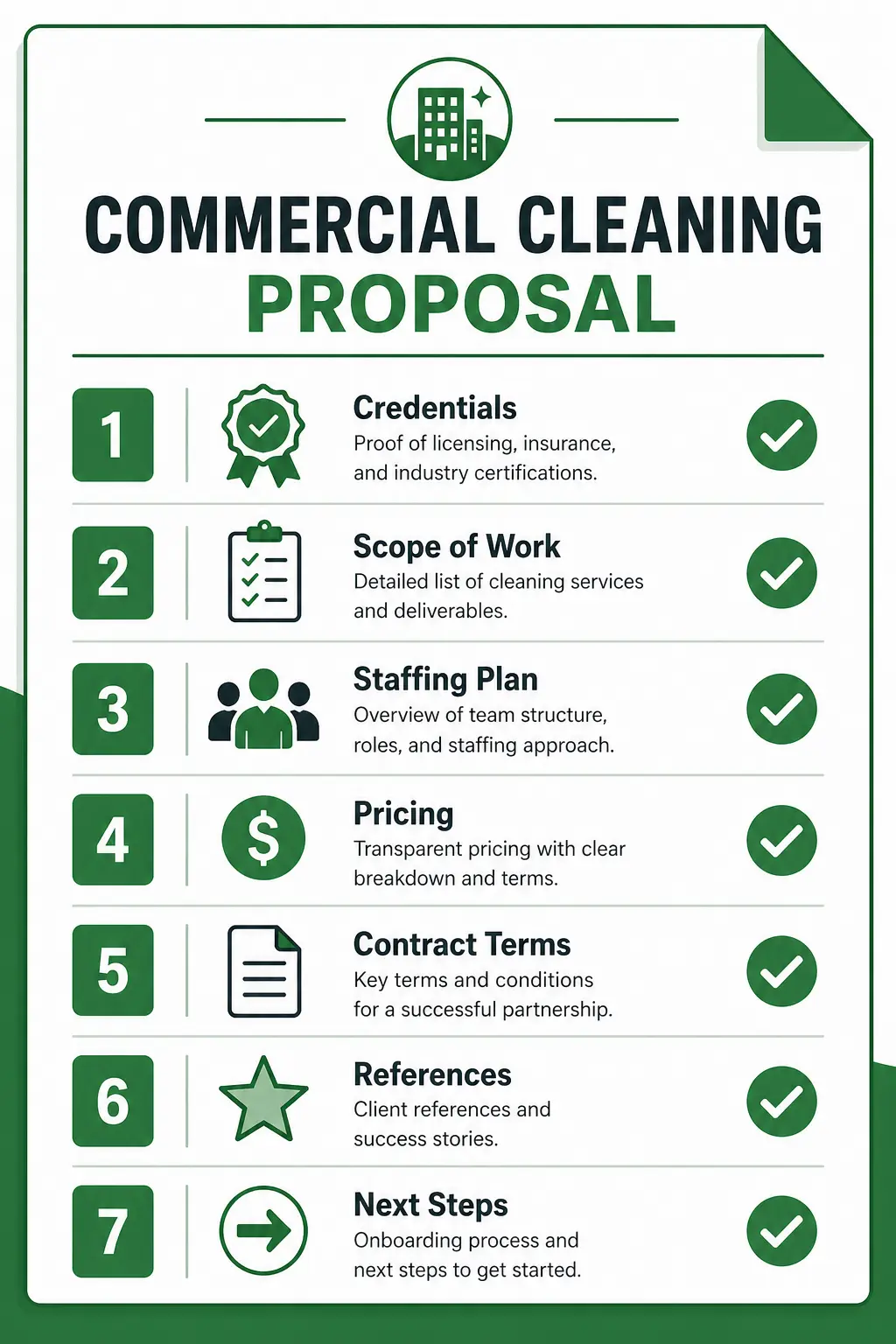
Include all of the following:
- Company credentials: Years in business, number of staff, insurance certificate (attach it), bonding details
- Scope of work: Specific tasks by area (lobby, restrooms, offices, break room), cleaning frequencies (nightly, weekly, monthly), and any exclusions
- Staffing plan: Named supervisor for the account, crew size, confirmation of background checks
- Pricing: Monthly contract total or per-visit rate, broken out by service frequency — not an hourly estimate
- Contract terms: Contract length, cancellation notice period (30 days standard), liability clause
- References: At least 2 contacts at comparable commercial sites who will take a call
- Next steps: How to sign, who to contact with questions, and your response time commitment
For help structuring the quote itself, the guide on how to write a job quote covers the core elements that turn a price into a professional document. If you’re sending proposals digitally, quote management tools for service businesses let clients approve online without a back-and-forth email chain.
How to Price Commercial Cleaning Contracts Without Underbidding
Underbidding is the fastest way to land a contract you’ll regret. A job priced below your actual cost means you’re paying to work, not getting paid.
Build your price from the bottom up:
Step 1 — Calculate your cost per visit. Take a 5,000 sq ft office cleaned 3 nights per week as an example. If it takes 2 cleaners 2 hours each at $18/hour, your labor cost per visit is $72. Add supplies ($8 per visit), your share of insurance and overhead ($15 per visit), and travel ($5). Your cost per visit is $100.
Step 2 — Add your margin. At a 30% profit margin, your per-visit price is $130. Multiplied by 13 visits per month, the monthly contract rate is $1,690.
Step 3 — Sanity-check against your market. Ask yourself whether a comparable cleaning company in your area could undercut this significantly while covering their own costs. If yes, revisit your costs — not your margin. Your margin is not the problem.
Use the job estimate calculator to run these numbers quickly for any site you’re bidding on.
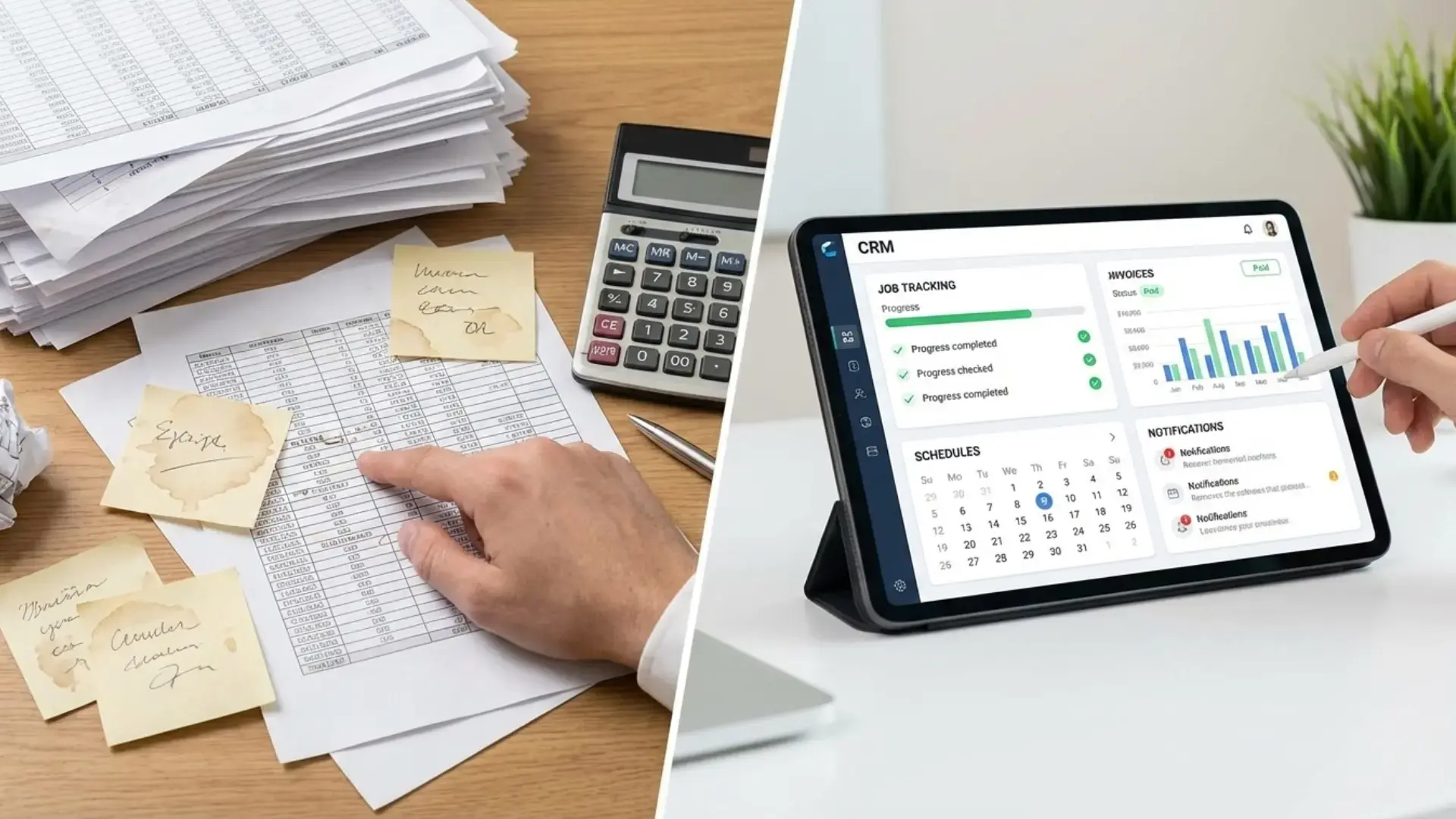
Once you land a commercial contract, the next challenge is running it without a single missed visit or late invoice. Fieldified’s janitorial software handles recurring scheduling, crew dispatch, and automated invoicing so every contract runs on its own. Book a demo to see how it works on a real cleaning schedule.
What Happens After You Win the Contract
Winning the contract is step one. Keeping it for years is what builds a real business.
The first two weeks after signing are critical. Do a formal site walkthrough with the client: confirm access codes, emergency contacts, any restricted areas, and specific preferences the scope didn’t capture. Assign a named supervisor to the account and make sure the crew knows the client’s name and what matters to them.
From there, your job is consistent execution and clean documentation:
- Crew checks in and out of each visit with a timestamped record
- Site-specific checklist completed on every visit
- Photos uploaded for any issues found on site
- Invoice sent automatically at the end of each billing cycle
The businesses that lose commercial contracts don’t usually lose them on quality. They lose them on communication gaps — a missed visit that wasn’t reported, an invoice that came late, or a client who had to chase someone down to ask a question. For a closer look at how the operational side runs with the right tools in place, see how Fieldified manages commercial cleaning operations.
Frequently Asked Questions
How long does it take to get a commercial cleaning contract?
Most commercial cleaning contracts take 2 to 6 weeks from first contact to signed agreement. The timeline depends on the client’s procurement process and how many bids they’re comparing. Consistent follow-up throughout the evaluation period is what separates the companies that get chosen from the ones that get forgotten.
Do I need to be licensed to clean commercial buildings?
Licensing requirements vary by state, but most commercial clients require proof of general liability insurance and janitorial bonding at minimum. Medical offices and government buildings often have additional compliance requirements. Confirm what each prospect requires before submitting your proposal.
How much should I charge for commercial cleaning?
Build your rate from your actual costs: labor, supplies, overhead, and travel — then add your target profit margin. Most small janitorial businesses target 25 to 35% gross margin on commercial contracts. Pricing by the visit or by a flat monthly rate is easier for clients to budget for than hourly quotes.
How do I get my first commercial cleaning client with no references?
Offer a free trial clean for a small local business in exchange for a written review and a reference call. A single documented clean with before-and-after photos gives you tangible proof of quality. Be upfront with prospects that you are actively building your commercial portfolio — many small business owners respect the honesty.
What’s the difference between a cleaning contract and a service agreement?
A service agreement defines the operational scope: what gets cleaned, how often, and to what standard. A cleaning contract covers the legal terms: payment, cancellation, liability, and dispute resolution. Most commercial clients want both in a single document. The scope is what they evaluate; the terms are what their legal team reviews.
Recurring commercial contracts are the foundation of a stable janitorial business. Land enough of them, and your revenue becomes predictable month after month without starting from zero every week. The businesses that win these contracts consistently aren’t the lowest bidders — they’re the most prepared ones, with the documentation, pricing, and follow-through to back up every proposal they send.
Stop managing commercial contracts by hand. Book a demo and see how Fieldified keeps every contract on schedule and paid on time, automatically.