
 EN
EN DE
DE ES
ES FR
FR NL
NL PT
PT





Quick Answer: Window Cleaning Pricing Window cleaning prices depend on property size, number of windows, access difficulty, and whether the job is residential or commercial. Most residential visits cost between $150 and $302, with a national average of $220. To build prices you can actually profit from, start with your real costs (labor, equipment, overhead, and travel) and apply your target margin on top.
Window cleaning pricing is where a lot of window cleaning businesses quietly lose money. You take a job, spend two hours on-site plus travel, and walk away with $100 after expenses. It feels like a win until you do the math.
The US window cleaning industry generates around $2.9 billion in annual revenue, according to industry data compiled by Gitnux (2023). With thousands of operators competing for the same residential and commercial accounts, the businesses that build a real pricing system (instead of matching the cheapest local quote) are the ones that actually grow.
This guide walks through every input that should determine your window cleaning rates, from labor and overhead to the right model for your market.
Why Window Cleaners Undercharge (And How Much It Costs Them)
Most window cleaning businesses price by one of two methods: what competitors charge, or what feels right for the job. Neither accounts for your actual cost structure.
Here is what undercharging looks like in practice. If you price a two-story residential job at $120 but your real cost (labor, travel, equipment, overhead) is $86, your margin is $34, which is 28 percent. Price that same job at $170 and your margin climbs to $84, close to 50 percent. The difference across 15 jobs a week adds up to over $39,000 a year in lost profit.
The fix is not raising every price blindly. It is building a floor price below which you simply will not take a job, and knowing exactly where that floor sits for your operation.
The 5 Factors That Should Set Your Window Cleaning Rates
Before you quote a single job, you need to know five cost inputs:
- Labor cost per hour: what you pay yourself and any crew members per hour, including payroll taxes if applicable. The median hourly wage for building cleaning workers is $17.27, according to the Bureau of Labor Statistics (May 2024). Your own rate should reflect your market and experience level.
- Travel time: portal-to-portal time is a real cost. Not charging for it means you are working for free on the road.
- Equipment depreciation and supplies: squeegees, water-fed poles, extension ladders, cleaning solution, and vehicle wear all have a cost per job.
- Overhead: business insurance, vehicle insurance, fuel, licensing, and admin costs divided across your weekly job volume.
- Target profit margin: the percentage above your total cost that stays in the business. For most small window cleaning operations, a 40 to 55 percent gross margin is a healthy target.
Most operators can calculate inputs 1 through 4 in under 30 minutes. The number you get is your floor price. Every job priced below it costs you money to do.
Window Cleaning Pricing Models: Per Pane, Per Window, or Flat Rate
Three pricing structures are common in window cleaning, and each works better in different situations.
Per pane: You charge a set fee per individual pane of glass. This is granular and accurate for complex properties with varied window sizes, but it slows down quoting on larger jobs. It can also confuse residential customers who do not know how many panes their home has.
Per window: You charge per window unit (inside and out counted together). This is the most widely understood model for residential work and speeds up quoting significantly. It works well for standard-size residential windows where job time per unit is predictable.
Flat rate per property: A single price for the full job based on your assessment. This is best for recurring commercial contracts where you know the property, have done the job before, and want a clean monthly invoice figure. It requires accurate initial quoting, because if you underestimate on a flat rate, you absorb the loss.
For most residential window cleaning businesses, per-window pricing hits the right balance of speed and accuracy. For commercial contracts, flat-rate monthly billing is the norm.
Residential vs. Commercial Window Cleaning: Different Pricing Logic
Residential and commercial window cleaning are essentially two different businesses with the same tools.
Residential jobs are typically one-time or seasonal, priced per visit, and won or lost on speed of response and professionalism of the quote. The client is a homeowner comparing prices across two or three providers. Margins can be strong, but volume is variable.
Commercial contracts are recurring and built on trust. A cleaning company that shows up reliably and invoices cleanly keeps its accounts for years. Pricing for commercial work is almost always contract-based: monthly flat rate, per-visit rate on a recurring schedule, or annual contract with quarterly billing.
The key difference for quoting: residential clients often do not have a benchmark and will pay a professional rate if your quote is clear and arrives fast. Commercial clients have a budget and a history of what they have paid before. Know which type of job you are quoting before you name a number.
How to Calculate Your Minimum Price Per Job
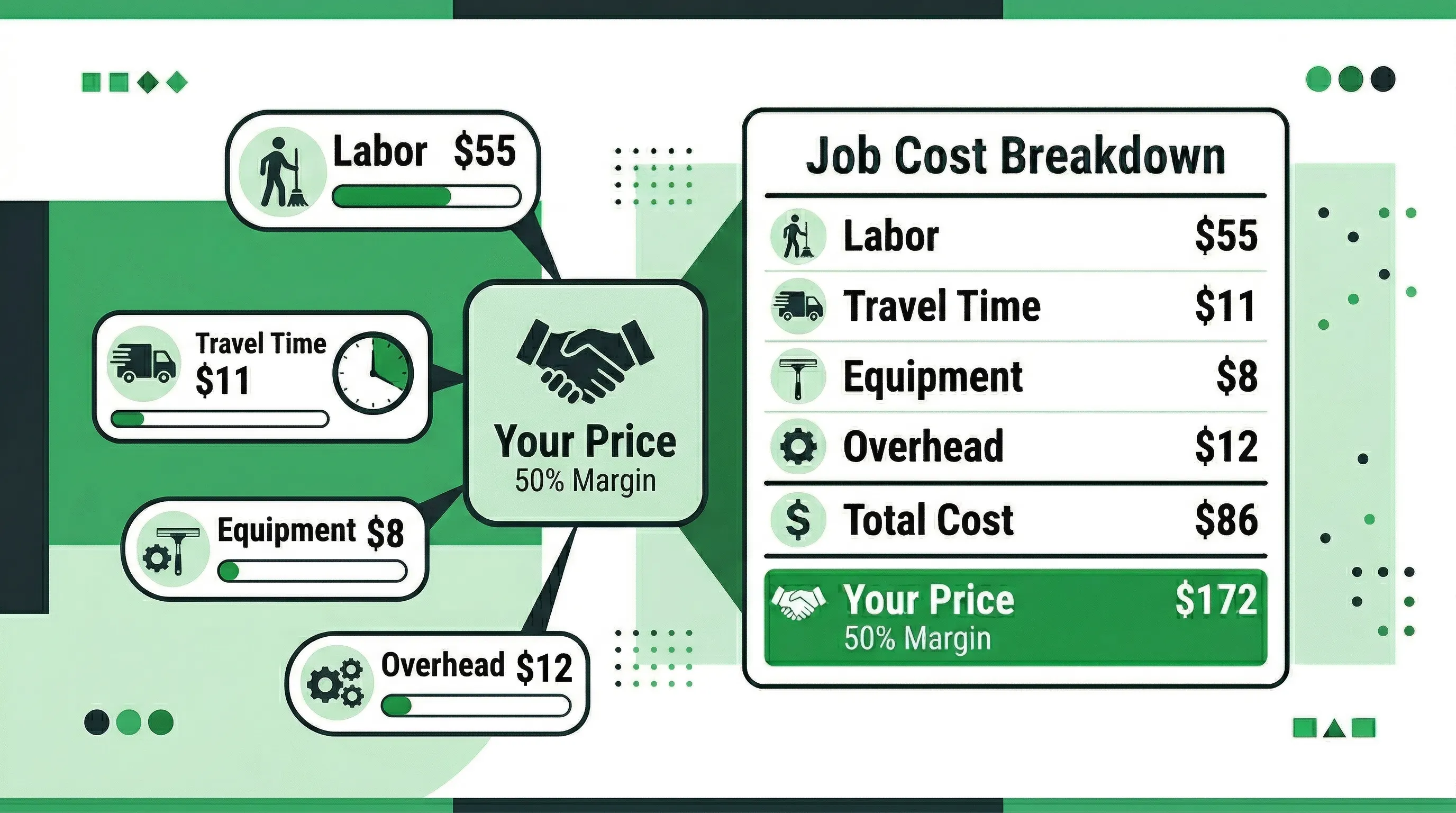
Here is a worked example for a residential two-story home with 20 windows (inside and out).
| Input | Calculation | Cost |
|---|---|---|
| Labor (2.5 hrs at $22/hr) | 2.5 x $22 | $55.00 |
| Travel time (30 min at $22/hr) | 0.5 x $22 | $11.00 |
| Equipment and supplies | per job estimate | $8.00 |
| Overhead (insurance, fuel, admin) | per job estimate | $12.00 |
| Total cost | $86.00 | |
| Price at 50% margin | $86 / 0.50 | $172.00 |
A window cleaner pricing this job at $120 is paying $34 out of their own pocket to do it. A price of $172 covers costs and generates a 50 percent gross margin.
Use the Profit Margin Calculator and the Service Price Calculator to run these numbers for your own operation in minutes without a spreadsheet.
Want to send professional window cleaning quotes in under two minutes and follow up automatically with clients who have not responded? Fieldified’s quote management tools handle the full process for your window cleaning business, free to start with no credit card required.
Window Cleaning Pricing Benchmarks: What the Market Charges
According to Angi’s 2026 cost data, the national average for residential window cleaning is $220 per visit, with most homeowners paying between $150 and $302.
Per-window rates run $4 to $8 for standard residential windows. Commercial window cleaning typically costs more per pane due to access requirements, height, and the volume of specialized equipment involved.
Common add-on pricing ranges to use as a starting point:
- Screen cleaning: $3 to $5 per screen
- Window track cleaning: $2 to $4 per track
- Hard water stain removal: $25 to $50 surcharge per job
- Interior-only cleaning: 40 to 50 percent of the full inside-and-out price
These benchmarks are a reference point, not a target. Your price must start with your cost structure. The benchmark tells you whether your market will support the rate you need to charge. If it does not, that is a market problem, not a pricing problem.
Common Pricing Mistakes Window Cleaners Make
Understanding where window cleaning pricing goes wrong helps you avoid the same errors.
Not charging for travel time. Every minute driving to a job is a minute you are not getting paid. A 20-minute drive each way on a $100 job means you are billing for two hours but working for two hours and forty minutes.
Not adjusting for access difficulty. A three-story building with restricted access takes significantly longer than a standard two-story residential job. If your quote does not account for the extra setup and risk, you absorb that cost.
Quoting commercial jobs at residential rates. Commercial jobs often involve more complex access, longer job times, and higher insurance requirements. A flat residential rate applied to a commercial account will lose money over time.
Not raising prices annually. Labor costs rise. Equipment costs rise. Insurance premiums rise. A window cleaning business that has not raised prices in two years is effectively running on a smaller margin every month.
Discounting recurring contracts below cost. Recurring clients are valuable, but not if you are losing money on every visit. A 10 percent loyalty discount on an already thin-margin job is not a relationship investment. It is a cost.
How to Quote Window Cleaning Jobs Without Losing the Sale
A confident, professional quote wins jobs as much as a competitive price.
Respond fast. The first window cleaner to send a written quote after a site visit or inquiry wins the job more often than the cheapest one. Speed signals professionalism and readiness.
Send a written quote, always. Verbal quotes leave room for dispute. A written quote that names the property, the scope (interior, exterior, add-ons), and the total price protects you and the client. For the full process, the guide on how to write a job quote covers each step in detail.
Set a quote expiry. A quote valid for 30 days creates gentle urgency without pressure. It also protects you if material or labor costs shift before the job starts.
Follow up. Most clients who do not respond immediately are not saying no. A single follow-up message three to five days after sending a quote significantly increases conversion rates for window cleaning businesses.
Frequently Asked Questions
How much should I charge for window cleaning?
Residential window cleaning averages $220 per visit nationally, with most jobs falling between $150 and $302, according to Angi. The right price for your business starts with your actual costs: labor, travel, equipment, and overhead. Use those inputs to set your floor price, then check it against local market rates.
Is per-window or flat rate pricing better for a window cleaning business?
Per-window pricing works well for residential jobs where each window is roughly the same size and job time is predictable. Flat rate pricing works better for recurring commercial contracts where you know the property and want a clean billing cycle. Many window cleaning businesses use both models depending on the job type.
What is the average cost of window cleaning for a residential home?
According to Angi’s 2026 cost data, the national average for residential window cleaning is $220, with a typical range of $150 to $302 per visit. Prices vary by region, property size, number of windows, and whether the job includes interior cleaning.
How do I price a commercial window cleaning contract?
Start with a thorough site assessment: count windows, note access requirements, and estimate total job time. Calculate your costs using the same labor-plus-overhead formula you use for residential work, then apply a commercial premium for height or restricted access. Present the total as a monthly or per-visit rate depending on the contract terms.
How often should window cleaning businesses raise their rates?
Most window cleaning businesses should review pricing annually. Labor costs, equipment, fuel, and insurance all increase over time. A 5 to 10 percent annual increase is reasonable and expected by established clients when communicated in advance with enough notice.
What add-ons should I charge for in window cleaning?
Common billable add-ons include screen cleaning ($3 to $5 per screen), track cleaning ($2 to $4 per track), hard water stain removal ($25 to $50 surcharge), and interior-only cleaning at roughly 40 to 50 percent of the full inside-and-out price. Add-ons increase revenue per job without adding new clients.
Build a Pricing System, Not Just a Price List
Profitable window cleaning pricing is not a single number you copy from a competitor. It is a floor price calculated from your real costs, checked against market benchmarks, and reviewed every year.
The operators who grow their window cleaning businesses profitably are the ones who know exactly what a job costs them before they name a price, and who follow up every quote instead of hoping the client calls back.
Ready to send professional quotes, track follow-ups, and manage your window cleaning clients in one place? Try Fieldified free with no credit card required, or explore the full platform built for window cleaning businesses.