 EN
EN DE
DE ES
ES FR
FR NL
NL PT
PT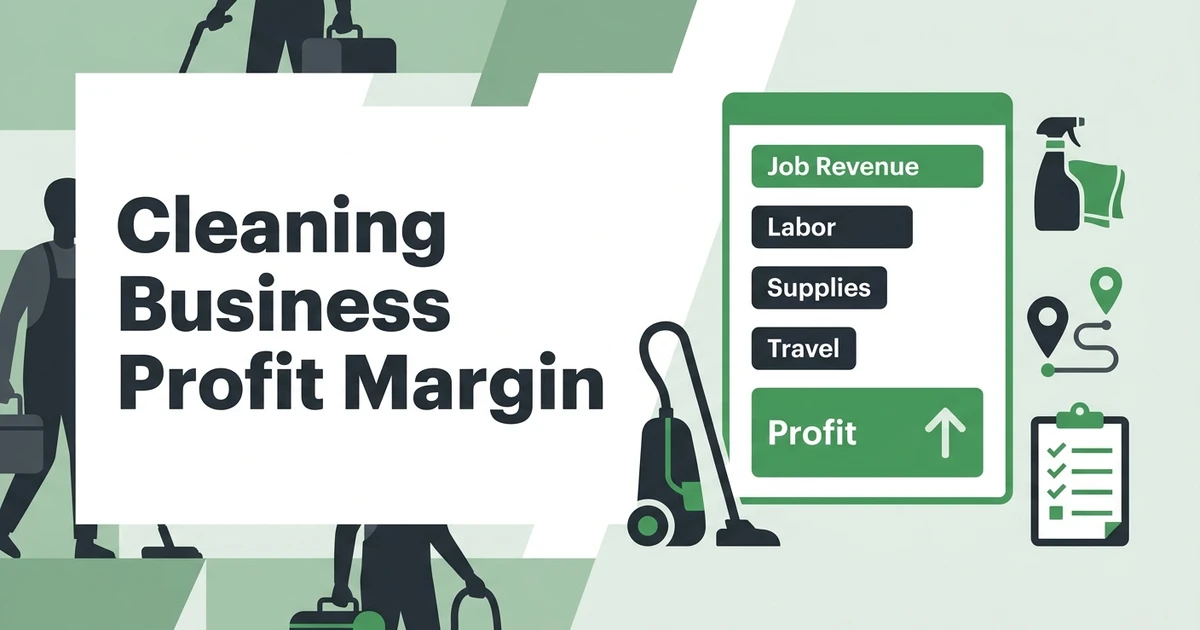





Quick Answer: Cleaning Business Profit Margin
Cleaning business profit margin shows how much of a job’s revenue remains after its costs. Calculate it with:(job revenue - total job costs) / job revenue x 100. Track margin per job and across the full company, because a packed cleaning calendar can still contain work that loses money.
A healthy cleaning business needs more than sales. It needs jobs that leave enough money after cleaner time, travel, supplies, callbacks, and overhead.
That starts with measuring each job using the same method. Once you know what every clean earns, you can fix weak scopes, routes, and processes before they drain the month.
Why a Busy Cleaning Business Can Still Have Thin Profit Margins
Revenue tells you what customers paid. Profit tells you what remained. Margin turns that remaining amount into a percentage you can compare across jobs of different sizes.
A weekly house clean may look dependable but run over its planned time every visit. A move-out clean may bring in more revenue but require extra supplies, a second trip, and an unpaid callback.
Labor is especially easy to underestimate. Janitors and building cleaners held about 2.4 million jobs in 2024, and their median hourly wage was $17.27 in May 2024, according to the U.S. Bureau of Labor Statistics occupational profile.
Your true labor cost is not just the cleaner’s hourly wage. It may also include payroll taxes, benefits, paid travel time, supervision, and the extra hour needed when a job’s scope was unclear.
What Is a Cleaning Business Profit Margin?
Cleaning business profit margin is the percentage of revenue left after selected costs are subtracted. The costs included depend on which margin you are measuring.
Use more than one view. A job can produce a positive gross margin but still fail to contribute enough toward office payroll, insurance, marketing, and other overhead.
| Margin View | What It Subtracts | What It Helps You Decide |
|---|---|---|
| Job gross margin | Direct labor, supplies, travel, and job-specific costs | Whether the individual clean earns enough |
| Operating margin | Direct costs plus normal business overhead | Whether operations are financially sustainable |
| Net margin | All business expenses and other applicable costs | What the company ultimately retains |
For daily decisions, start with job gross margin. Then review operating and net results monthly with your bookkeeper or accountant.
Do not confuse margin with markup. Margin measures profit as a share of revenue. Markup measures how much was added on top of cost.
How to Calculate Profit Margin for Each Cleaning Job
Use the same calculation for every recurring clean, deep clean, move-out job, and commercial visit. Consistency makes weak jobs easier to spot.
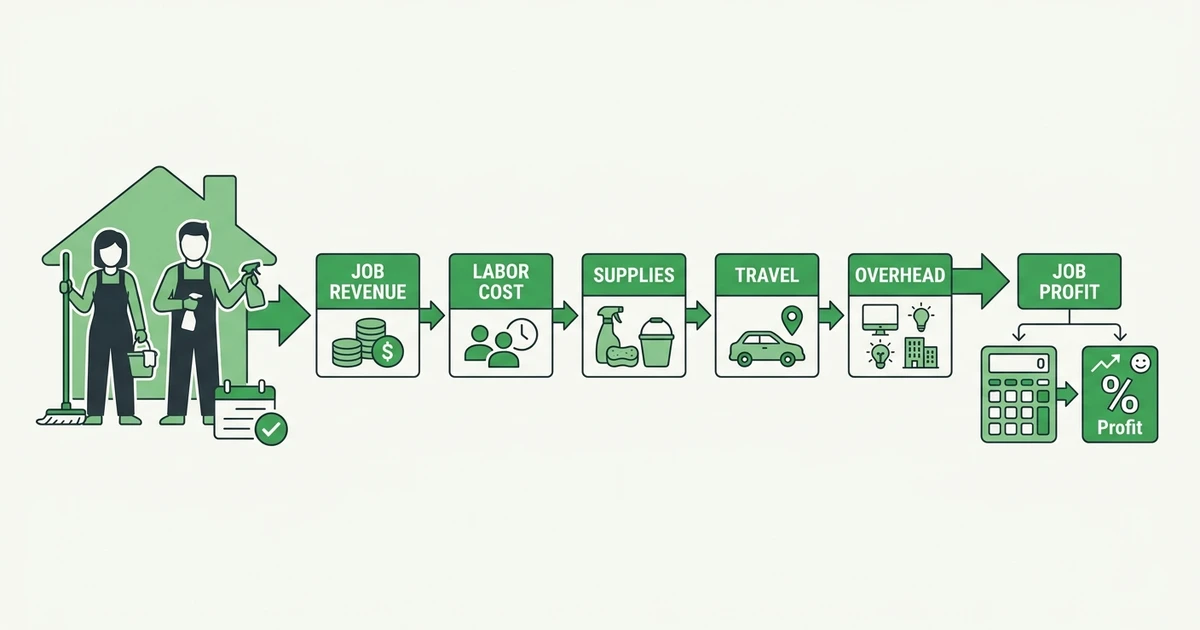
- Record job revenue. Use the final amount billed for the completed scope.
- Calculate direct labor. Multiply actual cleaner hours by the fully loaded labor cost you use internally.
- Add supplies and travel. Include consumables, mileage, parking, tolls, and paid travel time.
- Add job-specific adjustments. Count callbacks, payment fees, equipment rental, or approved extras.
- Allocate overhead. Assign a consistent share of office, insurance, software, and other operating costs.
- Calculate the margin. Subtract total costs from revenue, divide by revenue, then multiply by 100.
Imagine a recurring home clean billed at $220. Two cleaners spend a combined 5 labor hours on the property. Your internal fully loaded labor cost is $24 per hour.
| Job Item | Amount |
|---|---|
| Revenue | $220 |
| Labor: 5 hours x $24 | $120 |
| Supplies | $12 |
| Travel and parking | $18 |
| Allocated overhead | $25 |
| Total cost | $175 |
| Job profit | $45 |
The job margin is (220 - 175) / 220 x 100, or about 20.5%. If the same job takes one extra combined labor hour, the profit drops to $21 and the margin falls below 10%.
That is why actual time matters. Use the free profit margin calculator to test how a change in labor, costs, or price affects the result.
Which Costs Should a Cleaning Company Track Per Job?
The useful question is not whether a cost is large. It is whether ignoring that cost changes your view of the job.
Use a standard job-cost checklist so every client and service type gets measured consistently.
Direct labor and payroll burden
Track the hours each cleaner actually spends on the job. Add the employment costs your business carries beyond base wages using a method reviewed with your accountant.
If you clean alongside your team, assign a cost to your hours. Treating owner labor as free can make an exhausting job appear profitable.
Supplies and equipment
Record chemicals, disposable materials, laundry, specialty products, and equipment rental used for the clean. Small supply costs become meaningful across recurring visits.
For shared equipment, use a consistent allocation method. The goal is not perfect accounting on every vacuum pass. It is a fair comparison between jobs.
Mileage and travel time
Travel creates vehicle expense and consumes paid time that cannot be sold to another customer. The IRS set the optional 2026 business mileage rate at 72.5 cents per mile based on fixed and variable vehicle costs, as explained in its business mileage announcement.
That rate can be a useful cost reference, but it is not a required internal costing method or a guaranteed deduction. Choose an approach that fits your vehicles and confirm tax treatment with a qualified professional.
Book a demo to see how Fieldified connects actual labor, expenses, invoices, and payments so your cleaning team can track job profitability without rebuilding every number by hand.
Callbacks, scope creep, and overhead
A free return visit has a real labor and travel cost. So does an extra room that the customer expects every week but that never made it into the scope.
Allocate a fair share of overhead too. Insurance, office work, payment fees, marketing, and software keep the business operating even when they do not belong to one specific clean.
How to Find Cleaning Jobs That Look Busy but Lose Money
Start by comparing estimated hours with actual hours. Repeated overruns usually point to an inaccurate scope, inconsistent crew process, property access delays, or a price that no longer fits the work.
Then compare jobs within the same service type. A recurring home that the same crew knows well should not be evaluated exactly like a first-time deep clean with uncertain conditions.
Watch for these warning signs:
- Actual cleaner hours regularly exceed the estimate
- Unlisted extras become expected parts of the visit
- Travel time is high compared with time spent cleaning
- One property causes repeated callbacks or complaints
- Supply or equipment needs are higher than similar jobs
- A commercial account requires unpaid reporting or coordination
Review the full client relationship, not just one unusual visit. A profitable recurring account can absorb an occasional difficult day, while a consistently weak job needs a scope, process, route, or price correction.
If price is the problem, use the existing guide on how much to charge for house cleaning as a separate pricing review. Keep the margin analysis focused on what the work actually earns.
How to Improve Cleaning Job Profitability Without Guessing
Raising every price is not the only answer. First identify why the margin is weak, then fix the cause that applies to that job.
Use these practical actions:
- Rewrite vague scopes so cleaners and clients know what is included
- Match recurring properties with cleaners who already know the work
- Cluster nearby jobs to reduce travel and gaps between visits
- Track actual time instead of relying on the original estimate forever
- Review callbacks to find training or checklist problems
- Charge appropriately for approved add-ons and changed conditions
Break-even analysis helps connect individual jobs to the wider company. The U.S. Small Business Administration defines break-even as the point where total cost and total revenue are equal and notes that the analysis helps existing businesses evaluate profit at different sales volumes in its break-even guidance.
For a cleaning company, that means knowing how much contribution each job makes toward monthly overhead. More jobs only help when they contribute enough after their direct costs.
Cleaning Profit Tracking: Spreadsheet vs Connected Job Records
A spreadsheet can calculate a margin. The hard part is collecting complete, timely inputs from every clean.
When hours live in one app, expenses in receipts, invoices in another system, and callbacks in text messages, the owner must reconstruct the job after everyone has moved on.
| Workflow | Spreadsheet Reconstruction | Connected Job Record |
|---|---|---|
| Cleaner time | Entered later from notes or memory | Recorded against the job |
| Supplies and expenses | Added from separate receipts | Attached to the job record |
| Scope changes | Buried in messages | Stored with job notes |
| Profit review | Rebuilt at month end | Reviewed from current job data |
Cleaning business software can help connect the information, but the habit matters most: record actual work, compare it with the estimate, and review the result.
This is also where cleaning job tracking and payments support margin visibility. Completed work and collected revenue need to match before the owner can trust the number.
Frequently Asked Questions
What is a good cleaning business profit margin?
A useful target depends on your service mix, team structure, local costs, and the amount of owner labor included. Compare each job against your own target margin, then review the full business after overhead.
How do I calculate profit per cleaning job?
Subtract direct labor, payroll burden, supplies, travel, callbacks, and allocated overhead from job revenue. Divide the remaining profit by job revenue and multiply by 100.
What cleaning expenses should be included in profit margin?
Include cleaner wages, payroll burden, supplies, mileage, travel time, equipment costs, callbacks, payment fees, and a fair share of overhead. Include owner labor too, even if you do not run payroll for yourself.
Why is my cleaning business busy but not profitable?
Some jobs may take longer than estimated, require unpaid extras, sit far outside your route, or trigger callbacks. A full calendar can hide those losses when costs are not tracked by job.
How often should a cleaning company review job profitability?
Review completed jobs weekly while details are fresh, then compare service types and clients monthly. Recheck any job after a scope change, staffing change, or repeated time overrun.
Conclusion: Know What Every Cleaning Job Actually Earns
Cleaning job profitability becomes clearer when every visit uses the same calculation. Track actual labor, travel, supplies, scope changes, callbacks, and overhead instead of judging a job by revenue alone.
Once weak jobs are visible, you can fix the right problem. That may mean changing the scope, crew process, route, or price.
Book a demo to see how Fieldified helps cleaning owners track job details, labor, expenses, invoices, and payments in one place, so the jobs filling the calendar also support the business.