 EN
EN DE
DE ES
ES FR
FR NL
NL PT
PT





Are you thinking of starting a house cleaning service business? Then, you plan to step into a vast industry with significant competition and substantial opportunities.
The cleaning industry is growing fast, especially in countries like the United States, Canada, Australia, and the UK. More people are working long hours, managing businesses, or handling family responsibilities. Because of this, they prefer to hire professionals to keep their homes clean.
As a cleaning business owner, many of you face various challenges. You have to find clients, manage schedules, buy cleaning supplies, handle marketing, hire staff, and maintain service quality.
But the biggest question is: how much should you charge for house cleaning? like deep cleaning, move-in/move-out cleaning, post-construction cleaning, carpet cleaning, and add-on services.
Around 10% of U.S. households now pay for professional cleaning services, and this percentage is growing each year as more Americans seek convenience and time savings. With busy lifestyles, the demand for cleaning services is expected to continue rising in 2026 and beyond.
In this blog, we’re going to understand how much you should actually charge for cleaning services that work for both your customers and your business. We’ll break down every aspect in detail.
By the end, you’ll know how to set profitable, confident cleaning prices for 2026 and beyond.
Running a cleaning business?
Fieldified helps cleaning companies manage recurring jobs, customer details, schedules, invoices, and payments from one platform.
Why Pricing Your Cleaning Services Matters
Setting the right price for your cleaning services can feel confusing and stressful, especially when you are just starting your business. Price charging is not just about picking a number that sounds good. It directly affects your profit, your customers, and your business’s long-term growth.
Struggling to set a price can create serious problems for you. That is why understanding pricing is one of the most important steps. Here’s the breakdown of those steps
The Risk of Charging Too Low
Many new cleaning business owners think that charging low prices will help them get more customers quickly. At first, this may work. You might attract people who are looking for cheap services.
But most of the customers are price shoppers. They are not loyal. If someone offers even $10 less, they may leave you. This means you constantly have to search for new clients. More jobs mean longer working hours and more physical effort.
Charging too low also creates a low profit margin. After paying for cleaning supplies, transportation, gas, equipment, insurance, and maybe employee wages, you may realize that you are barely making money. That’s why you must understand your true costs and stop underpricing yourself.
The Risk of Charging Too High
On the other hand, charging too high can also hurt your business. If your prices are much higher than those of other cleaning services in your area, customers may not even consider you.
They may think your services are too expensive, especially if you are new. High prices can also make it harder to compete in competitive markets. Customers compare options online before booking.
If they see similar services at a lower price, they might choose them. Higher pricing can reduce bookings and slow your business growth without a proper explanation of your value.
The Goal: Profitable and Competitive Pricing
The real goal is to find a balanced approach. You want pricing that covers all your costs, gives you a healthy profit, and still feels fair to customers. Profitable and competitive pricing means you understand your expenses, your time, and the value of your work.
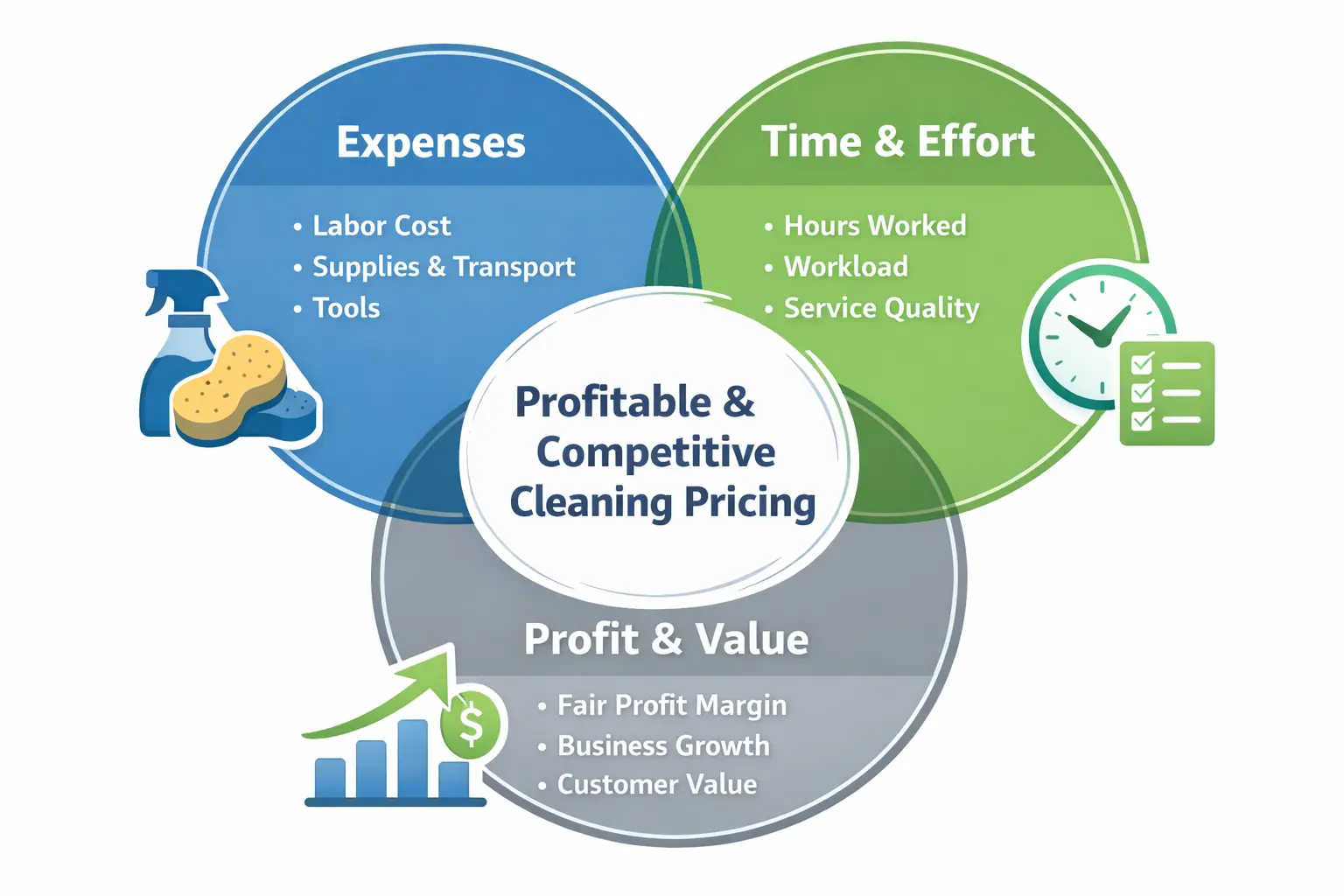
Instead of blindly copying competitors, focus on value-based thinking. Ask yourself: What quality do I provide? What experience do customers get? When you price based on value and clear calculations, you can feel confident in your rates and build a sustainable cleaning price for your business.
What Affects House Cleaning Prices?
Cleaning service prices are not random. Most cleaning businesses do not just pick a number without thinking; they carefully look at different factors before writing a job quote.

Things like the size of the home, the type of cleaning service, the condition and location of the property, and many other details are important.
You can read below to better understand how pricing would affect.
1. Size of the Home
The size of the home is one of the biggest factors that affects cleaning prices. A small apartment takes less time and effort to clean compared to a large house. More rooms usually mean more dusting, vacuuming, mopping, and bathroom cleaning.
Square footage also matters. A 900-square-foot apartment will cost much less than a 3,000-square-foot home because it takes more time, more supplies, and sometimes more cleaners to complete the job.
2. Type of Cleaning Service
The type of service a customer chooses also changes the price.
- Standard cleaning typically includes basic tasks such as dusting, vacuuming, mopping, and cleaning bathrooms and kitchens.
- Deep cleaning is a more thorough process that includes scrubbing baseboards, cleaning inside appliances, and removing heavy dirt buildup.
- Move-in / Move-out cleaning requires extra attention because the home needs to be spotless for new residents.
- Post-construction cleaning is often the most expensive because it involves removing dust, debris, and construction residue.
The more detailed and time-consuming the service is, the higher its price goes.
3. Condition of the Property
The condition of the home also makes a huge difference. A well-maintained home that is cleaned regularly will cost less than a home that has not been cleaned for months. Heavy dirt buildup, stains, pet hair, or clutter require extra time and effort, which increases the price.
4. Location (City vs Small Town)
Location plays an important role in setting cleaning prices. Companies in large cities often charge more than those in small towns because expenses like rent, fuel, and wages are higher. To stay profitable, companies adjust their prices based on their local market or use route optimization to reduce travel time.
5. Frequency of Service
How often the customer books cleaning services also matters.
- Weekly cleaning usually costs less per visit.
- Biweekly cleaning may have moderate pricing.
- Monthly cleaning may cost slightly more per visit.
- One-time cleaning is often more expensive because it takes more effort.
Regular cleaning keeps the home in good condition, which reduces workload.
6. Experience & Reputation
A new cleaning business may charge lower rates to attract customers. But an established company with good reviews, trained staff, and a strong reputation can charge higher prices because customers trust their quality and reliability.
7. Supplies & Equipment
Prices can also depend on who provides the supplies. If the cleaning company brings its own products and equipment, the cost may be higher. Using eco-friendly or specialized cleaning products can also increase the price because they are often more expensive.
8. Local Demand
Local market demand also affects your pricing. Checkout the rates in your areas so you don’t charge too high or too low, and try to stand out by offering special services that other cleaning companies may not provide.
Different Ways to Charge for House Cleaning
There is no perfect way to charge for house cleaning. Different businesses use different pricing models depending on their experience, market, and customer needs. Below are the most common ways to charge for cleaning services.
Hourly Pricing Model
Hourly pricing means you charge customers based on the number of hours spent cleaning their home. You set a fixed rate per hour, and the final price depends on how long the job takes.
In the US, house cleaning services usually charge between $25 to $75 per hour per cleaner, depending on experience, location, and service type. In bigger cities, rates may be higher.
Hourly pricing works well when:
- The home condition is unknown.
- It is a first-time cleaning.
- The job may take longer than usual.
- You are just starting your business.
- It gives flexibility when you are unsure about the total time required.
Pros:
- Easy to calculate.
- Good for unpredictable jobs.
- Simple for new businesses.
Cons:
- Customers may worry about slow work.
- Final price may surprise clients.
- Income can vary for each job.
Example Calculation:
If you charge $35 per hour and the cleaning takes 4 hours, the total cost will be: $35 × 4 = $140
If two cleaners work for 3 hours at $35 per hour each, the cost will be: $35 × 3 × 2 = $210
Flat Rate Pricing
Flat rate pricing means you charge one fixed price for the entire job, no matter how long it takes. The customer knows the full cost before the work starts.
To calculate a flat rate, you estimate:
- How many hours will the job take?
- Your hourly goal.
- Extra costs like supplies or travel.
Then you set one final price that covers everything and includes profit.
Many cleaning businesses prefer flat rate pricing because customers like knowing the exact price in advance. It builds trust and avoids confusion about time.
Pros:
- Clear and simple for customers.
- Encourages efficient work.
- Easier to sell recurring services.
Cons:
- Risk of underpricing if the time estimate is wrong.
- Requires good experience to calculate correctly.
Flat-rate and hourly pricing are the most common methods used in the U.S., and most cleaning businesses prefer these two options. Because of this, competition between hourly and flat-rate pricing is increasing.
Example Calculation:
You estimate a home will take 4 hours, and your target rate is $40 per hour.
4 × $40 = $160
So you offer a flat price of $160 for the job.
Per Room Pricing
With per-room pricing, you charge a fixed amount for each room in the house. For example, you may charge $30 per bedroom and $40 per bathroom. The total price depends on how many rooms need cleaning.
This model works well for:
- Small apartments or compact homes.
- Homes where customers only want specific rooms cleaned.
- Businesses that prefer a simple and clear pricing structure.
Pros:
- Easy for customers to understand.
- Quick and simple to calculate.
- Transparent pricing with no confusion.
Cons:
- Not all rooms are the same size or condition.
- Some rooms may take more time than others.
- You may undercharge for large or heavily used rooms.
- It may not fully reflect the actual effort required.
Example Calculation
If a home has 3 bedrooms and 2 bathrooms.
And you charge $30 per bedroom and $40 per bathroom: (3 × $30) + (2 × $40) = $90 + $80
The total cleaning cost would be $170
This makes pricing simple and easy to explain to the customer.
Per Square Foot Pricing
Per square foot pricing is a pricing method where you charge customers based on the total size of their property in square feet. It’s often used for larger homes or commercial spaces.
In the U.S., residential cleaning usually ranges between $0.10 to $0.25 per square foot, depending on service type and location.
This model works well for:
- Large homes or luxury properties.
- Commercial offices and retail spaces.
- Clients who want full-property cleaning.
Pros:
- Fair pricing based on property size.
- Easy to estimate for large projects.
- Scales well for commercial contracts.
Cons:
- Does not consider the room condition or dirt level.
- May overcharge small but lightly used spaces.
- Can undercharge if the property is heavily soiled.
- Customers may not always know their exact square footage.
Example Calculation:
If a home is 2,000 square feet and you charge $0.15 per square foot: 2,000 × $0.15
So the total cleaning cost would be $300
Average House Cleaning Prices in the US (By Service Type)
Cleaning prices in the U.S. are different depending on the type of service a customer chooses. Basic cleaning costs less, while detailed and heavy-duty cleaning costs more.  Below is a simple breakdown of common service types and their typical price ranges.
Standard Cleaning Prices
Standard cleaning usually covers basic tasks like dusting, vacuuming, mopping floors, cleaning bathrooms, wiping kitchen surfaces, and taking out trash. It is meant for homes that are already maintained regularly.
In the U.S., standard cleaning usually costs between $120 to $250 per visit for an average-sized home. Smaller apartments may cost less, while larger homes may cost more, depending on size and location.
Deep Cleaning Prices
Deep cleaning includes everything in standard cleaning, plus extra-detailed work. This may include scrubbing baseboards, cleaning inside appliances, removing heavy dirt buildup, washing interior windows, and detailed bathroom scrubbing. It takes more time and effort.
Deep cleaning usually costs between $200 to $400 or more, depending on the home size and condition. Very large or heavily dirty homes may cost even more.
Move-In / Move-Out Cleaning Prices
Move-in or move-out cleaning requires the home to be spotless. Cleaners must clean inside cabinets, drawers, closets, and appliances. Since the home is usually empty, every corner must be cleaned properly.
This type of cleaning typically ranges from $250 to $500, depending on square footage and the level of detail required.
Post-Construction Cleaning Prices
Post-construction cleaning is one of the most difficult types of cleaning. It involves removing dust, debris, paint spots, and construction residue. Special tools and extra time are often needed.
Because it is labor-intensive, pricing usually starts around $300 and can go up to $800 or more, depending on the size of the property and the amount of work required.
Recurring Cleaning Discounts
Many cleaning businesses offer discounts for recurring services because regular cleaning keeps the home in good condition.
- Weekly cleaning: Often comes with the biggest discount since the home stays cleaner.
- Biweekly cleaning: Usually offers a moderate discount compared to one-time services.
Recurring clients are valuable for cleaning businesses, so companies often reduce the per-visit price to encourage long-term bookings.
Add-On Services and Extra Charges
Sometimes customers ask for extra services that are not included in standard cleaning. These are called add-ons. You can charge extra for them because they take more time and effort.
Popular Add-Ons
Below, we mention some popular types of add-on services:
- Oven Cleaning - Cleaning inside the oven takes more time because of the grease and burnt food. It usually costs extra.
- Refrigerator Cleaning - Cleaning inside the fridge includes removing shelves and wiping stains. This is also charged separately.
- Interior Windows - Cleaning windows from inside the house is often not included in basic cleaning, so it is added as an extra service.
- Carpet Shampooing - This requires special equipment and more time, so the price is higher than regular floor cleaning.
- Laundry - Washing, drying, and folding clothes can be offered as an extra service with an additional charge.
How to Set Price for Add-Ons
1. Flat Add-On Fee
You can charge one fixed price for each extra service.
Example: $25 for oven cleaning.
2. Time-Based Fee
You can charge based on how long the extra work takes.
Example: $30 per hour for deep refrigerator cleaning.
Travel Fees & Minimum Charges
Some cleaning businesses charge a travel fee if the location is far away. This covers fuel and travel time. Many companies also set a minimum charge. This means even if the job is small, they will charge a fixed minimum amount to make sure the work is profitable.
For travel fees, cleaning businesses charge around $10 to $25, depending on distance. This amount is usually fair for both the business and the customer.
Understanding the Price Difference in Add-On Services
Add-on service prices vary based on time required, effort involved, equipment used, and the condition or size of the area being cleaned.
This clear pricing differentiation helps you maintain transparency, ensure fair compensation for your work, and build stronger trust with your customers while protecting your profit margins.
| Add-On Service | Average Price | How It’s Usually Charged | Why Price Changes |
|---|---|---|---|
| Baseboard cleaning | $25–$75 | Per job | Depends on the home size and dirt buildup |
| Cabinet organization | $100 | Flat rate | Time depends on the clutter level |
| Carpet cleaning | $75-$200 | Per room/per job | Based on carpet size and stain level |
| Cleaning the interior of cabinets | $20-$50 | Per job | More if cabinets are greasy or heavily used |
| Changing bedsheets | $10–$40 | Per bed | Depends on bed size (single, queen, king) |
| Dusting blinds | $10–$50 | Per blind | Based on the blind size and material |
| Exterior window cleaning | $150–$302 | Per job | Higher due to ladders and safety risk |
| Interior window cleaning | $4–$10 | Per window | Depends on window size and accessibility |
| Floor polishing/waxing | $25–$50 | Per room | Depends on floor type and condition |
| Fridge cleaning | $10-$40 | Per appliance | More if deep cleaning is required |
| Furniture/curtain cleaning | $120-$231 | Per job | Based on fabric type and the number of items |
| General dusting | $10-$30 | Add-on fee | Depends on area coverage |
| Green cleaning | ~$50 per hour | Hourly rate | Eco-friendly products cost more |
| Laundry | $15–$30 | Per load | Depends on load size and folding |
| Oven cleaning | $20–$40 | Per appliance | More of the heavy grease buildup |
| Polishing wood surfaces | $25–$50 | Per room | Based on surface area and polish type |
How to Calculate Your Own Cleaning Rates (Step-by-Step Formula)
Step 1: Calculate Your Monthly Expenses
First, calculate all your monthly business costs, including cleaning supplies like products, tools, equipment, and gloves, transportation expenses such as fuel and vehicle maintenance, insurance for business protection, and marketing costs like ads, website maintenance, social media promotions, or printed flyers.
This helps you understand how much money you must earn to cover expenses.
Step 2: Decide Your Profit Goal
After covering expenses, decide how much profit you want to make each month. Your profit goal should support business growth and personal income.
Step 3: Estimate Time Per Job
Calculate how many hours a typical cleaning job takes. Time depends on house size, condition, and the type of service. Step 4: Set Your Final Rate
Now divide your total monthly cost + profit goal by the number of working hours per month.
Formula Example:
If your monthly expenses are $3,000 and your profit goal is $2,000
Total needed = $5,000
If you work 100 hours per month,
$5,000 ÷ 100 hours
So your final rate should be $50 per hour.
Smart Pricing Guide (How to Decide What to Charge)
| Situation | What You Should Consider | Suggested Pricing Strategy | Why This Helps You |
|---|---|---|---|
| Small apartment (light cleaning) | Less time, fewer rooms | Flat rate pricing | Easy for the customer to understand |
| Large home (regular cleaning) | More rooms, more time | Hourly or per room rate | Covers extra effort properly |
| Very dirty home | Extra scrubbing and supplies | Extra charge add-on | Prevents undercharging |
| Move-out cleaning | Inside cabinets, appliances, detailed work | Higher flat rate | Work is more detailed and time-consuming |
| Luxury homes | High expectations, premium service | Premium pricing | Positions your brand as high-quality |
| First-time customer | You don’t know the condition yet | On-site estimate | Protects you from pricing mistakes |
It’s crucial to understand pricing, positioning, and the psychology of your cleaning business because positioning shapes how customers view your brand, whether basic or premium. It also helps you present your prices in a way that highlights value instead of just cost.
Together, these strategies allow you to compete based on quality and perception, not just on offering the lowest price.
Final Recommendation
Pricing your house cleaning services should be based on your expenses, time, effort, and profit goals. Review your prices regularly and adjust them when costs increase, demand grows, or you add premium services. Smart pricing helps you stay profitable and competitive.
As your cleaning business grows, managing schedules, invoices, and client details manually can also become confusing and time-consuming. A proper system helps you stay organized, track every job clearly, and avoid missing payments. This not only saves time but also builds a more professional and reliable image in front of clients.
Using CRM software is also a plus, as it keeps your bookings, invoices, and customer details organized, and also simplifies job tracking and payments. So you spend less time managing paperwork and more time growing your business.
If you’re thinking about switching to a CRM, you should check out the 10 Best scheduling software for your service business and compare the features carefully. It will help you choose the one that fits your needs, budget, and business size.
FAQs
1. How much should I charge per hour for house cleaning?
In the U.S., most house cleaners charge between $25 to $75 per hour per cleaner. The exact rate depends on your experience, location, and service type. New businesses may start lower according to their profits and increase prices as they grow.
2. Is it better to charge hourly or a flat rate for cleaning?
Both methods are common and profitable when used correctly. Hourly pricing works well for unknown or first-time jobs, while flat rates give customers a clear final price. Many businesses use both depending on the situation.
3. How do I calculate my own cleaning rates?
First, calculate your monthly expenses such as supplies, transportation, insurance, and marketing. Then add your profit goal and divide the total by your working hours. This helps you set a confident and profitable hourly rate.
4. What affects house cleaning prices the most?
The biggest factors are home size, service type, and property condition. Deep cleaning, move-out cleaning, and post-construction cleaning cost more because they require extra time and effort. Location and demand also affect pricing.
5. How much should I charge for deep cleaning?
Deep cleaning usually costs more than standard cleaning because it includes detailed tasks like scrubbing baseboards and cleaning inside appliances. In the U.S., prices typically range between $200 to $400 or more, depending on home size.
6. Should I offer discounts for recurring cleaning services?
Yes, many cleaning businesses offer discounts for weekly or biweekly services. Regular cleaning keeps the home maintained and reduces workload. Recurring clients also provide stable and predictable income.
7. How can I avoid undercharging for cleaning services?
Do not copy competitors blindly or set random prices. Always calculate your real costs and include a profit margin. Pricing based on value and clear calculations helps you stay profitable and avoid burnout.