
 EN
EN DE
DE ES
ES FR
FR NL
NL PT
PT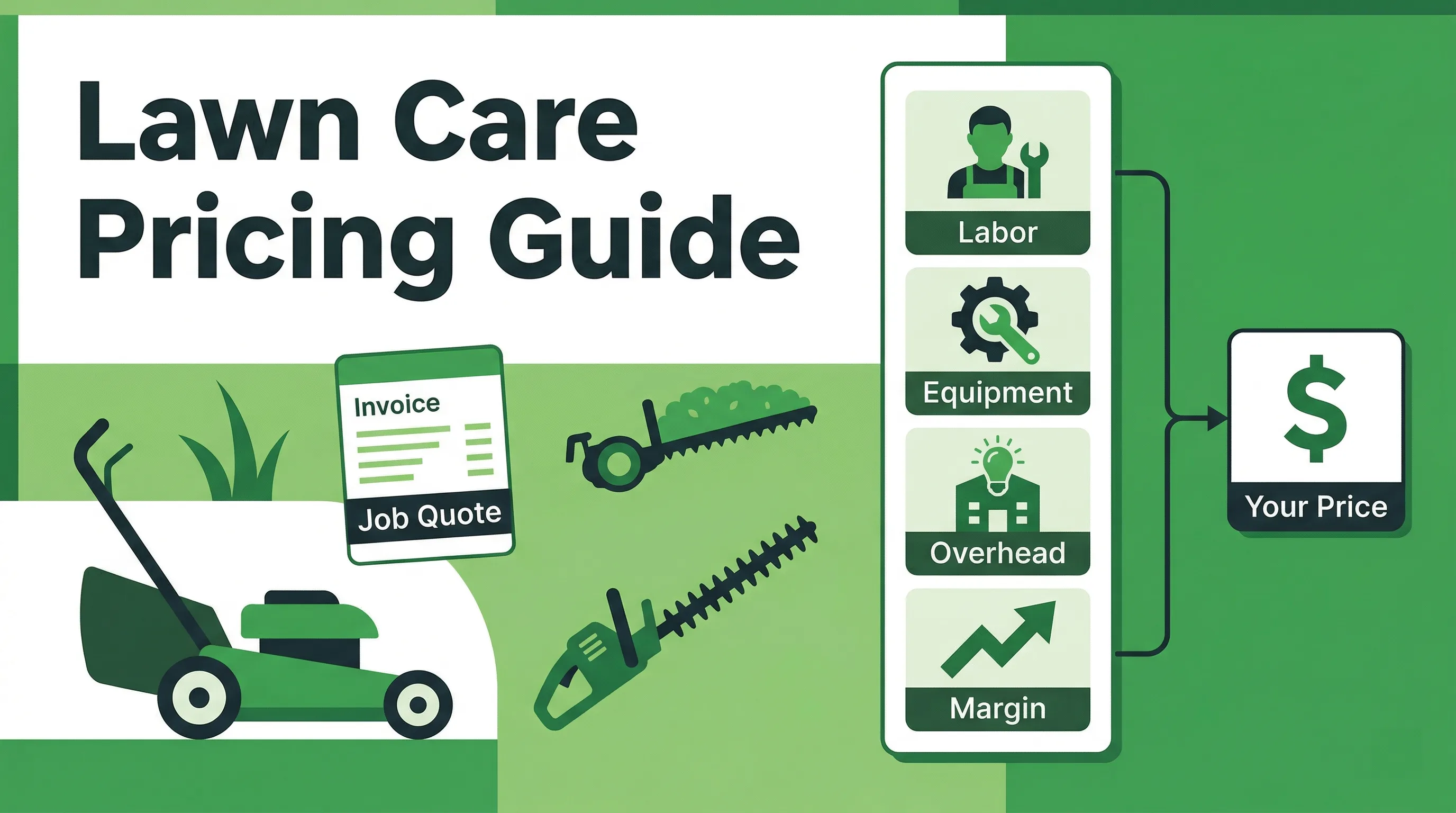





Quick Answer: Lawn Care Pricing Lawn care pricing comes down to four inputs: labor cost, equipment cost, overhead, and your target profit margin. Add those four numbers together per job, then apply your margin on top. Most lawn care businesses should target a 40-50% gross margin. This guide shows you exactly how to calculate that number for your jobs.
If you’re quoting lawn care jobs based on what your competitor down the street charges, or what feels fair when you pull up to a property, you’re running your business on guesswork. A solid lawn care pricing guide doesn’t start with what others charge. It starts with your costs, your time, and the margin your business needs to stay profitable.
Most lawn care owners are surprised when they actually do the math. Jobs that seemed fine on the surface turn out to be barely breaking even once drive time, equipment wear, and fuel get factored in.
Why Lawn Care Businesses Leave Money on the Table
The math is straightforward once you see it. Say you’re undercharging by just $5 per lawn. You mow 20 lawns a week. That’s $100 per week, $400 per month, and $4,800 per year left behind for the same hours worked.
The reason most lawn care businesses underprice isn’t carelessness. It’s that they never built a pricing system from actual costs. They started by matching a competitor’s rate, then kept that price because it felt like it was working. “Feels like it’s working” isn’t the same as knowing your margins.
According to IBISWorld’s Lawn Care Services industry report, the average profit margin for US lawn care operators sits under 10%. That’s a narrow window. Any job priced without knowing your true costs chips directly into it.
Building a pricing system doesn’t take long. But once you have it, every quote you send is based on data, not instinct.
The 4 Factors That Should Determine Your Lawn Care Prices
Most lawn care owners think of a price as one number. In practice, it’s four numbers added together.
1. Labor cost This includes what you pay your crew per hour, plus your own time if you’re on the job. Don’t stop at the hourly wage. Payroll taxes, workers’ comp, and any benefits you provide push the true cost per hour higher. If you pay a crew member $18/hour, your actual burdened labor cost is closer to $22-24 per hour. Use the Labor Rate Calculator to calculate this precisely for your operation.
2. Equipment cost and depreciation Your mowers, trimmers, blowers, and trailers all cost money to operate per hour of use. A commercial mower that costs $8,000 and lasts 2,000 hours of productive use costs $4 per hour before fuel or maintenance. Add fuel and periodic upkeep and most lawn care equipment runs $5-10 per hour.
3. Overhead These are your fixed business costs spread across every job: insurance, software subscriptions, phone, marketing, and vehicle costs. Divide your total monthly overhead by your billable hours per month to get your overhead cost per hour. For most small lawn care operations, this runs $5-12 per billable hour.
4. Target profit margin This is what the business earns after all costs are covered, including paying yourself fairly. A healthy gross margin for a lawn care business is 40-50%. Use the Profit Margin Calculator to see where yours stands right now.
Lawn Care Pricing Models: Which One Fits Your Business?
There’s no single right model. The best approach depends on what you do and how predictable your jobs are.
| Pricing Model | Best For | Watch Out For |
|---|---|---|
| Flat rate per visit | Standard residential mowing on known properties | Hard to quote accurately for new or irregular lots |
| Per square foot | Large properties, fertilization, overseeding | Requires accurate measurement upfront |
| Hourly rate | Cleanups, new site takeovers, complex landscaping | Clients may push back if time runs over estimate |
For most residential lawn care businesses, flat rate pricing is the most practical. Once you’ve mowed a property a few times, you know exactly how long it takes. Set a flat price based on that time at your calculated rate, and stick to it. This protects your margin and gives clients the predictability they prefer.
Hourly billing works well for irregular or scope-heavy work where you genuinely can’t estimate the time upfront. Use it where it makes sense, not as a default.
What to Charge: Common Lawn Care Services
These ranges come from Angi’s 2024 lawn care cost data. Use them as a market reference, not as your final prices. Your actual number should come from your cost calculation first, then be checked against what the local market supports.
| Service | Typical Range | Notes |
|---|---|---|
| Lawn mowing (standard yard) | $30-80 per visit | Varies by region and property size |
| Fertilization | $50-150 per treatment | Higher for large properties or specialty products |
| Core aeration | $75-225 | Depends on square footage |
| Overseeding | $100-350 | Often bundled with aeration |
| Seasonal cleanup (spring/fall) | $150-500 | Highly variable based on scope |
| Hedge and shrub trimming | $60-150 per visit | Depends on volume and complexity |
If your cost calculation gives you $60 for a standard mow and the local market supports $55-75, you’re in a healthy position. If your calculation comes back at $70 and the market is paying $45, you have a cost problem that pricing alone can’t fix.
How to Calculate Your Minimum Viable Price per Job
Here’s a worked example using a real residential scenario. You’re mowing a 6,000 sq ft property. The job takes 45 minutes including setup and cleanup.
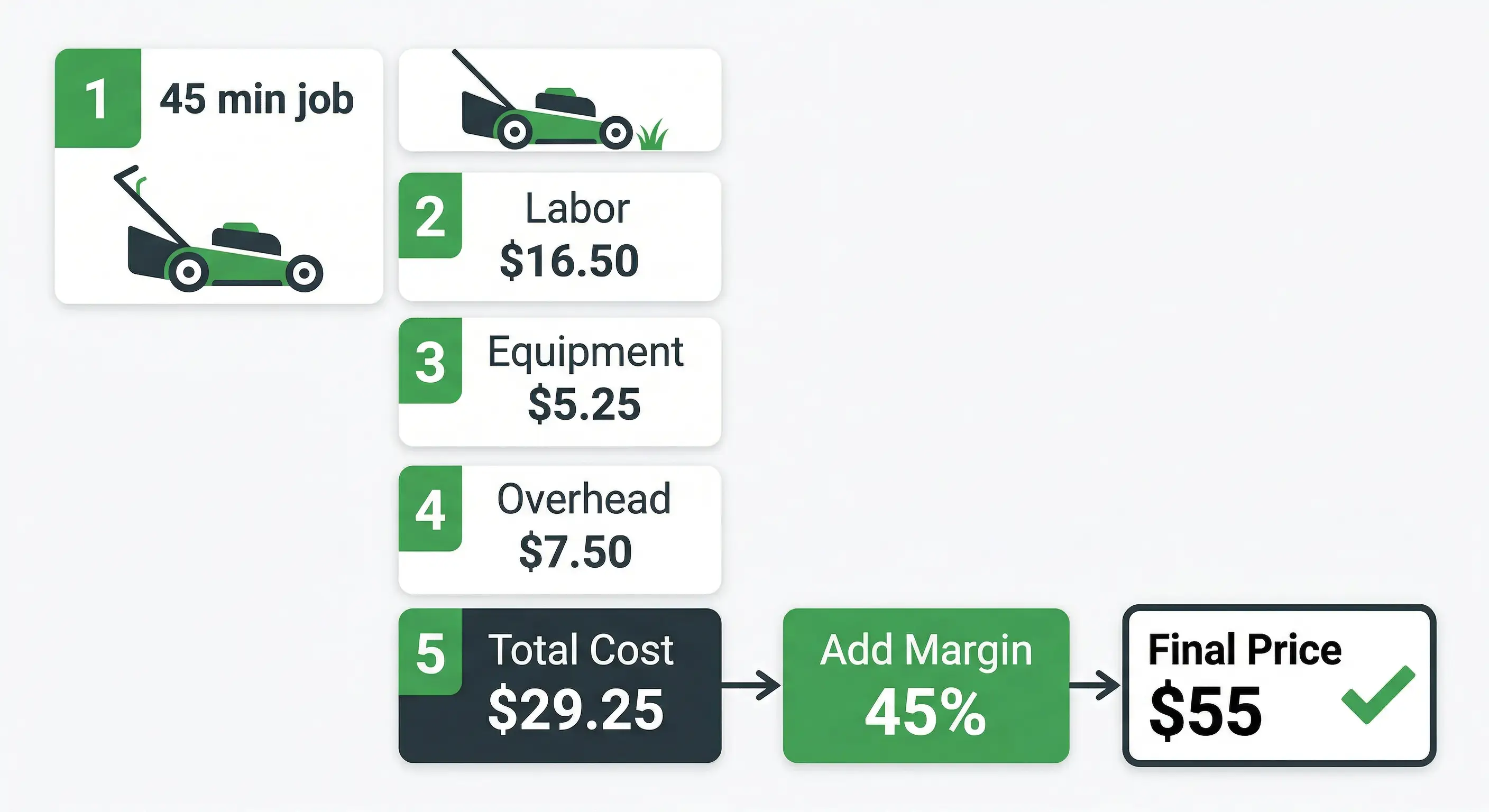
- Labor: 0.75 hours x $22 (burdened) = $16.50
- Equipment: 0.75 hours x $7 = $5.25
- Overhead: 0.75 hours x $10 = $7.50
- Total cost: $29.25
- Apply 45% margin: $29.25 / (1 - 0.45) = $53.18 minimum price
Round to $55. That’s within normal market range for a standard residential mow, and your gross margin is 46.8%.
This is your floor. You can charge more if the property is difficult, if it’s a one-time job rather than recurring, or if your local market commands a premium. But you shouldn’t go below your floor on a regular basis without understanding exactly why.
Use the Labor Rate Calculator and the Service Price Calculator to build this calculation for every service type you offer. Do it once, save the numbers, and use them on every quote going forward.
Ready to turn your pricing into professional quotes that clients actually approve? Fieldified’s quote management lets lawn care businesses build, send, and automatically follow up on quotes from any device. Try it free on your lawn care business, no credit card needed.
Common Pricing Mistakes Lawn Care Businesses Make
Knowing the formula is step one. Applying it consistently is where most businesses slip.
Not charging for drive time. If a property is 25 minutes away, you’re spending 50 minutes driving to and from it. That’s nearly a full hour unpaid. Either build drive time into your flat rate for distant properties, or set a minimum charge for jobs outside a defined service radius.
Not adjusting for property difficulty. A 5,000 sq ft yard with 12 obstacles and a steep slope takes twice as long as a flat open lot of the same size. Your price should reflect actual time and complexity, not just square footage.
Matching the cheapest competitor. The lowest price in the market is usually set by someone who doesn’t know their costs, is about to burn out, or will be out of business in two years. Don’t anchor your pricing to their mistakes.
Not raising prices annually. Fuel, labor, and equipment costs rise every year. If your prices stay flat, your margin shrinks. Build a 5-8% annual review into your process, and communicate increases to clients at the start of each season.
Undervaluing recurring contracts. A client who books weekly mowing across the entire season is worth far more than a one-time job. You can offer recurring clients a slightly better rate, but keep the discount modest. The value is in the predictability and lower acquisition cost, not in discounting yourself out of margin.
How to Quote Lawn Care Jobs Professionally
A professional quote does two things: it wins the job and it locks in your margin. Verbal quotes do neither.
Every quote should include the property address, specific services included, frequency for recurring work, the price per visit, and your quote validity window. Sending a written quote also signals professionalism, which is a genuine differentiator in a market full of operators who quote by text message.
For a full breakdown of what a solid contractor quote should include, see the guide on how to write a job quote.
Follow up on every quote within 48 hours if you haven’t heard back. Most lawn care jobs aren’t lost because the price was too high. They’re lost because another operator called back first.
Frequently Asked Questions
What is a lawn care pricing guide and why do I need one?
A lawn care pricing guide is a structured system for calculating what to charge based on your real costs, target margins, and local market rates. Without one, most lawn care businesses undercharge without realizing it. Margins erode slowly until the business is busy but not profitable.
How much should I charge per hour for lawn care?
Your hourly rate should cover labor, overhead, equipment depreciation, and your target profit margin. According to the Bureau of Labor Statistics, landscaping workers earn a median hourly wage of $17.67. Factor in payroll taxes and burden and your true cost per employee hour is closer to $22-24. Most residential markets support $45-75 per billable hour for professional service.
How do I price a lawn care job for a new client?
Estimate the job time based on property size and complexity, multiply by your hourly rate, add any material costs, and apply your target margin. A site visit before quoting helps you price accurately and signals professionalism to the client.
Should I use flat rates or hourly pricing for lawn care?
Flat rates work best for repeatable residential jobs where you can predict time accurately. Hourly billing is better for irregular or complex work where scope is hard to estimate upfront. Many lawn care businesses use both: flat rates for recurring mowing, hourly for one-off cleanup work.
How do I raise my lawn care prices without losing clients?
Give written notice 30 days before the increase, keep it modest (5-10% for recurring clients), and explain it as a cost-of-business adjustment. Most clients who receive consistent service will stay. The ones who leave over a fair increase were already shopping for the cheapest option.
What factors affect lawn care pricing the most?
Property size, service type, drive distance, local labor rates, and market competitiveness are the biggest factors. Your own cost structure matters as much as what competitors charge. Build prices from actual costs up, then compare to the local market for a final check.
Wrapping Up
Pricing based on gut feel works for a while. Then a fuel price spike or a bad hiring month shows that thin margins have no cushion. Lawn care businesses that survive and grow are the ones that know their numbers and price from them.
Build your floor price using the formula above. Use the Profit Margin Calculator and Labor Rate Calculator to check your math. Send every quote in writing, follow up every time, and review your prices at the start of each season.
Stop quoting from memory and start winning jobs on paper. Fieldified gives lawn care businesses a faster way to build, send, and follow up on quotes, schedule recurring jobs, and collect payment without chasing clients. Start your free trial, no credit card required.