
 EN
EN DE
DE ES
ES FR
FR NL
NL PT
PT





Quick Answer: How to Start a Snow Removal Business
Start by understanding local demand, then begin with basic equipment and simple residential snow-clearing jobs. Focus on getting your first clients through local outreach and referrals. As you grow, use proper pricing and tools like a CRM to manage jobs and build a steady, profitable snow removal business.
Every winter, heavy snowfall turns driveways into obstacles, makes roads dangerous, and stops homeowners and businesses from going about their day. Most people see that as an inconvenience, but entrepreneurs see it as a market.
If you’ve been thinking about how to start a snow removal business but aren’t sure where to begin, this guide gives you a clear, beginner-friendly roadmap. You’ll learn what equipment to buy, how to price your services, how to get your first paying clients, and how tools like Fieldified help you run and grow the business without chaos.
Why Starting a Snow Removal Business Makes Sense
A snowplowing business is one of the few service businesses where demand is essentially guaranteed. When snow falls, people need it gone fast. That urgency means you’re rarely negotiating; clients call you.
The global snow removal market was valued at nearly $19.8 billion in 2023, with steady growth expected as extreme weather events become more frequent. For new entrants, that’s good news: there’s room.
What makes this business particularly accessible to beginners:
- Low startup cost — you can begin with basic tools and upgrade later
- Recurring revenue — the same clients need you every time it snows
- Local advantage — focusing on one neighborhood puts you ahead of larger, less responsive competitors
- Seasonal income that compounds — clients from year one often return year after year
This business is well-suited for side hustlers looking for extra winter income, students wanting a practical startup, existing landscapers expanding into winter services, and anyone in a snowy region who understands local demand firsthand.
Choosing the Right Business Model for Your Snow Removal Service
Before buying equipment or printing flyers, decide how you want to earn. Different models suit different budgets, schedules, and growth goals.
Residential Snow Clearing
This is the most beginner-friendly path. You clear driveways, sidewalks, and small properties for homeowners. Jobs are manageable in size, equipment costs stay low, and it’s easy to build a loyal base in a single neighborhood. Once you’ve done a good job for one household, the neighbors notice.
Commercial Contracts
Offices, shopping centers, and apartment complexes pay more — but they demand consistency and fast response. This model makes more sense once you’ve built some operational confidence. Locking in even two or three commercial clients for a full season can anchor your revenue.
Emergency / On-Demand Services
Some clients need immediate snow removal after unexpected snowfall. On-demand jobs command premium pricing. The trade-off is that you need to be available and mobile. For those who can manage the flexibility, this can significantly boost income during heavy-snowfall weeks.
Subscription / Seasonal Packages
Instead of pricing per visit, offer clients a flat seasonal rate that covers scheduled visits throughout winter. This model gives you predictable income, reduces the marketing grind each season, and builds long-term client relationships. It works for both residential and commercial accounts.
Related Read> 17 Strategies to Market your Snow Removal Business
By understanding these business models and strategies, you can choose the best path that fits your resources, skills, and goals. This helps in turning a seasonal venture into a profitable winter service business
Equipment You Actually Need (Budget-Friendly Starting Point)
You don’t need a fleet of trucks to start a snow removal business. Begin with what gets the job done, then reinvest as revenue grows.
- Snow Shovels — essential for driveways, sidewalks, and tight spaces
- Snow Blower — clears large volumes faster and saves serious physical effort
- Snow Plow (truck or ATV-mounted) — needed for larger driveways or parking lots as you scale
- Ice Scrapers & Snow Brushes — remove ice buildup and keep surfaces safe
- Salt Spreader — prevents refreezing; clients specifically ask for this
- Protective Gear — insulated gloves, waterproof boots, heavy jacket (non-negotiable)
- Transport Equipment — buckets, carts, or racks for moving supplies between jobs
For most beginners, a solid shovel, a mid-range snow blower, and a salt spreader are enough to handle residential snow-clearing jobs comfortably. That setup can run you $500–$1,500 to get started.
How to Start a Snow Removal Business: Step-by-Step Action Plan
The following steps are ordered deliberately. Each one builds on the last, so resist the urge to jump ahead.
Step 1: Research Your Local Demand
Before starting, understand the level of demand in your area. Check how often it snows and what services people need.
- Look at local competitors and their pricing.
- Join Facebook groups or communities to see demand.
- Talk to nearby homeowners or small businesses.
Step 2: Register Your Business
Register your snow removal service officially. This varies by location, but at a minimum, you’ll likely need a business name registration and a basic local permit.
Being registered makes you look legitimate; clients are more willing to sign seasonal contracts with a real business than with someone who operates informally.
Keep the structure simple at first: a sole proprietorship or single-member LLC works fine for most beginners.
Step 3: Get Your Basic Equipment
Start with the essentials only (see the equipment list above). Set a realistic monthly revenue goal for your first three to six months and use that to guide what you can afford to buy.
Don’t finance expensive machinery before you have clients to justify the cost. Upgrade as the business grows.
Step 4: Set Your Pricing
Pricing should be competitive but never desperate. Research what other snowplowing businesses in your area charge. Build in your actual costs: fuel, equipment wear, and your own time, so every job is profitable.
Offer per-visit pricing for new clients and seasonal packages for those who want commitment. Don’t discount heavily to win your first jobs; you’ll attract clients who don’t value reliability, which is exactly what this business requires.
Step 5: Get Your First Clients
Start local and start personal. Knock on doors in your neighborhood, distribute flyers on your street, post in local WhatsApp or Facebook groups, and ask friends and family for referrals.
This isn’t glamorous, but it works. Your first five to ten clients almost always come from proximity and word of mouth. Do excellent work for them, and they’ll do your marketing for you.
Related Read> Cost Breakdown of Owning and Operating a Snow Plow Business
Snow Removal Pricing Strategy: Don’t Undersell Yourself
Many new snow removal businesses make the same mistake: they charge too little to win clients quickly and then find themselves working hard for margins that don’t justify it. Here’s how to set prices that are fair, competitive, and actually profitable.
| Pricing Step | What to do |
|---|---|
| Calculate Your Costs | Add up fuel, equipment maintenance, labor, and insurance. This is your floor never price below it. |
| Research Local Rates | Check what other residential snow clearing and snowplowing businesses in your area charge. Use this as your baseline. |
| Choose a Pricing Model | Per-visit pricing is simplest for beginners. Seasonal packages offer steadier income once you have returning clients. |
| Adjust for Job Size | Charge more for parking lots and large commercial properties; less for small residential driveways. Keep it proportional. |
| Ensure Profit Margin | Don’t just cover costs, price to grow. A reasonable margin funds equipment upgrades, marketing, and slower weeks. |
Getting your first ten clients is the hardest part. After that, word-of-mouth takes over if your work is good.
How to Get Snow Removal Clients: Your First 10
Getting your first 10 clients is the hardest part. After that, word-of-mouth takes over if your work is good.
Start within walking distance of where you live. Talk to neighbors, post in local community groups, and distribute simple flyers that explain your service, your service area, and how to reach you. Keep it straightforward. People don’t hire based on elaborate marketing; they hire based on trust and proximity.
As jobs start coming in, you’ll face a new problem: keeping track of everything. Scheduling, client details, follow-ups, and invoices become hard to manage with a notebook or a WhatsApp thread. That’s when a CRM becomes a practical necessity, not a luxury.
It’s better to switch from WhatsApp to a CRM early, before things get chaotic. A reliable CRM saves you significant time and prevents missed jobs, unpaid invoices, and frustrated clients.
How Fieldified Helps You Run and Grow Your Snow Removal Business
Managing a snow removal service during peak winter is a demanding job - jobs pile up, routes need coordinating, and clients expect fast responses. Fieldified is built specifically for field service businesses like snow removal, and it handles the operational side so you can stay focused on the work.
Below are some useful features of this software: 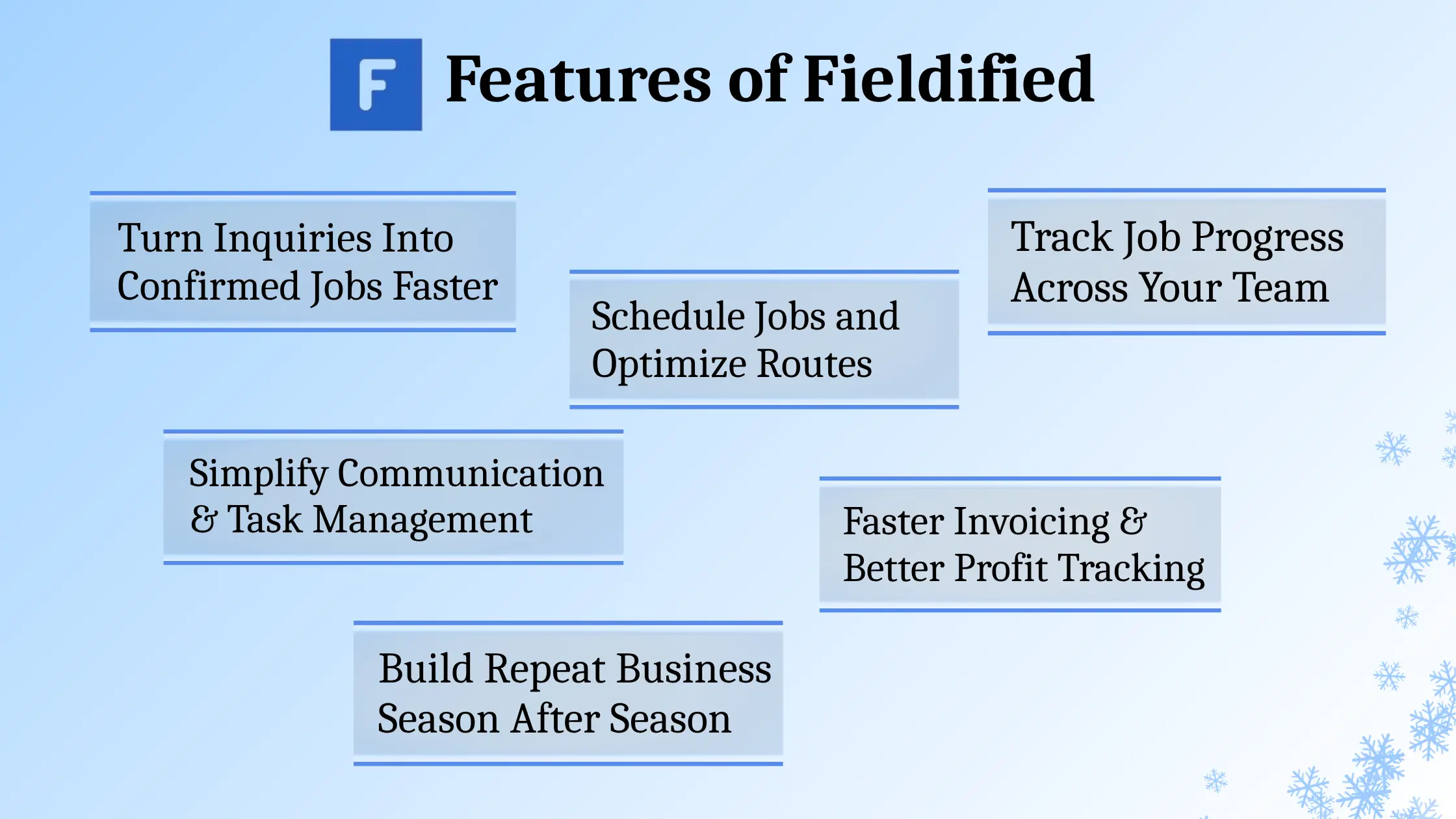
Turn Inquiries Into Confirmed Jobs Faster
Fieldified gives you a built-in quoting system so you can respond to new leads with a professional estimate in minutes, not hours. Quotes convert to confirmed jobs with a single click, and the client record is created automatically without double entry.
Schedule Jobs and Optimize Routes
During heavy snowfall, you may have a dozen jobs queued up across different parts of town. Fieldified’s scheduling view lets you assign jobs to the right team member and organize them by location so you’re not wasting time backtracking across routes. You can see your entire day’s work at a glance and adjust in real time.
Track Job Progress Across Your Team
Fieldified allows you to plan your work in a better way by organizing schedules and tracking every job. This helps you complete more work in less time and reduces confusion during busy days.
- Plan routes and assign jobs easily.
- Track job progress and manage teamwork.
Simplify Communication & Task Management
All your customer conversations and job details stay in one place. This avoids miscommunication and helps you deliver better service to your clients.
Faster Invoicing & Better Profit Tracking
You can send invoices quickly after completing work and keep track of payments. This helps you get paid faster and clearly understand your business growth.
Build Repeat Business Season After Season
Fieldified helps you stay in contact with past clients before winter arrives. You can identify who booked last season and reach out early to lock in returning customers before they look elsewhere, one of the most cost-effective ways to grow your snow removal service year over year.
Final Recommendation
Starting a snow removal business is a realistic, low-barrier path to building a profitable service — but it requires a clear plan, competitive pricing, and consistent execution to work. The businesses that succeed aren’t necessarily the ones with the most equipment; they’re the ones that show up reliably, communicate well, and make it easy for clients to book again.
Use this guide as your starting framework. Do the research, start small, price honestly, and focus your early energy on getting those first ten clients. Once the foundation is solid, tools like Fieldified handle the operational complexity that comes with growth.
Note> If you’re using a van or truck to reach jobs and transport equipment, keeping that vehicle maintained and tracked is part of running the operation efficiently. Check out our practical guide to fleet management for field service businesses.
FAQs
1. How much does it cost to start a snow removal business?
Startup costs typically range from $500 to $5,000, depending on your equipment choices. Beginners can start with a shovel, a snow blower, and basic supplies, then invest in heavier equipment as revenue grows.
2. Is a snow removal business profitable?
Yes, particularly during heavy winters with consistent snowfall. With a solid client base and seasonal contracts, many operators build reliable income year after year. Profitability depends heavily on your pricing discipline and how efficiently you manage job volume.
3. Do I need a license to start a snow removal business?
Requirements vary by location, but most areas require at a minimum a basic business registration. Check your local rules before you start; operating without required permits can limit your ability to secure commercial contracts.
4. How do I get my first snow removal clients?
Start local. Distribute flyers in your neighborhood, post in community Facebook or WhatsApp groups, and ask family and friends for referrals. Your first few clients almost always come from personal proximity and trust, not advertising.
5. What equipment is needed for snow removal?
The essentials are snow shovels, a snow blower, a salt spreader, and protective gear. For larger residential or commercial jobs, a truck- or ATV-mounted snow plow becomes necessary. Start with what you need for the jobs you have, and upgrade as your client base grows.