



Today, many field teams are using WhatsApp for almost all their daily work. They use WhatsApp to share job updates, customer details, photos, locations, and daily progress. Because of this habit, WhatsApp has become a common tool for field team communication. It is simple, familiar, and easy for everyone to use, especially for small teams.
Many times, WhatsApp is helpful, but not enough for managing field operations properly. As work increases, messages get mixed, tasks are not clearly assigned, and updates are hard to track. WhatsApp cannot manage things like task ownership, job status tracking, performance reports, reminders, or structured workflows. These limitations create confusion and slow down field team productivity.
This is where a field service CRM comes in. A CRM helps field teams manage tasks, track job progress, store customer data, and communicate in an organized way from one system. In this blog, you will learn why field teams should switch from WhatsApp to a Field Service CRM and how you can choose the right CRM for your field team.
Before moving to the main topic, let’s first discuss
The Problems Field Teams Face While Using WhatsApp
When field teams grow steadily, several challenges begin to appear that WhatsApp can’t handle alone:
1. Lack of Task Clarity and Accountability
WhatsApp does not provide a proper way to assign or track tasks. As a result, field teams often get confused about who is responsible for which job. This creates problems like:
- Unclear task responsibility among team members
- Missed tasks and delayed job updates
- Repeated follow-ups from managers
- Over-dependence on manual messages and calls
2. Unorganized Communication and Data Loss
Work-related messages get mixed with regular chats, making it hard to find the real-time messages. Important updates and job details often get lost over time. This creates confusion among team members:
- They struggle to find important work messages on time
- Job updates and details get missed or ignored
- There is no central system to store and access work information
- Team members waste time searching old chats instead of working
3. No Visibility and Performance Tracking
WhatsApp does not help managers to monitor field work properly. There is no real-time tracking or performance measurement. Because of this, several problems were also created, such as:
- Managers do not know the real-time status of field work
- Team performance cannot be measured or compared
- It becomes difficult to control and manage growing field teams
These problems are an everyday part of many field teams. These issues slow down the work and create confusion that reduces overall productivity.
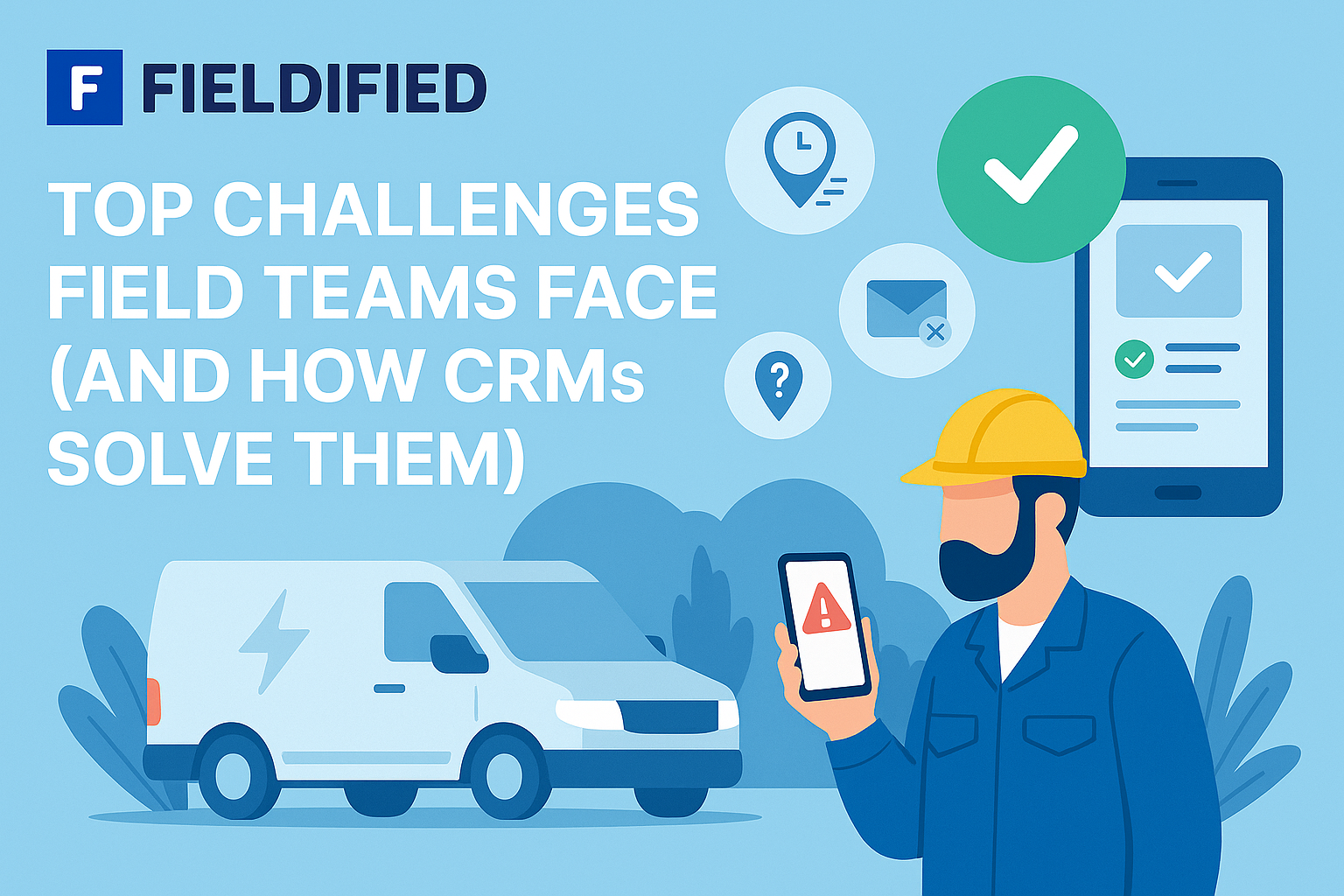
To get rid of these problems, it is important to understand them clearly and choose a better system. For that, you can go through the challenges that CRM solves and how it helps businesses manage field operations more efficiently.
Now let’s talk about
Why Field Service CRM Matters?
A field service CRM is a field service management software that helps field teams and small businesses to manage their daily operations in a better way. It allows teams to plan tasks, assign jobs, and track work progress from one central system.
It helps to manage clients, jobs, and estimates in one tool. With a CRM, field teams can improve communication, reduce manual work, and complete jobs more efficiently. Managers also get better visibility, reports, and control over field team performance.
Difference between WhatsApp and CRM
| Feature | CRM | |
|---|---|---|
| Field Team Communication | Work messages are mixed with personal chats, making it hard to follow important updates. | All your team communication stays organized in one central place for easy access |
| Task Management | There is no proper way to assign tasks or track who is working on what. | Tasks can be assigned clearly, tracked in real time, and updated as work progresses. |
| Data Management | Customer details, photos, and job information are scattered across multiple chats. | All customer and job-related data is stored securely in one system for easy access and tracking. |
| Real-Time Updates | Managers do not get live updates or visibility into field work. | Live location, task status, and progress updates help managers stay informed. |
| Reports & Dashboards | WhatsApp does not provide reports or performance insights. | CRM offers dashboards and reports to track team productivity and job completion. |
| Team Control | Limited control makes it difficult to manage growing field teams. | Better control through data-driven decision making and structured workflows. |
This differentiated table comparing WhatsApp and CRM software highlights the clear advantages that a field service CRM tool offers.
Many small businesses utilize CRM software instead of basic messaging tools like WhatsApp, and companies that adopt CRM software see a 21–30% increase in sales and growth in customer satisfaction.
How Switching to Field Service CRM Improves Field Team Productivity
Switching to field service CRM software can be difficult at first, but it is very helpful for your team. It can be costly if you have a large team, so choose a CRM that fits your budget and business needs.
A field service CRM helps organize tasks, improve team communication, and reduce confusion by keeping all work details in one place.
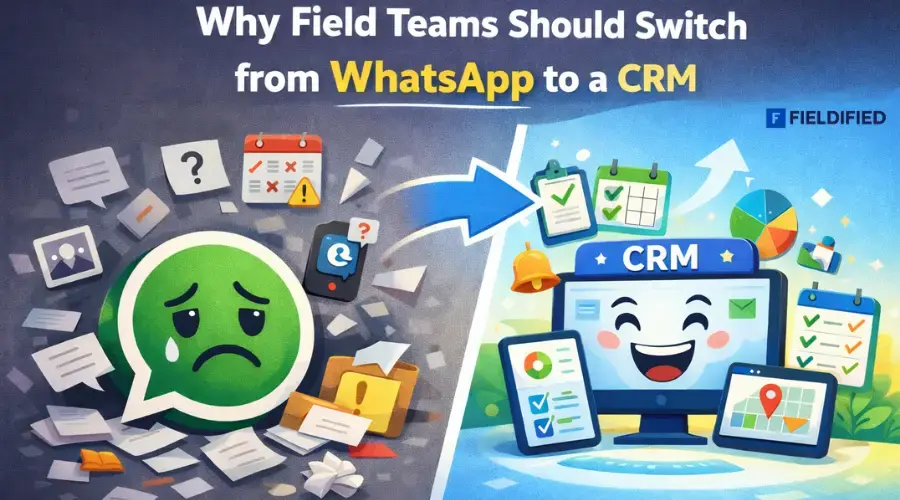
As you can see in the image below, using a CRM improves overall field team productivity. 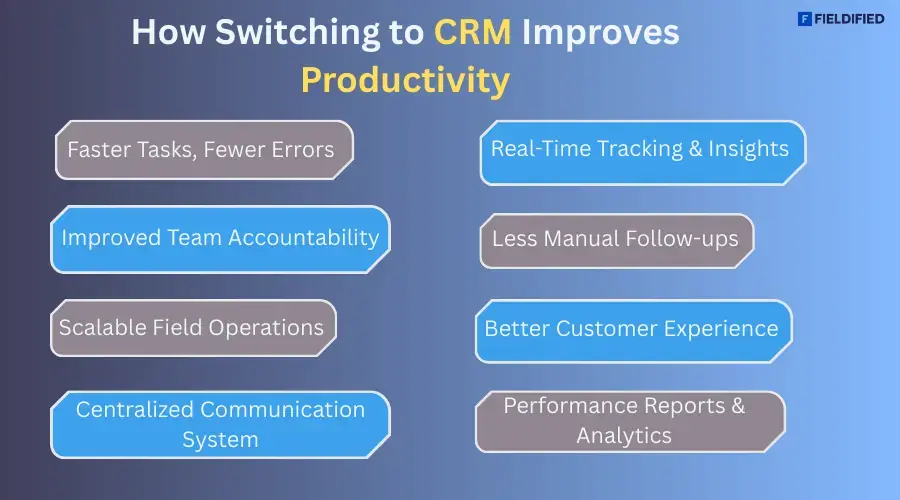
Faster Task Execution and Reduced Errors
Where WhatsApp can’t help to properly assign, manage, or track tasks, field teams often face confusion and delays. There is no clear task structure, which leads to missed details and repeated follow-ups.
A field service CRM software creates clear workflows for your field teams. Tasks are assigned with proper details like job location, customer information, and deadlines.
This helps team members understand exactly what they need to do without needing to ask repeated questions. Field staff don’t waste time searching for messages or calling managers for clarification, which helps them complete tasks faster with fewer errors.
Improved Team Accountability and Transparency
You can’t trace real-time task progress on WhatsApp, and there is no clear visibility into who is working on which job.
With a field service CRM, every task is traceable. Managers can easily see who is assigned to which job, when the task was started, and whether it is completed or pending.
Team members know their work is being tracked, which encourages them to complete tasks on time. This builds a culture of responsibility and improves overall team discipline.
Scalable System for Growing Field Operations
A field CRM software is designed to grow with your business. As your field operations expand, you can easily add more users without changing the system or creating confusion.
Unlike WhatsApp, which becomes messy as teams grow and work increases, a CRM keeps communication structured and tasks well-organized.
Even with a larger field team, managers can maintain control, track work easily, and manage operations smoothly.
Better Communication and Centralized Information
CRM tool keeps all work-related communication in one place. Job updates, customer details, photos, and notes are stored inside the system instead of scattered across multiple chat threads.
This makes it easy for both field staff and managers to access the field team communication at the right time. Better communication reduces delays, avoids misunderstandings, and helps teams work smoothly throughout the day.
Real-Time Tracking and Smarter Decision Making
A field CRM software provides real-time updates on field activities, so managers can track job status, team location, and progress without calling team members repeatedly.
The system also generates reports and dashboards that WhatsApp cannot provide. These insights help managers make better decisions, improve planning, and optimize field operations for long-term growth.
Reduced Dependency on Manual Follow-ups
WhatsApp does not support automated reminders or task alerts. Because of this, managers have to repeatedly call or message field team members to remind them about tasks, deadlines, and updates.
But a field service CRM tool, reminders, and notifications are automated. Field staff receive alerts for new tasks, deadlines, or changes on time, reducing manual follow-ups, saving manager time, and allowing teams to focus more on actual field work instead of constant messaging.
Better Customer Experience and Faster Response
A field CRM tool stores customer history, job details, and previous interactions centrally. This helps field teams understand customer needs in advance, respond faster, solve issues efficiently, and deliver a more professional service.
But WhatsApp does not store all the customer history or past job details in one place. Field teams often reach the site without full information, which leads to delays, repeated questions, and poor service experience.
Improved Reporting and Performance Evaluation
The last thing that WhatsApp cannot do is record your work data or generate performance reports, which is why managers don’t have a clear way to track completed jobs, delays, or individual team performance.
But Field service CRM software automatically records all your work activity and generates reports. This makes performance evaluation fair and data-based, helps identify improvement areas, and supports better planning for future field operations.
Final Thoughts
WhatsApp becomes a daily routine for many small businesses to manage field team operations, but it can’t be useful in many ways. So a smart use of a field CRM tool can truly change your business and help you grow. Most CRM tools are easy to use and affordable in the market, so choosing the right one can seem difficult at first. Many small service business owners worry that they won’t know how to use a CRM properly, even after buying it.
If you’re a small service business owner and want to switch to CRM software but don’t know how to start, then you can definitely check out a good beginner’s guide on how to use CRM software.
This guide explains the basics of using a CRM, from setup to daily use. Once you learn the basics, you’ll find that CRMs are not only powerful but also very helpful for growing your business. Starting with a simple system and learning gradually will make the switch easier and faster.
FAQs
1. Why is WhatsApp not enough for field teams?
WhatsApp is not enough for field teams because it’s a messaging app, not a work management tool. It cannot properly assign or track tasks, store customer data in one place, or show real-time work progress.
2. What is a field service CRM?
A field service CRM is software that helps manage field jobs, team communication, customer data, and work tracking from one system.
3. How does CRM improve field team productivity?
CRM assigns clear tasks, gives real-time updates, and reduces confusion, helping teams complete work faster and more efficiently.
4. Can small businesses use CRM software?
Yes, many CRM tools are affordable, easy to use, and specially designed for small service businesses and field teams.
5. Is CRM better than WhatsApp for task management?
Yes, CRM offers structured task assignment, tracking, reminders, and reports, which WhatsApp does not help with.
6. How does CRM help managers manage field teams?
CRM gives managers real-time visibility, performance reports, and better control over field operations without constant follow-ups.
Blog Summary
- WhatsApp is widely used by field teams, but it is not built for managing tasks, tracking work, or handling growing field operations. As teams grow, communication becomes messy and unorganized.
- Field teams face problems like unclear task ownership, lost messages, no real-time tracking, and no performance reports when they rely only on WhatsApp for daily work.
- A field service CRM solves these problems by organizing field team communication, managing tasks, storing customer data, and giving managers full visibility of field work.
- With features like real-time tracking, automated reminders, reports, and dashboards, CRM improves team productivity, accountability, and decision-making.
- Switching from WhatsApp to a field service CRM helps businesses work more efficiently, serve customers better, and scale field operations smoothly with less confusion.