 EN
EN DE
DE ES
ES FR
FR NL
NL PT
PT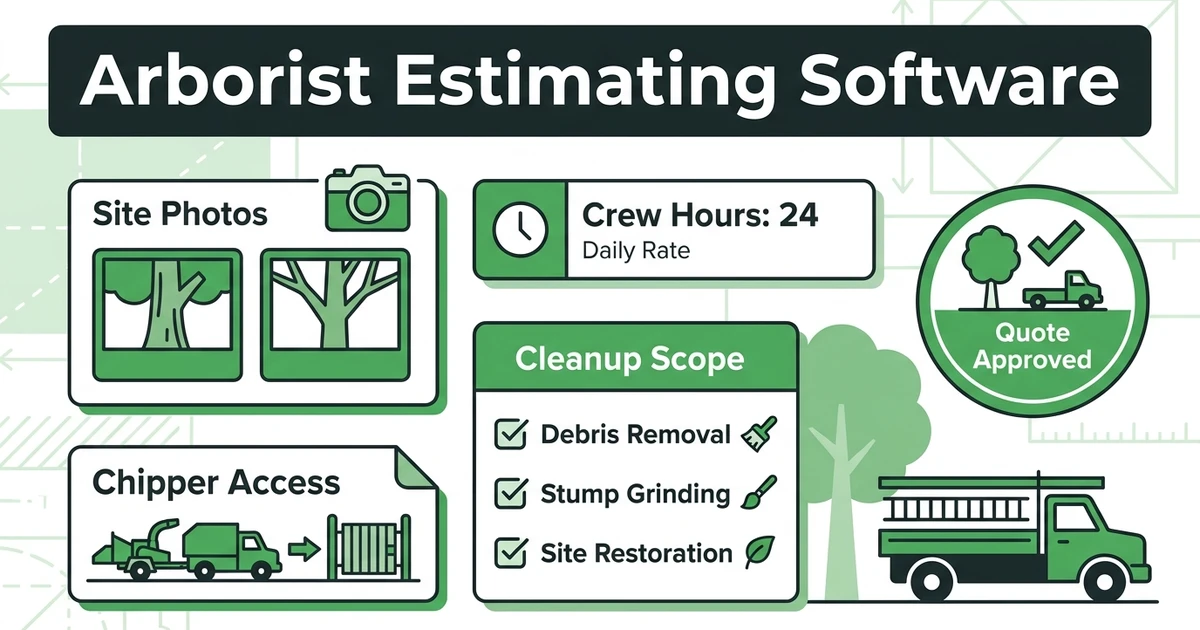





Quick Answer:
Arborist estimating software helps tree care teams turn site notes, photos, labor, equipment, cleanup, and risk details into professional quotes faster. The best setup also connects approved estimates to scheduling, dispatch, invoices, and client history so the work does not get lost after the customer says yes.
Fieldified helps tree care businesses manage quotes, jobs, schedules, invoices, and payments from one place. For an arborist crew, the estimate is not just paperwork. It is where job profit, crew planning, and customer expectations first meet.
A tree removal quote can look simple from the street. Once you walk the property, the real job appears: tight gate access, overhead lines, a fence under the drop zone, hauling distance, stump work, and a customer who wants the patio spotless by Friday.
That is why a dedicated estimating workflow matters. It gives your estimator a repeatable way to capture the full job, not just the final price.
Why tree care estimates get lost between site visits and crew schedules
Tree care estimates get messy because the person who sees the property is often not the same person building the schedule, loading the truck, or collecting payment. The estimator notices the narrow driveway. The office only sees “remove oak.” The crew arrives and realizes the job needs different equipment.
That handoff costs time. It also creates avoidable arguments with customers when cleanup, hauling, stump grinding, or access work was discussed on site but not written into the approved quote.
Tree work has another layer: risk. OSHA reported that BLS data showed 222 fatal workplace injuries and illnesses in tree and landscape services in 2022, with causes including falls, falling trees or branches, electrocution, heat, and chemical exposures in its 2024 tree and landscape safety release. Your estimate is not a safety program, but good site notes help crews arrive with fewer surprises.
The Bureau of Labor Statistics reported 55,160 tree trimmers and pruners in May 2025 with a mean annual wage of $55,970 in its May 2025 wage release. With labor that valuable, every missed detail that adds an hour to a job hits the margin.
What arborist estimating software should include
Good estimating tools should capture the work the way tree crews actually do it. They should not stop at customer name, address, and total price.
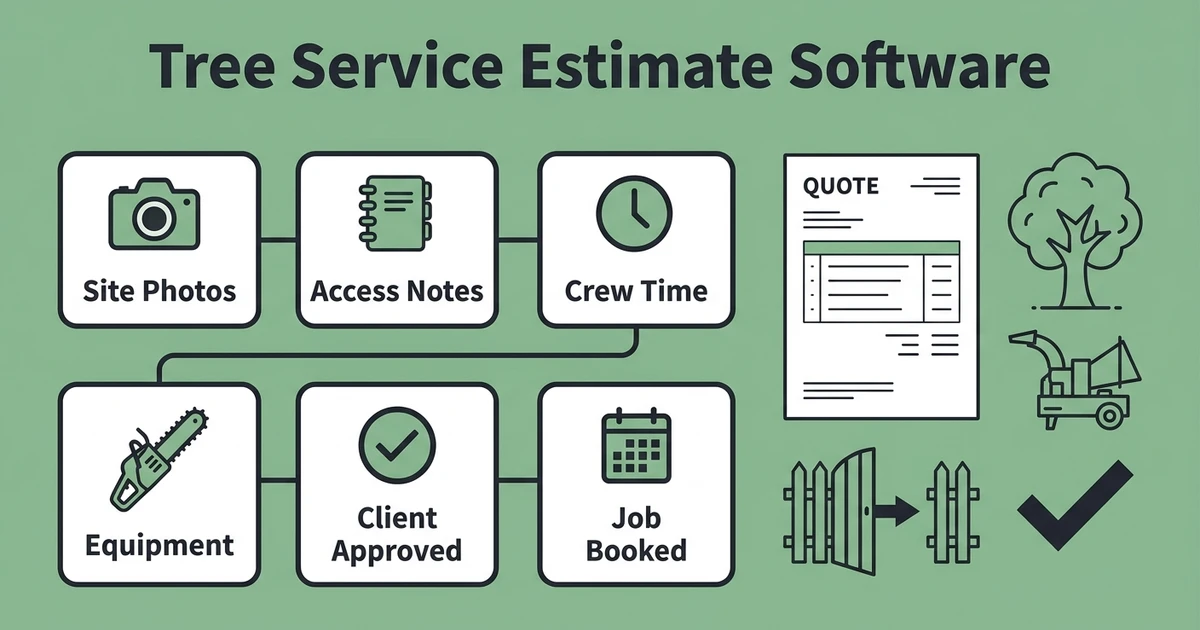
At minimum, your estimating workflow should include:
- Customer and property details
- Tree location and service type
- Photos from the site visit
- Access notes for gates, slopes, fences, and driveways
- Crew size and labor time
- Equipment needs, including lifts, loaders, chippers, or stump grinders
- Hauling, disposal, and cleanup scope
- Safety and hazard notes
- Quote approval status
- Follow-up reminders
- Job notes that carry into scheduling
That is the difference between a quote document and a job record. A document tells the customer what it costs. A job record tells your office, crew, and billing process what was promised.
This is where tree service and arborist software earns its keep. The estimate should become the starting point for the whole job, not a file the office has to rebuild later.
How to price tree jobs without undercounting labor, equipment, or risk
Start with labor, then add the parts of tree work that are easy to forget. A pruning job with clean access is not the same as a removal over a roof. A stump grind with clear space is not the same as one beside irrigation, pavers, and a fence line.
Use a simple pricing checklist before sending the quote:
- Estimate crew hours by task.
- Add equipment time and rental costs if needed.
- Include hauling, disposal, and dump fees.
- Add cleanup expectations as a line item or scope note.
- Note access constraints that affect setup time.
- Add risk notes that the crew needs before arrival.
- Check gross margin before the quote goes out.
Grounds maintenance work is not shrinking. BLS projects overall employment of grounds maintenance workers to grow 4 percent from 2024 to 2034 and projects about 171,600 openings each year over that decade in its Occupational Outlook Handbook profile. That demand makes repeatable pricing more important, especially when busy seasons hit.
Use the job estimate calculator when you need a quick pricing check. Then keep the final scope, photos, and approval inside the estimate record.
Turn approved tree estimates into scheduled work.
Fieldified keeps quote details, crew notes, scheduling, invoices, and payment follow-ups connected. Book a demo to see how a tree job moves from first estimate to final payment.
Tree service estimate app vs. full tree care software: what is the difference?
A tree service estimate app helps you build and send quotes. That can be enough if the owner handles every site visit, every schedule change, and every invoice.
Full tree care software goes further. It connects estimating to the work that happens after approval, including dispatch, customer history, job tracking, invoicing, and payments.
| Need | Estimate-only app | Full tree care software |
|---|---|---|
| Build quotes | Yes | Yes |
| Store photos and notes | Sometimes | Yes |
| Convert quotes into jobs | Limited | Yes |
| Schedule crews | Rarely | Yes |
| Track invoices and payments | Rarely | Yes |
The difference shows up when the quote wins. If the approved estimate has to be copied into a calendar, retyped into an invoice, and explained again to the crew, the app only solved the first part of the job.
For crews comparing broader tools, this tree service estimate software guide is a useful next read. It focuses on pricing the work, while this article focuses on whether the estimate can carry the job forward.
A practical arborist estimate workflow from first call to approved quote
Picture a storm-damage Monday. Three homeowners call before breakfast. One has a limb over the driveway, one has a cracked maple near a garage, and one needs a removal before roofers arrive later in the week.
Without a connected workflow, the estimator takes photos, texts the office, writes a rough number, and hopes the right notes make it onto the schedule. By Thursday, the crew is asking which job needs the chipper and which customer approved stump grinding.
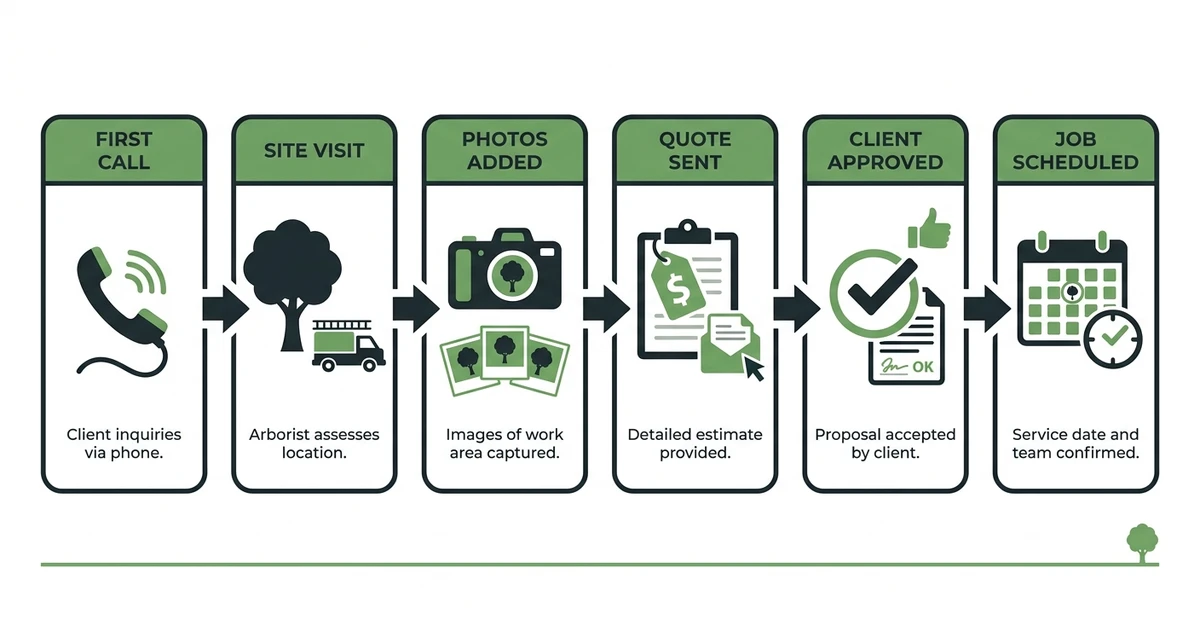
A cleaner workflow looks like this:
- Create the customer record during call intake.
- Add property notes before the site visit.
- Attach photos and access details during the estimate.
- Build line items for labor, equipment, hauling, cleanup, and stump work.
- Send the quote and track approval status.
- Use quote management tools for service contractors to follow up before the lead goes cold.
- Once approved, turn approved quotes into booked jobs without re-entering the scope.
That workflow does not remove judgment from estimating. It gives the estimator’s judgment a place to live so the office and crew can use it.
Checklist: how to choose tree estimating software
Choose software around the job handoff, not only the quote template. The quote has to sell the work, but it also has to prepare your crew.
Use this checklist when comparing options:
- Can estimators add photos from the field?
- Can each quote include access, cleanup, and hazard notes?
- Can approved quotes become scheduled jobs?
- Can the crew see the approved scope before arrival?
- Can the office send quote follow-ups without manual reminders?
- Can invoices use approved job details?
- Can the system scale without punishing every new hire with per-user pricing?
That last point matters for growing crews. If every new climber, ground worker, or office user pushes the software bill higher, the tool can start feeling like a tax on growth.
Fieldified uses flat plan pricing for core plans, so growing teams can add structure without watching costs jump every time the crew expands.
How Fieldified helps tree care teams turn estimates into booked jobs
Fieldified helps tree care companies keep the estimate connected to the job. Your team can create quotes, track approvals, schedule crews, manage customer records, send invoices, and follow up on payments from one workflow.
That matters because tree work has too many moving parts for scattered notes. Photos, cleanup terms, access details, and equipment needs should not live across phones, spreadsheets, and inboxes.
With Fieldified, the office can see what was quoted. The crew can see what was approved. The owner can see which estimates are pending, won, or ready to invoice.
It is not about making the estimate fancy. It is about making sure the job you sold is the job your crew is ready to complete.
Frequently Asked Questions
What is estimating software for arborists?
It helps tree care companies create quotes for removals, pruning, stump grinding, storm cleanup, and plant health work. It keeps labor, equipment, photos, risk notes, customer approvals, and follow-ups tied to the same job record.
How do tree estimating tools help with job pricing?
It gives the estimator a place to account for crew time, equipment, access, hauling, cleanup, and safety conditions before the quote is sent. That helps reduce underpriced jobs caused by missing scope details.
Is a tree service estimate app enough for a growing crew?
A simple tree service estimate app can work when the owner handles every quote. Growing crews usually need estimating connected to scheduling, dispatch, job notes, invoicing, and payment follow-up.
Can arborist estimate tools include photos and site notes?
Yes. Photos and site notes are important because tree work depends on access, hazards, tree condition, and cleanup expectations. The software should keep those details attached to the quote and job.
Should tree estimate software connect to scheduling?
Yes. When an approved estimate becomes a scheduled job without retyping details, the office has fewer handoff errors and the crew sees the scope before arriving on site.
Conclusion
Your estimating workflow should do more than create a clean quote. It should protect the handoff from site visit to approval, scheduling, crew work, invoicing, and payment.
If your tree care team is growing, the estimate cannot live in one person’s head. It needs to carry photos, labor, equipment, cleanup, risk notes, and customer approval forward.
See how Fieldified helps tree care teams quote, schedule, invoice, and collect payment in one place. Book a demo and walk through your estimate-to-payment workflow.