 EN
 DE
 ES
 FR
 NL
 PT
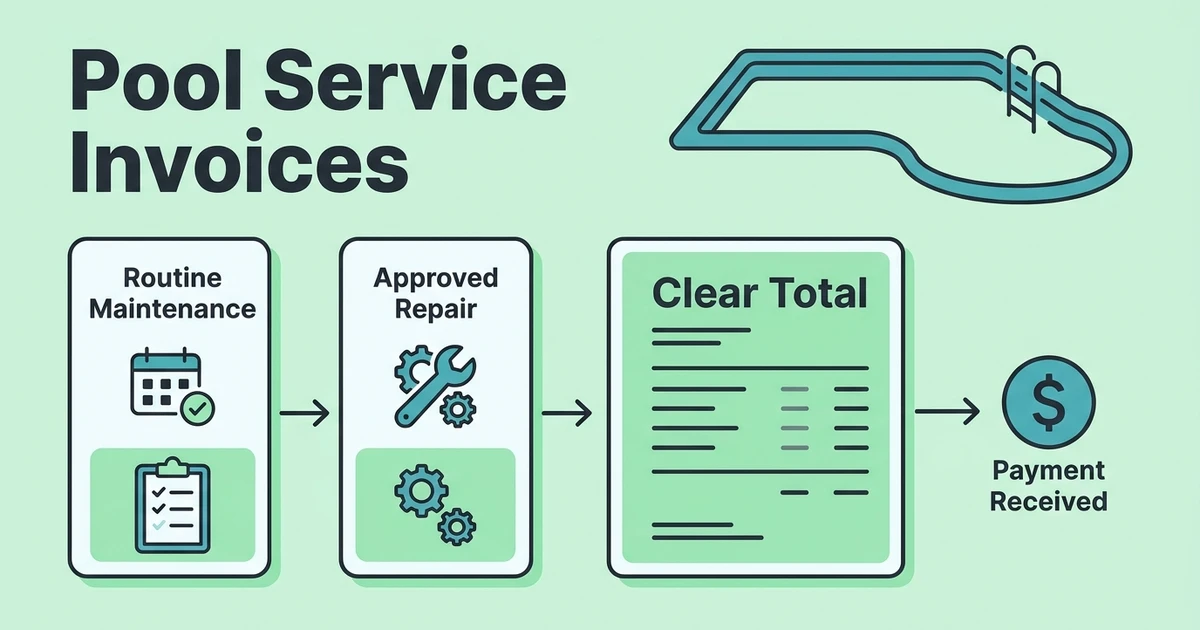





Quick Answer: Pool service invoices work best when recurring maintenance and repair work are documented differently. Fieldified lets teams build an invoice from completed-job details, send it by email or text, and keep the payment record with the work.
Pool customers often receive the same maintenance service week after week. That makes a clear routine invoice valuable. But the moment a technician finds a leak, failed equipment, or an approved part replacement, the visit changes. The invoice needs to show that change without making the customer decode a long monthly charge.
The simplest approach is to use one format for planned maintenance and another for variable repair work. Both should start with the same completed job record. They should not rely on a technician’s memory at the end of the week.
Pool maintenance has a repeatable service rhythm, while repair work introduces a variable scope, labor, and parts. That distinction matters in the office, too. A repeat service visit and a repair call may serve the same property, but they create different billing information.
The pool service business software guide covers the larger operation around recurring work and field records. This article stays focused on the customer-facing handoff after the work is complete: the invoice, the payment request, and the record that supports both.
General maintenance and repair workers are projected to grow 4% from 2025 to 2035, according to the Bureau of Labor Statistics.BLS maintenance and repair outlook That is not a pool-service forecast. It is a reminder that repair work is a meaningful operational category and should not be buried in a generic maintenance invoice.
Why pool maintenance and pool repair invoices need different detail
A maintenance invoice confirms the routine service the customer already expects. It should identify the service period or visit dates, the agreed plan, and any information the customer needs to understand the charge. The aim is consistency.
A repair invoice needs more context. It should identify the issue, the work that was approved, labor, parts, and any relevant tax or payment terms. The aim is clarity when the amount differs from the usual monthly service charge.
Treating both jobs as a generic “pool service” line is where avoidable billing questions start. The customer may not remember a repair approved by phone, and the office may lose the connection between a part used and the job where it was installed.
What to include on a recurring pool maintenance invoice
Start with the information that lets the customer recognize the account and the covered work. Include the customer and property, service period or visit date, plan name or description, total due, and the payment terms your agreement uses.
You can also use a concise service summary when it is useful to the customer. Do not turn the invoice into a full technician report unless that is part of your process. The invoice should be easy to scan, while detailed notes remain with the job record.
For a monthly maintenance plan, a clear invoice might show four completed weekly visits under the regular agreement. For a per-visit plan, it might show the completed date and the scheduled maintenance service. The format can differ. The customer should not have to guess what the total represents.
Keep internal technician detail where your team can use it, and keep the invoice readable for the client. A technician may need notes about equipment condition, readings, photos, or a recommendation for later work. The customer invoice needs the completed service and the amount due. Those records should be connected, but they do not have to be the same document.
How to invoice a repair when parts or scope change on-site
When a technician discovers additional work, pause the billing flow until the scope is clear. Record the issue, the recommended repair, the customer’s approval method, and the labor or parts needed. That gives the office a defensible job record before it becomes an invoice.
Then make the repair charge separate from the recurring plan. A clean repair entry might include the diagnostic or repair description, labor, parts, and the date of the work. If the customer declined a recommendation, do not bill it as completed work.
| Billing situation | What the invoice should make clear | Example |
|---|---|---|
| Routine maintenance | The agreed recurring service | Monthly maintenance plan for the listed service dates |
| Approved repair | The problem and completed repair | Pump seal repair with labor and approved part |
| Replacement item | The item separate from labor | Replacement component listed apart from installation labor |
| Return visit | Why a second visit occurred | Follow-up repair after the original diagnosis |
This structure reduces confusion without forcing your team to create a different process for every customer. It also lets the office see where repair revenue is coming from when it reviews the record later.
It also gives the technician a cleaner handoff. Rather than calling the office with a rough description after leaving the property, the team can attach the needed information to the completed job. The office reviews the work, issues the invoice, and has the same context if the customer responds with a question.
How to keep pool service invoices tied to the completed job
The invoice should begin with the job, not with a blank accounting screen. When the technician closes the visit, the office needs the property, service details, notes, any approved change, and the amount due in the same workflow.
Fieldified supports one-click invoicing from completed jobs, carrying job scope, materials, and taxes into the invoice. It can also send reminders by email or SMS and record payments against invoices. That gives a pool office a cleaner handoff from technician to customer without retyping the work into another system.
The IRS lists invoices as supporting documents for business records.IRS Publication 583 Your billing records should match your actual agreements and local requirements. For tax or record-retention decisions, use guidance from your accountant or qualified adviser.
How should customers pay for recurring service versus repairs?
Recurring maintenance works best with a predictable payment expectation. A customer may receive a payment link after each visit, a regular statement, or another agreed recurring arrangement. Whatever you choose, make the cadence visible in the original agreement and on the invoice.
Repairs are different because the scope can change. Send the repair invoice promptly after the documented work is complete, and make it easy for the customer to see the approved charge. If a repair is large enough to require a deposit or staged payments, set that expectation before work begins.
Do not assume that one payment method fits every customer. The important part is that the office can see the invoice status, follow up consistently, and avoid asking the technician to explain a charge weeks after the visit.
For recurring work, set expectations in the original agreement about the billing cadence and how changes will be handled. For repair work, make the approval and scope visible before the job is closed. That protects the customer experience as much as it protects the office process.
What to look for in pool service invoice software
Test software with a real maintenance customer and a real repair scenario. A polished invoice template alone is not enough. The record should stay connected from customer history to completed job, invoice, payment, and follow-up.
Use this short buying checklist:
- Can routine maintenance and repair charges be separated clearly?
- Can a technician’s job details reach the office without re-entry?
- Can the office send an invoice and see payment status from the same record?
- Can the team handle a customer pause, added part, or return visit without losing the original context?
- Can customers pay through a simple option that fits the agreement?
The pool service software page covers the broader operation, including customer records and field workflow. For billing, focus on whether the tool preserves the details that explain the invoice.
Ask the vendor to run that test live. The demo should show a routine maintenance visit, a discovered repair, an approval, a completed repair invoice, and the payment status afterward. If the process breaks when one job changes, it will not become easier during a busy route week.
Also check what happens when a customer calls two weeks later. The office should be able to open the original job, see the work and charge, and respond without asking the technician to reconstruct the visit. That is the standard for a billing workflow that supports a growing route.
Choose the system that makes this review ordinary, not an exception handled only by the owner.
For a one-off invoice format, use the free contractor invoice generator. For recurring operations, choose a workflow that keeps the invoice connected to the job from the start.
Keep routine service and repair billing in the same job record. Fieldified helps your office send clear invoices, follow up on payment, and keep the completed pool visit behind every charge. Book a demo.
Pool service invoice FAQs
What should pool service invoices show for recurring maintenance?
Show the customer, property, service period or dates, the recurring service description, total due, and payment terms. Add enough detail for the customer to recognize the work without turning the invoice into a full route report.
Can pool service invoice software separate repairs from recurring service?
It should allow the office to keep a repair or approved add-on distinct from the regular plan. Test that scenario before choosing a system, especially if technicians frequently identify work during a maintenance visit.
Should I bill for a pool repair before or after the work is complete?
The agreement, approval process, and scope of work should determine the timing. Document the approval and the payment expectation before the repair, then make the final invoice match the work actually completed.
How do I avoid disputes over parts on a pool invoice?
Describe the approved repair and list parts separately from labor when that helps the customer understand the charge. Keep the job notes and approval record with the invoice so the office can answer questions from the same source of truth.
Can I use one invoice template for every pool customer?
Use a consistent base format, but let the service details reflect the actual job. A stable maintenance plan and a variable repair should not read like the same transaction.
Conclusion: make maintenance and repair billing easier to review
Clear pool service invoices begin with a clear job record. Keep routine maintenance predictable, document approved repair changes, and make the customer-facing invoice match the work completed.
Fieldified brings completed pool work, invoices, payment reminders, and payment status into one connected workflow. Book a demo to see how it can work for your team.