 EN
EN DE
DE ES
ES FR
FR NL
NL PT
PT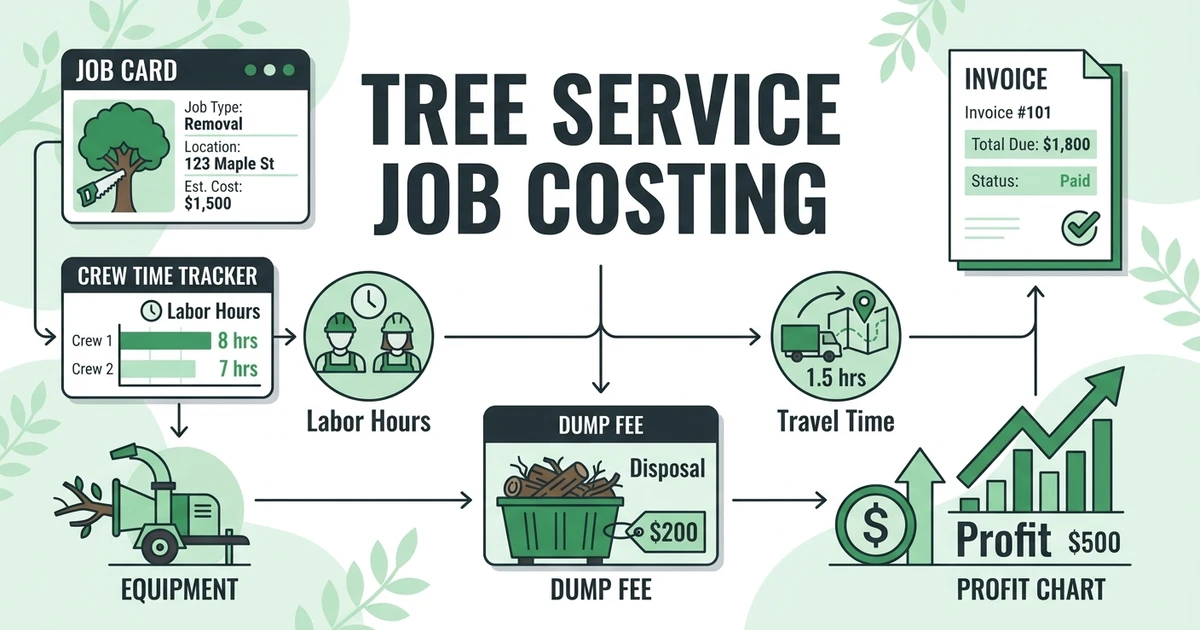





Quick Answer: Tree Service Job Costing
Tree service job costing is the process of tracking labor, equipment, materials, disposal, travel, overhead, and revenue for each job so you know which work is profitable. For arborists, job costing turns “busy crews” into clear numbers by showing whether removals, pruning, stump grinding, and storm cleanup are actually covering their costs.
Fieldified helps tree service companies manage jobs from schedule to invoice. Tree service job costing is the part that tells you whether the work actually protected margin.
A full calendar can hide weak jobs. Crews may be busy, invoices may go out, and revenue may look fine. But if a removal runs long, a chipper sits too far from the work zone, or disposal takes an extra trip, the job can quietly lose profit.
Job costing fixes that by assigning the real costs back to the job. It gives the owner a clearer answer than “we were busy.”
Managing a tree service business?
Fieldified helps arborists and tree care companies schedule crews, create estimates, manage customers, send invoices, and collect payments from one platform.
Why Tree Service Job Costing Gets Missed
Tree service job costing gets missed because the work is moving fast. A crew finishes a removal, rushes to the next job, and the office sends an invoice from the approved quote. Nobody stops to compare expected cost against actual cost.
That is understandable. Tree work is physical, weather-sensitive, and equipment-heavy. A job that looked simple during the estimate can change once the crew sees access, traffic, disposal distance, or extra stump work.
BLS says tree trimmers and pruners use chainsaws, chippers, and stump grinders on the job in its occupational profile. Those tools are necessary, but they are not free to own, fuel, transport, repair, or replace.
BLS also reports that tree trimmers and pruners had a median hourly wage of $24.25 in May 2024 in its pay data. Labor is only one piece of the cost, but it is usually the first one owners notice when a job runs long.
What Costs Should Arborists Track on Every Job?
Arborists should track costs that change job by job and costs that need to be allocated across jobs. The goal is not to create accounting busywork. The goal is to know whether a completed job paid for the resources it used.
At minimum, track:
- Crew labor hours
- Travel and setup time
- Equipment used, including trucks, chippers, lifts, saws, and grinders
- Fuel, maintenance, and equipment wear assumptions
- Disposal, dump fees, and hauling time
- Materials, treatments, or supplies
- Subcontractors, permits, or traffic control
- Change orders and extra approved work
- Invoice amount, payment status, and discounts
This is where tree service and arborist software should connect field updates with office records. If the crew time is in one place, the invoice in another, and job notes in a third, true job costing becomes a guessing exercise.
The most useful job cost record is specific. A pruning job, a backyard removal, and a storm cleanup should not be judged by the same assumptions. Each job type uses different labor, equipment, time, and risk.
How to Calculate Tree Service Job Profitability
Picture a three-person crew assigned to a removal that was estimated as a half-day job. The tree is behind a fence, the chipper has to be parked farther away, disposal takes an extra trip, and the customer adds stump work while the crew is on site.
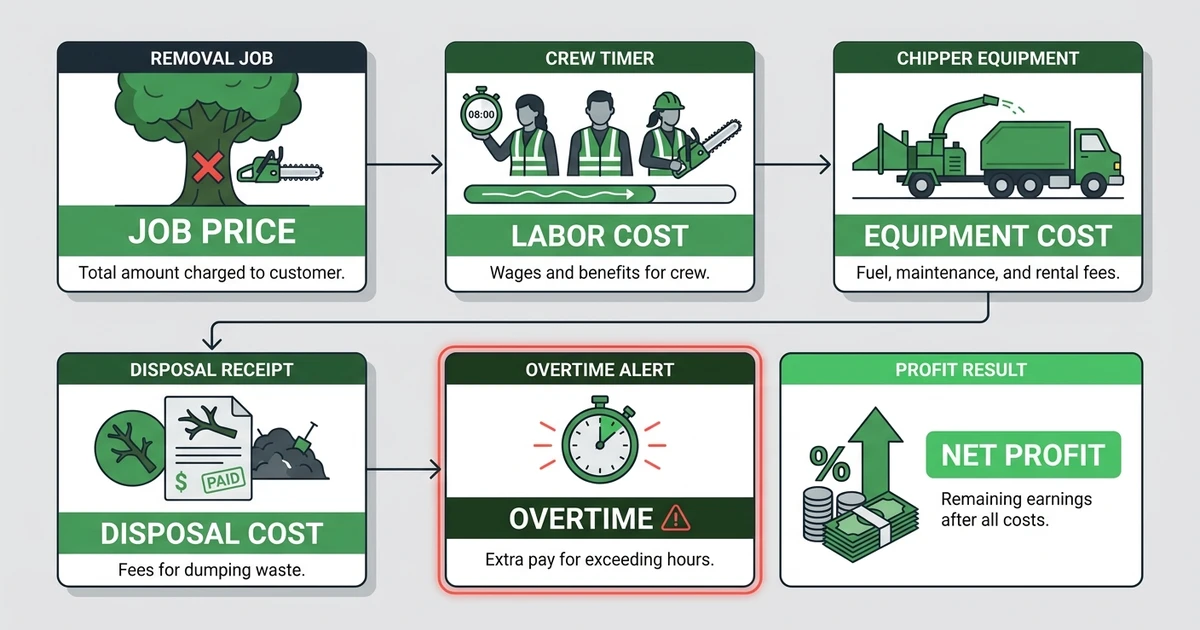
Revenue may still look fine. The invoice goes out at the approved price plus the add-on. But once you include labor, equipment time, travel, disposal, and overtime, the margin may be thinner than expected.
A simple job costing workflow looks like this:
- Start with the approved job price.
- Add actual crew labor hours.
- Add travel, setup, and cleanup time.
- Assign equipment cost for the job.
- Add disposal, materials, subcontractors, or permits.
- Include change orders and extra approved work.
- Compare total cost against revenue.
- Review margin by job type.
TCIA says tree care companies should understand direct labor, equipment, and overhead costs when setting target hourly rates in its financial metrics article. The article gives this target hourly rate formula: labor rate plus equipment rate plus overhead rate, divided by one minus profit margin.
Use a profit margin check when you need a quick read on whether a completed job protected margin. Then use your job records to understand why the margin landed where it did.
Book a demo and see how Fieldified connects crew time, job status, invoices, and reporting so tree service owners can see which jobs protect margin.
Tree Service Job Costing vs Estimating
Estimating and job costing are related, but they are not the same workflow. Estimating happens before approval. Job costing happens after the work is complete or as the job moves through the day.
Estimating asks, “What should this job cost?” Job costing asks, “What did this job actually cost?”
| Workflow | When It Happens | What It Answers |
|---|---|---|
| Estimating | Before customer approval | What price should we quote? |
| Scheduling | After approval | Which crew and time slot fit? |
| Job tracking | During the work | What is happening in the field? |
| Job costing | During and after completion | Did the job make money? |
| Invoicing | After completion or milestone | What does the customer owe? |
If your estimates are strong but your job costs are not tracked, you only see half the picture. You may know what you intended to charge, but not whether the crew, equipment, and disposal matched the assumptions.
For the pre-sale side of the workflow, this guide to tree service estimate software covers how to build cleaner quotes. Job costing takes the next step and checks the real outcome.
Still managing estimates, crew schedules, and invoices manually?
Use Fieldified to keep tree service jobs organized from first quote to final payment.
How Fieldified Helps Track Job Costs From Schedule to Invoice
Fieldified helps tree service teams connect job details, crew updates, completion status, invoices, and reporting. That matters because job costing depends on clean handoffs between the field and office.
Crews can update work status and job details from the field. The office can use time and GPS tracking to understand where labor hours went and when a job ran longer than planned.
Fieldified’s job profitability reporting helps owners review job performance instead of relying on gut feel. That is useful when a high-revenue job looks impressive but uses more labor and equipment than expected.
After completion, your team can invoice completed tree work faster. Fast invoicing matters because job costing is not only about cost control. It is also about making sure completed work turns into collected revenue.
What to Look for in Job Costing Software for Tree Services
Job costing software for tree services should be practical enough for crews and detailed enough for owners. If the crew will not use it in the field, the numbers will not be accurate.
Look for a workflow that can handle:
- Crew time by job
- Job status updates from the field
- Equipment and vehicle visibility
- Photos and notes for scope changes
- Invoice status and payment follow-up
- Reporting by job, customer, crew, or service type
- Simple review of estimated vs actual job performance
TCIA says ANSI A300 standards provide standard practices and specification-writing guidelines for arborists, urban foresters, horticulturalists, landscape architects, and contractors on its standards page. Clear work records support that same operating habit: document the work well enough that the office, crew, and customer understand what happened.
The right software should help you spot patterns. Maybe backyard removals with tight access are underpriced. Maybe stump grinding add-ons are profitable when scheduled separately. Maybe storm cleanup looks good in revenue but burns overtime.
Those patterns are where job costing becomes useful. It stops being bookkeeping and starts becoming decision support.
Ready to run your tree service jobs from one place?
Book a demo to see how Fieldified helps tree care teams manage estimates, scheduling, CRM, invoices, and payments.
Frequently Asked Questions
What is tree service job costing?
Tree service job costing tracks the actual costs and revenue tied to each job. It helps arborists see whether removals, pruning, stump grinding, storm cleanup, and PHC visits are covering labor, equipment, disposal, travel, and overhead.
What costs should a tree service include in job costing?
Include crew labor, travel time, setup time, equipment use, fuel, maintenance, disposal, materials, subcontractors, overtime, change orders, and invoice status. The exact model can be simple at first, but it should be consistent.
How is job costing different from tree service estimating?
Estimating predicts the price before the customer approves the work. Job costing compares that price against actual costs after the crew performs the work, so the owner can see whether the estimate protected margin.
Can job costing improve future tree service quotes?
Yes. When you know which job types run long or use more equipment, you can build better assumptions into future estimates. That helps you quote based on real operating history instead of memory.
Does Fieldified help tree service owners track profitability?
Yes. Fieldified connects scheduling, job updates, crew visibility, invoices, payments, and reporting. That gives tree service owners a clearer view of job performance from schedule to payment.
Conclusion: Know Which Tree Jobs Actually Make Money
A busy tree service is not always a profitable one. The difference is in the job details: labor, equipment, travel, disposal, overtime, invoices, and payment.
Tree service job costing gives those details structure. It helps you see which jobs protect margin and which jobs need better pricing, planning, or crew allocation.
Book a Fieldified demo to track tree service jobs from schedule to invoice and see labor, equipment, and payment details in one workflow.