
 EN
EN DE
DE ES
ES FR
FR NL
NL PT
PT





Quick Answer: Concrete job pricing starts with accurate measurements and scope, then adds material quantities, labor hours, equipment, prep, disposal, overhead, and profit. Change orders should be documented and approved before extra work begins.
Concrete job pricing can look simple from the outside. Measure the slab, price the yards, add labor, and send the quote. Any contractor who has eaten the cost of extra excavation, poor access, bad weather, or a missed finish detail knows it is not that simple.
Concrete labor has real cost behind it. O*NET, using BLS-backed wage and employment data, reports median wages of $27.41 hourly and $57,020 annually for cement masons and concrete finishers in 2025, with 206,700 employees in 2024 and 14,300 projected job openings from 2024 to 2034 in its occupation summary. Your estimate has to respect that labor reality.
This guide shows how small concrete contractors can price slabs, driveways, patios, repairs, prep, equipment, and change orders without guessing.
Why concrete job pricing is easy to underquote
Concrete work punishes vague estimating. A missed inch of depth, a bad access assumption, or a forgotten pump cost can wipe out the profit on a job.
Many underquotes happen because the estimate starts with a square-foot price instead of a job plan. Square-foot pricing can be useful as a sanity check, but it should not replace measurements, scope, prep, labor planning, and equipment review.
Concrete work also depends on timing. Crews, trucks, forms, weather, finishing windows, and cleanup need coordination. A scheduling mistake can cost more than the office expects.
That is why profitable concrete pricing starts at the site, not in a generic pricing table.
What factors affect concrete job pricing?
Every concrete estimate should start with scope. A broom-finished patio, stamped walkway, driveway replacement, garage slab, and repair patch each carry different labor, material, and risk.
Pricing factors include:
- Length, width, and depth
- Concrete volume
- Site access
- Excavation and grading
- Base material
- Forms and reinforcement
- Finish type
- Pumping or buggy work
- Equipment rental
- Weather exposure
- Disposal and cleanup
- Travel and crew time
- Overhead and profit
Construction labor sits in a broader market too. BLS reported that construction and extraction occupations had a median annual wage of $58,360 in May 2024 in its Occupational Outlook Handbook. Underpricing skilled labor means the business absorbs the gap later.
Do not price concrete jobs as if every site behaves the same. A backyard pour with narrow access is not the same as a driveway with room for truck positioning.
How to estimate concrete materials, labor, equipment, and overhead
Start with measurements. For a rectangular slab, calculate length x width x depth, then convert cubic feet into cubic yards. Add a reasonable waste factor and confirm whether the project needs reinforcement, base material, sealant, color, stamping, or specialty finish work.
Then calculate labor. Include layout, excavation, forming, base prep, reinforcement, pour, finish, cleanup, and return visits if needed.
Use a simple estimating flow:
- Define the exact scope.
- Measure the area and depth.
- Calculate concrete volume.
- Add base, forms, reinforcement, and finishing materials.
- Estimate labor hours by task.
- Add equipment, delivery, travel, and disposal.
- Add overhead and profit.
- Write exclusions and change-order rules.
O*NET lists concrete tasks such as checking forms, setting forms, spreading concrete, leveling surfaces, monitoring curing conditions, and finishing expansion joints in its task data. Those are separate work steps, not one vague labor line.
Use a concrete calculator for contractors to check material quantities, then test whether your hourly assumptions actually cover payroll and overhead.
Example concrete job price calculation
Here is a simplified example for a small patio slab. The actual price depends on your market, access, crew, finish, supplier cost, and risk.
| Cost item | Estimate | Notes |
|---|---|---|
| Concrete and delivery | $780 | Material, delivery, waste allowance |
| Base, forms, reinforcement | $420 | Gravel, lumber, mesh, stakes |
| Crew labor | $1,250 | Prep, pour, finish, cleanup |
| Equipment and tools | $260 | Rental, wear, fuel |
| Overhead allocation | $390 | Insurance, office, vehicle, admin |
| Total cost | $3,100 | Before profit |
If you add 25% gross profit, the job price becomes about $3,875. If access is poor, weather risk is high, or the finish is decorative, the price should increase.
This example is not a universal rate. The point is the structure. Every line item exists because the business actually pays for it.
The quote should also explain what is not included. Hidden exclusions are a common cause of disputes.
How to handle change orders and scope changes
Concrete jobs change when the ground opens up. You may find bad base, poor drainage, extra demolition, unexpected thickness, tree roots, or access problems that were not visible during the estimate.
Change orders protect both sides when they are handled before extra work begins. A clear change order should include:
- What changed
- Why it changed
- Added labor
- Added materials
- Added equipment
- Schedule impact
- Updated total
- Customer approval
Never rely on “we talked about it on site” for meaningful extra work. Write it down, get approval, and attach it to the job record.
Quote management helps concrete contractors document scope and approvals before work starts. Track every job detail matters even more when change orders appear mid-project.
Fieldified helps concrete contractors create estimates, track approvals, schedule crews, send invoices, and follow up on payment from one job record. Book a Fieldified demo to see how concrete quoting can stay organized from site visit to final invoice.
Build a repeatable concrete estimate template
A concrete estimate template should not be a blank page with a final number at the bottom. It should remind the estimator to check every cost category before the quote reaches the customer.
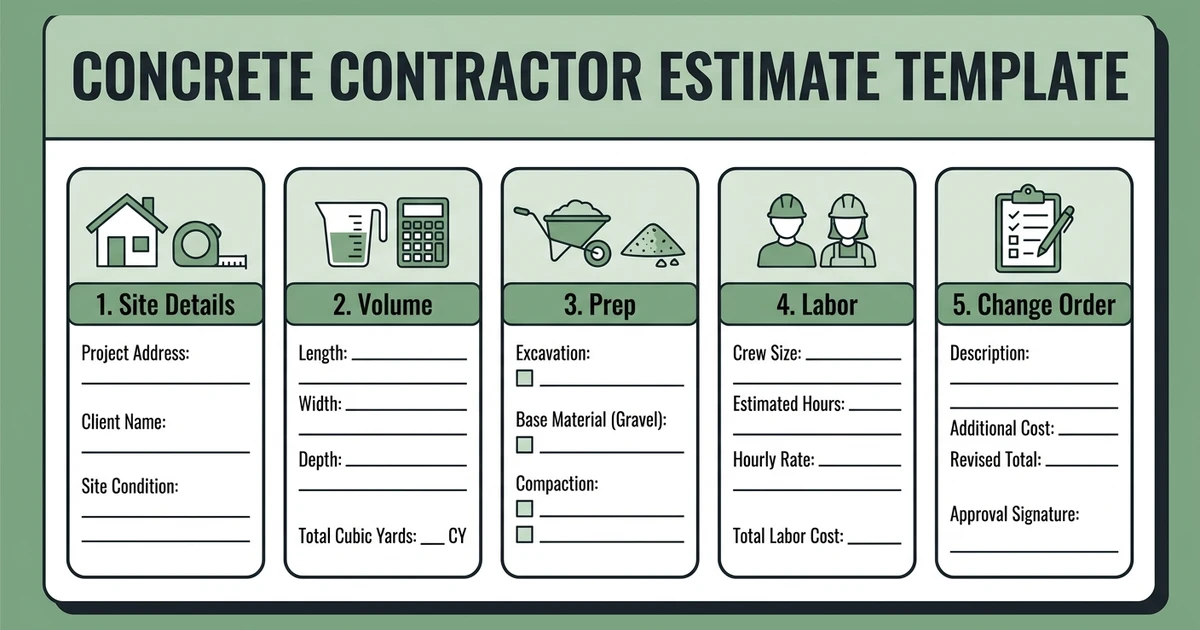
At minimum, the template should include:
- Customer and site details
- Measurements and depth
- Concrete volume
- Base preparation
- Reinforcement
- Forms
- Finish type
- Access notes
- Equipment needs
- Labor assumptions
- Disposal and cleanup
- Exclusions
- Change-order terms
The value is consistency. If every estimate follows the same order, it is easier to spot missing items before the customer approves the job.
The template also helps when someone besides the owner writes a quote. A project manager or office admin may not know every field habit yet, but the template pushes them to ask better questions.
Attach photos and measurement notes to the estimate whenever possible. Concrete customers often remember the final price, not the access issue, demolition detail, or finish assumption that shaped the number.
Add a final internal review step before sending. One missed disposal fee or equipment charge can turn a strong quote into a thin job.
How software helps concrete contractors quote and invoice faster
Concrete contractors often carry too much pricing knowledge in one person’s head. The owner knows the tricky access rules, the crew lead knows the prep time, and the office only sees the final number.
That works until the business gets busy. Quotes slow down, details get missed, and invoices go out without the right change-order notes.
Concrete contractor software helps by keeping measurements, photos, scope notes, estimates, schedule details, approvals, and invoices together. That gives the office a clearer record of what the customer approved.
If you are comparing contractor tools, look at how well each one handles estimating, field notes, and invoicing together. Review pricing model and workflow fit without choosing only by brand recognition.
Concrete pricing mistakes to avoid
Concrete pricing mistakes usually come from missing scope or undercounting time. The job looks profitable on the quote, then the crew burns hours on prep, access, cleanup, or customer changes.
Avoid these mistakes:
- Pricing only by square foot
- Forgetting depth changes
- Ignoring base prep
- Missing reinforcement
- Undercharging for access
- Not pricing equipment rental
- Treating decorative finish like basic broom finish
- Letting change orders stay verbal
- Sending invoices without approved extras
Review finished jobs against estimated jobs. If driveway replacements regularly run over labor hours, adjust the estimate template. If stamped work needs more setup, price it separately.
Good pricing improves with job history. The more you track, the less you guess.
Frequently Asked Questions
What is concrete job pricing?
Concrete job pricing is the process of calculating the full cost of a concrete project, then adding overhead and profit. It should include measurements, material quantities, labor, equipment, prep, disposal, travel, and change-order risk.
How do contractors estimate concrete materials?
Contractors estimate concrete materials by measuring length, width, and depth, then converting the volume into cubic yards. They should also account for waste, reinforcement, forms, base material, sealers, and delivery needs.
What should a concrete estimate include?
A concrete estimate should include scope, measurements, mix or material assumptions, prep work, labor, equipment, reinforcement, finish, cleanup, payment terms, and exclusions. It should also state how change orders will be handled.
How can software help with concrete job pricing?
Software helps concrete contractors save quote templates, track job details, document approvals, schedule crews, send invoices, and follow up on payment. It reduces the chance that measurements or change orders get lost between the site visit and the invoice.
How often should concrete contractors review pricing?
Concrete contractors should review pricing whenever labor, material, fuel, insurance, equipment, or disposal costs change. Many contractors review core rates monthly or quarterly because material and labor costs can move quickly.
Conclusion
Concrete job pricing should be built from scope, measurements, material quantities, labor, equipment, overhead, and profit. A simple square-foot number can help you compare jobs, but it should never replace a real estimate.
If you want to manage concrete estimates, approvals, crew schedules, job notes, invoices, and payment follow-up in one place, book a Fieldified demo. Fieldified helps concrete contractors keep the whole job record clear from first measurement to final payment.