
 EN
EN DE
DE ES
ES FR
FR NL
NL PT
PT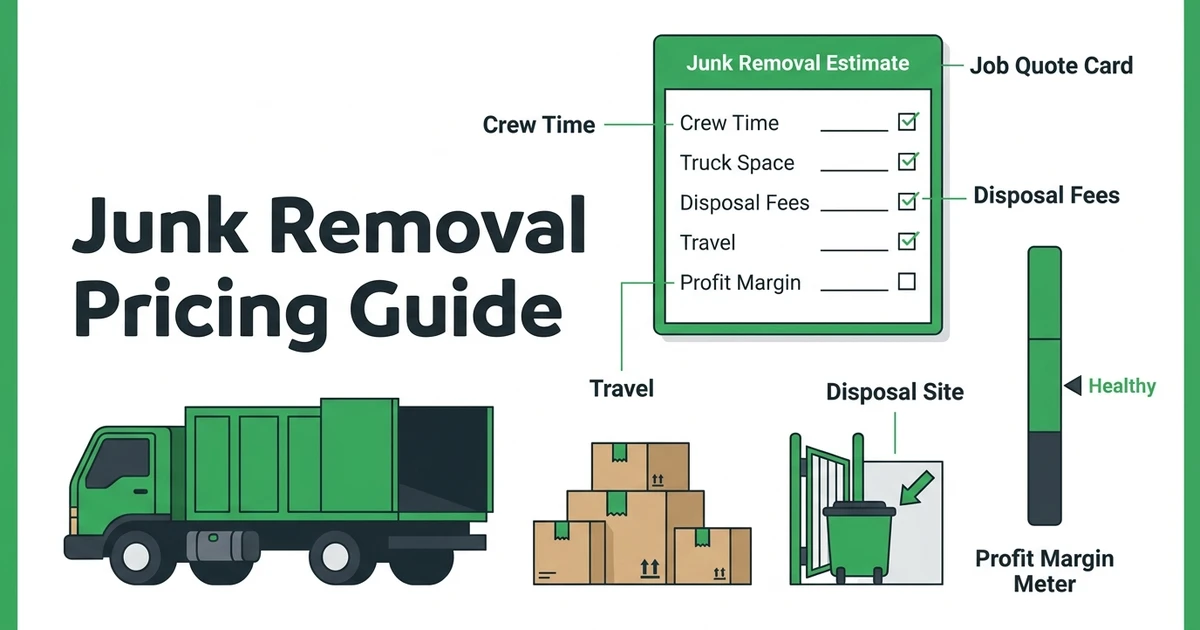





Quick Answer: A junk removal pricing guide should help you quote from real job cost, not gut feel. Start with crew time, truck volume, disposal fees, drive time, overhead, and target profit, then turn that into a repeatable estimate workflow your office and field crew can both trust.
Junk removal pricing looks simple until the crew gets to the job. A half-truck load can be easy money if it is boxed garage clutter by the curb. The same half-truck load can become a margin problem if it is a third-floor apartment, tight parking, heavy furniture, and a long wait at the dump.
That is why pricing needs a system. The waste collection market is large and competitive, with IBISWorld reporting 19,980 U.S. Waste Collection Services businesses in 2026 according to its 2026 industry analysis. Small junk removal crews need prices that are fast enough to win jobs and disciplined enough to protect profit.
This junk removal pricing guide is built for owner-operators and small crews that quote from the phone, confirm details by text, send a truck, and need payment before the day gets away from them.
Why junk removal pricing goes wrong when crews quote from memory
Most bad junk removal prices start with one sentence: “That should be about $250.” The number might be right sometimes, but it usually leaves out one or two cost drivers that matter.
The office hears “old couch and boxes.” The crew finds a sleeper sofa, wet cardboard, a narrow stairwell, no elevator, and a customer who wants two extra items added. If your price did not account for time, weight, disposal category, or access, the crew has to choose between arguing on-site or eating the cost.
Memory-based pricing also creates customer confusion. One person quotes $275 for a garage cleanup, another quotes $350 for a similar job, and a repeat customer notices the difference. That makes your company look inconsistent, even if both team members were trying to be fair.
Labor is too expensive to guess. BLS reported a median hourly wage of $22.00 for refuse and recyclable material collectors in May 2023 in its occupational wage data. Once you add payroll taxes, insurance, fuel, vehicle wear, marketing, office time, and disposal fees, every underpriced hour matters.
What should a junk removal pricing guide include?
A useful junk removal pricing guide should include the cost inputs your crew sees every day. It should not only list low, medium, and high prices. That might help a customer understand the market, but it does not help you build profitable quotes.
At minimum, include these pricing inputs:
- Truck volume used
- Number of crew members needed
- Estimated load and carry time
- Drive time to the customer and disposal site
- Dump, landfill, transfer station, or recycling fees
- Item-specific charges for appliances, mattresses, tires, or heavy debris
- Access difficulty, including stairs, elevators, distance from truck, and parking
- Minimum job price
- Overhead allocation
- Target profit margin
The point is not to make every quote slow. The point is to create a quick checklist so the person answering the phone does not forget the costs that make or break the job.
A good pricing system also tells your crew when to re-price. If the customer adds items, if the access is harder than described, or if the material type changes, the crew should know how to explain the updated price before loading starts.
Step 1: Calculate your real job cost before quoting
Start with your cost to perform the job. That means labor, vehicle cost, disposal, and admin time. If you skip this step, you can be busy all week and still wonder why cash feels tight on Friday.
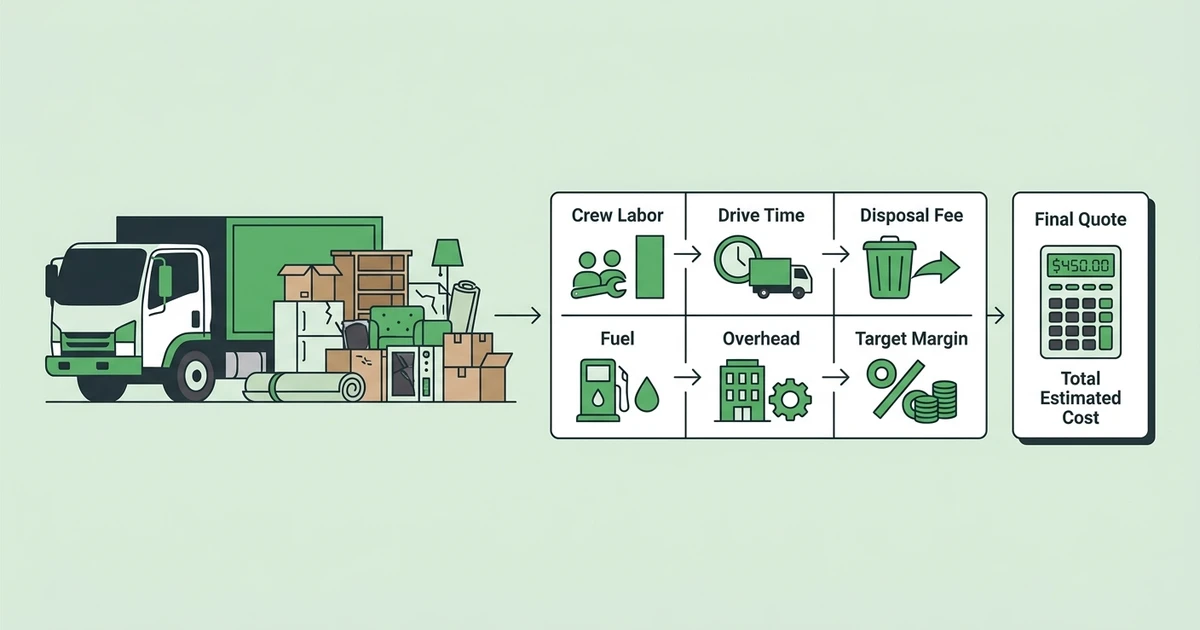
For a small junk removal crew, real job cost often includes:
- Crew labor for the whole appointment, including loading and cleanup
- Travel time from the previous job and to the next job
- Fuel and vehicle wear
- Dump or recycling fees
- Supplies, such as gloves, straps, bags, and protective materials
- Payment processing fees
- Office time for calls, quotes, reminders, and invoicing
- Insurance, licenses, marketing, and other overhead
The easiest method is to create an hourly crew cost. If a two-person crew costs $70 per hour fully loaded and a job takes two and a half hours including travel and dump time, labor is already $175 before disposal fees or margin.
Then add your truck and disposal costs. If disposal is $80 and estimated vehicle cost is $35, your hard cost is $290. If you want a 35% gross margin, the quote needs to be much higher than $290. This is where many crews undercharge.
Step 2: Price by truck volume, item type, and access difficulty
Truck volume is the easiest pricing language for customers. Half truck, quarter truck, full truck, and minimum load are simple to understand, especially when your website or quote includes photos.
But volume alone is not enough. A quarter truck of foam, boxes, and small furniture is different from a quarter truck of construction debris. Weight, handling risk, disposal category, and load time change the economics.
Use truck volume as the base, then adjust for:
- Heavy items, including pianos, safes, dense wood, tile, and concrete
- Appliances that require special handling
- Mattresses or upholstered items with disposal surcharges
- Yard waste or mixed debris that needs sorting
- Stairs, long carries, elevators, or tight hallways
- Jobs where parking is far from the removal area
- Same-day or after-hours requests
This is also where minimum pricing protects you. A single-item pickup across town still uses call time, scheduling time, drive time, payment processing, and vehicle cost. If your minimum is too low, small jobs can fill the calendar while better jobs wait.
Write these rules into the estimate process so every team member quotes the same way. Your pricing guide should make the job easy to explain, not just easy to calculate.
Step 3: Add disposal fees, recycling costs, and nonbillable drive time
Disposal fees are one of the fastest ways to lose margin. They vary by location, material type, weight, and facility. Some loads go to a landfill. Some need recycling. Some require separate drop-offs.
Your quote should account for the actual disposal path. If a crew has to unload in two places, the second stop is not free. It is crew time, fuel, and schedule capacity that cannot be used for another paid job.
Nonbillable drive time also deserves attention. Junk removal routes can look efficient on a map until the crew goes from a suburban pickup to a downtown apartment and then to a transfer station in the opposite direction.
Build drive time into the quote or route plan. A job that looks like 60 minutes of loading may still consume three hours of calendar time. When your pricing only accounts for the loading window, the schedule fills up without producing enough revenue.
This is where junk removal business software helps. When estimates, dispatch notes, customer history, and invoices live together, the office can see whether certain job types or neighborhoods are consistently harder than expected.
Step 4: Build a repeatable junk removal estimate workflow
A repeatable estimate workflow keeps pricing consistent when calls come in fast. The goal is to collect the same details every time, then let the quote reflect the job instead of the mood of the person answering the phone.
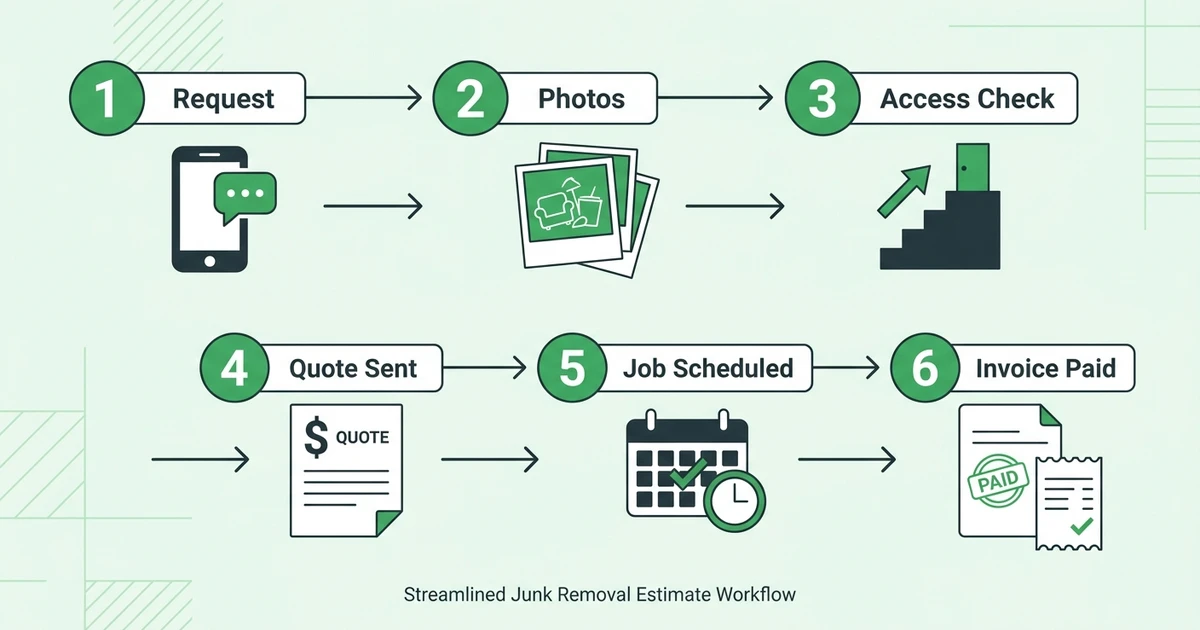
Use this simple intake flow:
- Ask what needs to be removed.
- Ask for photos or a short video.
- Confirm the location of the items.
- Ask about stairs, elevators, parking, and distance to the truck.
- Identify special disposal items.
- Estimate truck volume and crew time.
- Add disposal and access adjustments.
- Send a written quote with clear terms.
Photos are especially useful. They reduce surprises and give the crew confidence before arrival. They also create a record if the customer adds items later.
Written quotes matter just as much. A verbal price can become a dispute if the customer remembers a different number. With quote management tools, the quote can show the scope, price, approval status, and any notes the crew needs on-site.
Fieldified helps junk removal crews move from quote to scheduled job without retyping the same details. See how estimates, dispatch notes, and invoices stay connected in one workflow by booking a Fieldified demo.
Example junk removal quote calculation for a small crew
Here is a simple example. A customer wants garage junk removed: boxes, broken shelving, a small couch, and old household items. They send photos. You estimate a half-truck load with easy driveway access.
Your cost estimate might look like this:
| Cost item | Estimate | Notes |
|---|---|---|
| Crew labor | $175 | Two-person crew, 2.5 hours fully loaded |
| Vehicle and fuel | $35 | Route, truck wear, local travel |
| Disposal fee | $85 | Mixed household load |
| Supplies and processing | $15 | Bags, gloves, payment fees |
| Total cost | $310 | Before overhead and profit |
If you quote $375, the job may feel profitable because the customer pays more than the direct cost. But after overhead, marketing, insurance, and office time, the actual margin may be thin.
If your target gross margin is 35%, a better quote might be around $475 to $500. That gives the business room to cover admin and still make money if the job runs slightly long.
The key is not that every half-truck job should be $500. The key is that your team knows why the number is what it is. When a customer asks, you can explain the labor, disposal, access, and volume clearly.
How software helps junk removal businesses quote and invoice faster
Pricing is only one part of the job. The quote still needs to become a scheduled pickup, the crew needs the notes, and the customer needs an invoice. If those steps live in separate tools, details fall through the cracks.
For junk removal teams, software should connect:
- Online requests and phone-call leads
- Customer contact history
- Estimate templates
- Crew scheduling
- Job photos and notes
- Disposal or surcharge notes
- Invoice creation
- Payment reminders
The payoff is speed and consistency. When a customer approves a quote, your office should not rebuild the job from scratch. The same estimate should become a scheduled pickup, then an invoice once the crew marks the job complete.
That is why the estimate-to-invoice workflow matters. If your crew finishes at 2:30 p.m., the invoice should not wait until Friday night. Use invoice jobs faster after pickup workflows so customers can pay while the job is still fresh.
You can also test pricing scenarios with a job estimate calculator before you update your internal rate sheet. It is a simple way to see whether your current prices cover labor, materials, overhead, and profit.
Junk removal pricing mistakes that quietly reduce profit
The most dangerous pricing mistakes do not always look obvious. You can still collect payment, keep the crew busy, and get good reviews while margin leaks from every job.
Watch for these issues:
- Quoting minimum jobs too low
- Ignoring drive time between jobs
- Treating heavy debris like normal household junk
- Forgetting special disposal fees
- Not charging for stairs or long carries
- Letting customers add items without updating the quote
- Sending invoices days after pickup
- Failing to review which job types are most profitable
Another mistake is copying competitor prices without knowing their cost structure. A larger operator may have different dump rates, route density, truck size, payroll cost, or marketing spend. Their price sheet might not work for your crew.
Review your last 20 jobs. Look at quoted price, actual crew time, disposal cost, payment timing, and customer notes. You will quickly see which job types need better questions, better minimums, or better follow-up.
For a deeper workflow view, pair this guide with Fieldified’s article on managing estimates and invoices in one workflow. Pricing improves faster when you can see the quote, job, invoice, and payment together.
Frequently Asked Questions
What should a junk removal pricing guide include?
A junk removal pricing guide should include labor, truck volume, disposal fees, access difficulty, travel time, overhead, and profit margin. It should also define when crews can update a quote because the job changed from the original request.
How do I price junk removal jobs without losing money?
Start with the real cost of the job, then add margin. Include crew time, drive time, dump fees, fuel, payment processing, and office overhead before you check local market rates.
Is truck volume the best way to price junk removal?
Truck volume is usually the clearest base price for customers. You should still adjust for heavy materials, hard access, special disposal items, and extra labor because a quarter truck is not always a quarter truck in cost.
Should I charge extra for stairs or long carries?
Yes. Stairs and long carries increase crew time, injury risk, and schedule pressure. Make those charges clear in your pricing guide so customers understand them before the crew arrives.
Can Fieldified help with junk removal estimates and invoices?
Yes. Fieldified can help a junk removal team create quotes, schedule jobs, track job notes, send invoices, and follow up on payments. That keeps the quote-to-payment process organized as the crew gets busier.
Conclusion
Good junk removal pricing is not about finding one magic number. It is about building a quoting process that accounts for labor, volume, disposal, access, travel, overhead, and profit every time.
When your team prices from the same guide, customers get clearer quotes and your crew avoids awkward on-site surprises. More important, the business can stay busy without quietly undercharging its best working hours.
If you want quotes, scheduling, job notes, invoices, and payment reminders connected from the first call to the final receipt, book a Fieldified demo and see how junk removal crews keep the whole job lifecycle in one place.