





Getting consistent service calls should not feel unpredictable.
Yet many HVAC businesses still depend on referrals, seasonal spikes, or paid ads that stop working the moment budgets pause. When customers search for heating or cooling services, they are ready to book. If your business does not appear at that moment, the opportunity goes to someone else.
That is where HVAC SEO becomes critical. Not as a buzzword, but as a system that helps the right customers find you at the exact time they need service.
This guide explains how HVAC SEO works, why it is different from general marketing, and how it supports long-term growth without adding pressure on daily operations.
Need a better way to manage HVAC jobs?
Fieldified helps HVAC teams manage scheduling, dispatch, customer history, quotes, invoices, payments, and follow-ups from one platform.
What Is HVAC SEO and Why Does It Matter for Service Businesses
HVAC SEO is the process of improving your online visibility so your business appears when people search for heating and cooling services in your service area.
Unlike e-commerce or national brands, HVAC companies serve a specific location. Customers search with intent. They want a technician now, not later. HVAC SEO focuses on helping your business show up in local search results, map listings, and service-based searches that lead directly to calls and bookings.
It connects three core elements:
- How people search for HVAC services
- How Google evaluates local service businesses
- How your website and online presence support trust and action
When these elements work together, your business becomes easier to find, easier to trust, and easier to contact.
Related Read: How to Choose the Right CRM for Your Service Business
How People Actually Search for HVAC Services
Understanding search behaviour is the foundation of effective HVAC marketing.
Most customers do not search for brand names. They search for solutions. Their queries are practical and urgent:
- Furnace repair near me
- AC not cooling
- Heating service in my area
- Emergency HVAC repair
These searches happen on mobile devices. Often during uncomfortable moments. People scan results quickly and choose businesses that look reliable and nearby.
HVAC SEO aligns your online presence with this behavior. It ensures your business appears in the places customers already look, instead of trying to pull attention through ads or promotions.
Why HVAC SEO Is Different From General SEO
General SEO focuses on ranking content for broad topics. HVAC SEO focuses on local intent and service relevance.
Key differences include:
- Location matters more than volume
- Trust signals outweigh clever content
- Conversion matters more than traffic
- Visibility in maps often matters more than rankings
For HVAC companies, ranking number one for a national keyword means little. Ranking in the local map pack and organic listings within your service area makes the difference between steady calls and silence.
How HVAC SEO Supports Long-Term Business Growth
HVAC SEO is not a short campaign. It is a growth foundation.
Over time, it helps:
- Reduce dependence on paid ads
- Smooth seasonal fluctuations
- Build consistent lead flow
- Improve brand recognition locally
Unlike ads, SEO does not stop when budgets pause. It compounds. The longer it is maintained properly, the stronger its impact becomes.
HVAC Local SEO Explained: How Google Decides Who Shows Up
Local SEO is the most important part of HVAC SEO.
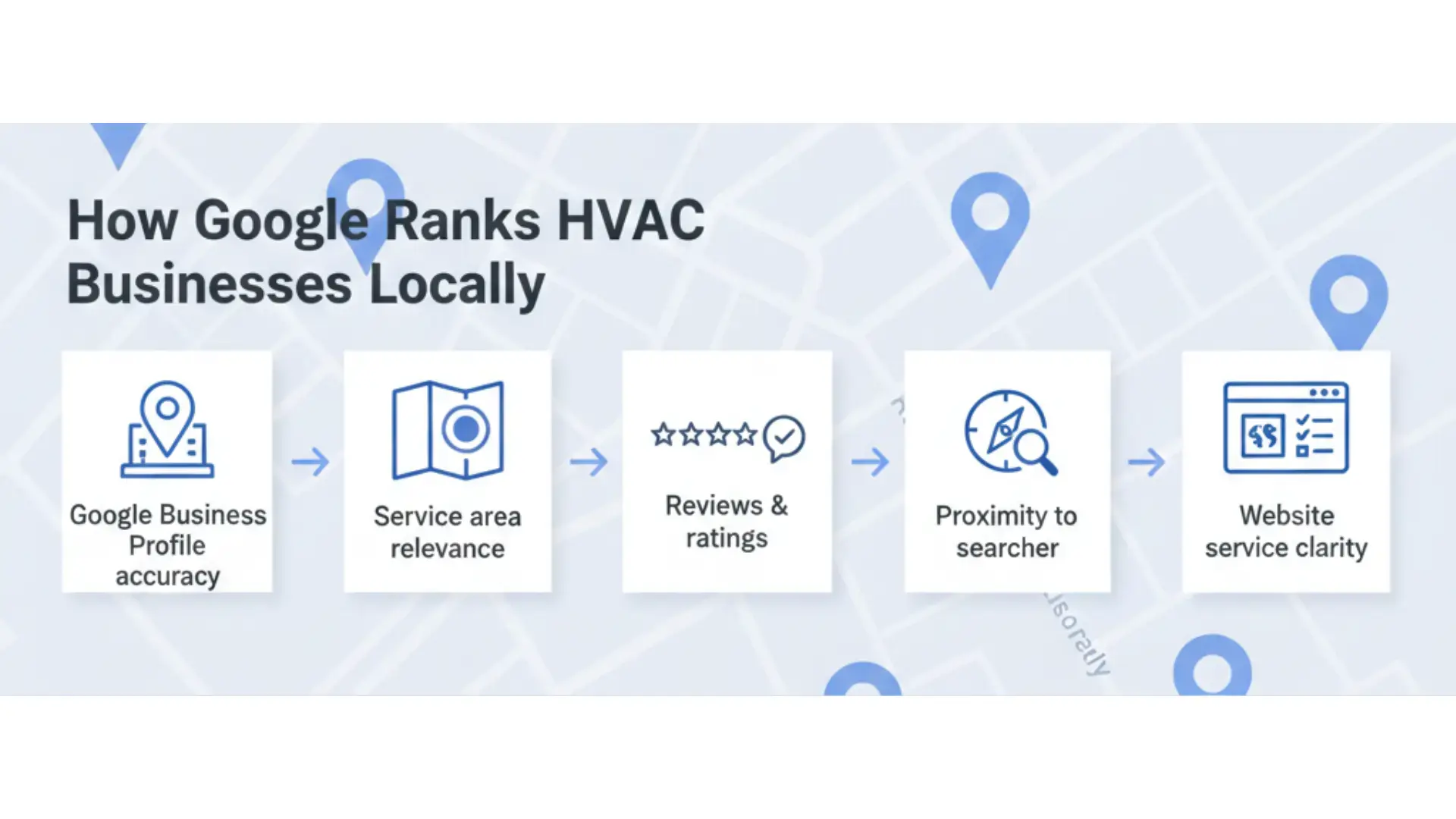
Google uses several signals to decide which HVAC businesses appear in local results. These signals help determine relevance, trust, and proximity.
Google Business Profile for HVAC Companies
Your Google Business Profile is often the first interaction customers have with your business.
It influences:
- Map visibility
- Call clicks
- Direction requests
- Trust perception
Accurate service areas, consistent business information, clear descriptions, and regular updates all help improve visibility. Businesses that treat this as a living asset perform better than those that set it once and forget it.
For practical steps on improving your Google Business Profile, including consistent business details, correct categories, service-area setup, and review management, this local SEO guide for HVAC service businesses breaks down the fundamentals many contractors overlook.
Reviews and Local Trust Signals
Reviews influence both rankings and conversions.
For HVAC companies, reviews signal:
- Reliability
- Timeliness
- Professional behavior
- Problem resolution
Consistent, authentic reviews across platforms help customers choose confidently. They also help search engines understand that your business is active and trusted within the community.
Service Areas vs Physical Locations
Many HVAC businesses operate without a storefront where customers can visit.
Local SEO still works for service-area businesses when service regions are clearly defined and supported by consistent online information. This includes website content, directory listings, and business profiles that all reinforce where you operate.
Related Read: 15 Actionable Tree Service Marketing Tips to Get More Tree Jobs Quickly
HVAC Website SEO: The Foundation Behind Visibility
Your website supports every part of HVAC SEO.
It is not just about rankings. It is about clarity and usability.
A strong HVAC website helps search engines understand:
- What services do you offer
- Where you provide them
- How customers can contact you
It also helps customers feel confident enough to take action.
Service Pages That Match Real Search Intent
Each core service should have its own page.
Clear service pages help:
- Rank for service-specific searches
- Educate customers before calling
- Reduce confusion for dispatch teams
Avoid combining unrelated services on one page. Focus on clarity, not volume.
Location Pages Without Duplication
Location pages help multi-city HVAC businesses rank locally. When done poorly, they create duplicate content issues. When done correctly, they reinforce relevance without repetition.
Each location page should reflect real differences:
- Service availability
- Local conditions
- Community references
Mobile Experience and Page Speed
Most HVAC searches happen on mobile devices.
A slow or confusing site loses leads quickly. Simple navigation, fast loading times, and clear contact options improve both user experience and SEO performance.
Related Read: Why Mobile-First CRMs Are the Future For Contractors
HVAC Content That Builds Authority Without Fluff
Content for HVAC SEO is not about blogging frequently. It is about answering real questions customers ask before calling.
Effective HVAC content includes:
- Service explanations
- Maintenance guidance
- Seasonal preparation tips
- Common problem breakdowns
This content supports visibility and trust without overwhelming readers.
Seasonal Content Planning for HVAC Businesses
Seasonality matters in HVAC marketing.
SEO content should align with:
- Pre-season preparation
- Common seasonal issues
- Maintenance reminders
This approach supports steady visibility throughout the year instead of reacting only during peak demand.
Authority Building for HVAC SEO
Authority helps Google trust your business.
For HVAC companies, authority comes from:
- Industry citations
- Local business listings
- Relevant backlinks
- Community involvement mentions
These signals reinforce that your business is real, active, and connected to its service area.
Educational resources from organisations like Google Business Profile Help provide insights into how local trust and visibility are evaluated.
HVAC SEO vs Paid Ads: Understanding the Difference
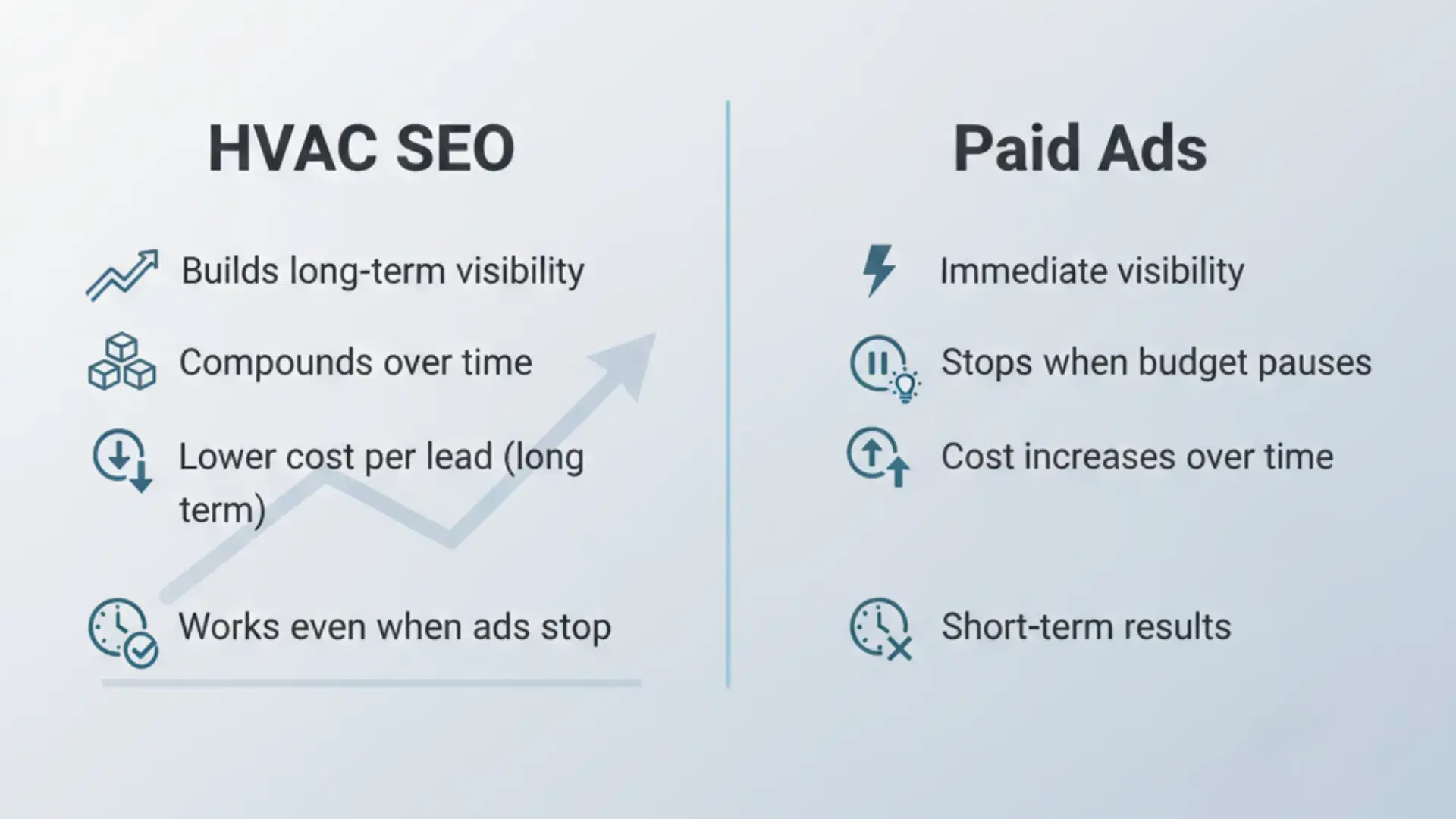
Paid ads deliver immediate visibility. HVAC SEO builds a lasting presence.
Ads work while budgets run. SEO works continuously.
Many HVAC businesses use both, but SEO creates stability. It reduces cost per lead over time and supports growth without constant spend increases.
This HVAC SEO guide highlights how specific elements of Google Business Profile optimisation, including category selection, service descriptions, and media, are key ranking factors for local search visibility.
HVAC SEO Timelines: What to Expect Realistically
SEO takes time.
For HVAC businesses, early improvements often appear within a few months. Strong, consistent results take longer.
Progress depends on:
- Competition in your service area
- Website condition
- Local presence quality
- Content depth
Clear expectations help businesses stay consistent instead of abandoning strategy too early.
How HVAC Website Structure Impacts SEO Performance
SEO is not just about keywords and content. For HVAC businesses, website structure directly affects rankings, crawlability, and lead conversion.
Many HVAC sites grow over time without a clear structure. Pages are added randomly, services overlap, and important locations are buried. This creates confusion for both users and search engines.
A strong HVAC SEO structure includes:
- Clear service hierarchy (Repair, Installation, Maintenance)
- Dedicated pages for major services
- Logical internal linking between related services
- Simple navigation that mirrors how customers think
When search engines can easily understand what your business offers and where you operate, rankings improve naturally. More importantly, visitors find what they need faster, which increases form submissions and calls.
SEO-friendly structure is often invisible to users, but it plays a major role in long-term performance.
The Role of Service Pages in HVAC SEO (Beyond Just Rankings)
Many HVAC websites rely heavily on blog content but neglect their service pages, even though these pages convert the most leads.
Service pages should not be thin descriptions. They are the backbone of HVAC SEO.
Well-optimised service pages:
- Match high-intent search queries
- Clearly explain the problem and solution
- Show local relevance and service coverage
- Build trust before the first call
For HVAC SEO, each core service deserves its own page:
- AC repair
- Furnace installation
- Heat pump services
- Emergency HVAC services
Search engines rank pages based on clarity and relevance. When service pages are detailed, location-aware, and easy to understand, they outperform generic “all services” pages.
This section strengthens both SEO and lead quality.
How Google’s E-E-A-T Principles Apply to HVAC SEO
HVAC SEO is evaluated differently from generic content niches because it falls under “Your Money or Your Life” (YMYL) considerations. Customers trust HVAC businesses with safety, comfort, and high-value decisions.
Google’s E-E-A-T framework (Experience, Expertise, Authoritativeness, Trustworthiness) plays a strong role here.
For HVAC businesses, E-E-A-T shows up through:
- Clear proof of real-world service experience
- Transparent business information
- Consistent branding and ownership details
- Content that reflects practical, hands-on knowledge
HVAC SEO improves when search engines can clearly see that the business is legitimate, experienced, and accountable. This goes beyond keywords and directly influences long-term visibility, especially in competitive markets.
Why HVAC SEO Content Must Reflect Real Service Scenarios
Many HVAC websites fail because their content sounds theoretical instead of practical.
Customers don’t search like marketers. They search based on real breakdowns, discomfort, and urgency.
Content performs better when it reflects:
- Common failure scenarios
- What customers notice before calling
- What happens during a service visit
- What customers should realistically expect
Search engines increasingly reward content that mirrors real situations. HVAC SEO improves when pages feel grounded in actual service experience rather than generic explanations.
This realism builds trust before a phone call ever happens.
The Impact of Online Citations on HVAC Local SEO
Citations are mentions of your HVAC business name, address, and phone number across the web.
They do not drive traffic directly, but they:
- Reinforce business legitimacy
- Support map pack visibility
- Reduce confusion across platforms
For HVAC SEO, consistency matters more than volume.
An effective citation strategy focuses on:
- Accuracy across all listings
- Industry-relevant directories
- Local business platforms customers actually use
When citations conflict, rankings become unstable. When they align, local visibility strengthens quietly over time.
Why HVAC SEO Needs Ongoing Content Refreshing
SEO content does not expire, but it loses relevance if left untouched.
HVAC SEO benefits from regular content refreshes because:
- Search behaviour changes
- Service offerings evolve
- Competitors update their pages
Refreshing content does not mean rewriting everything. Small updates like:
- Adding recent examples
- Updating service details
- Improving clarity
Help maintain rankings without starting from scratch.
This keeps long-form guides like this one competitive year after year.
How HVAC SEO Supports Better Lead Qualification
Not every lead is a good lead.
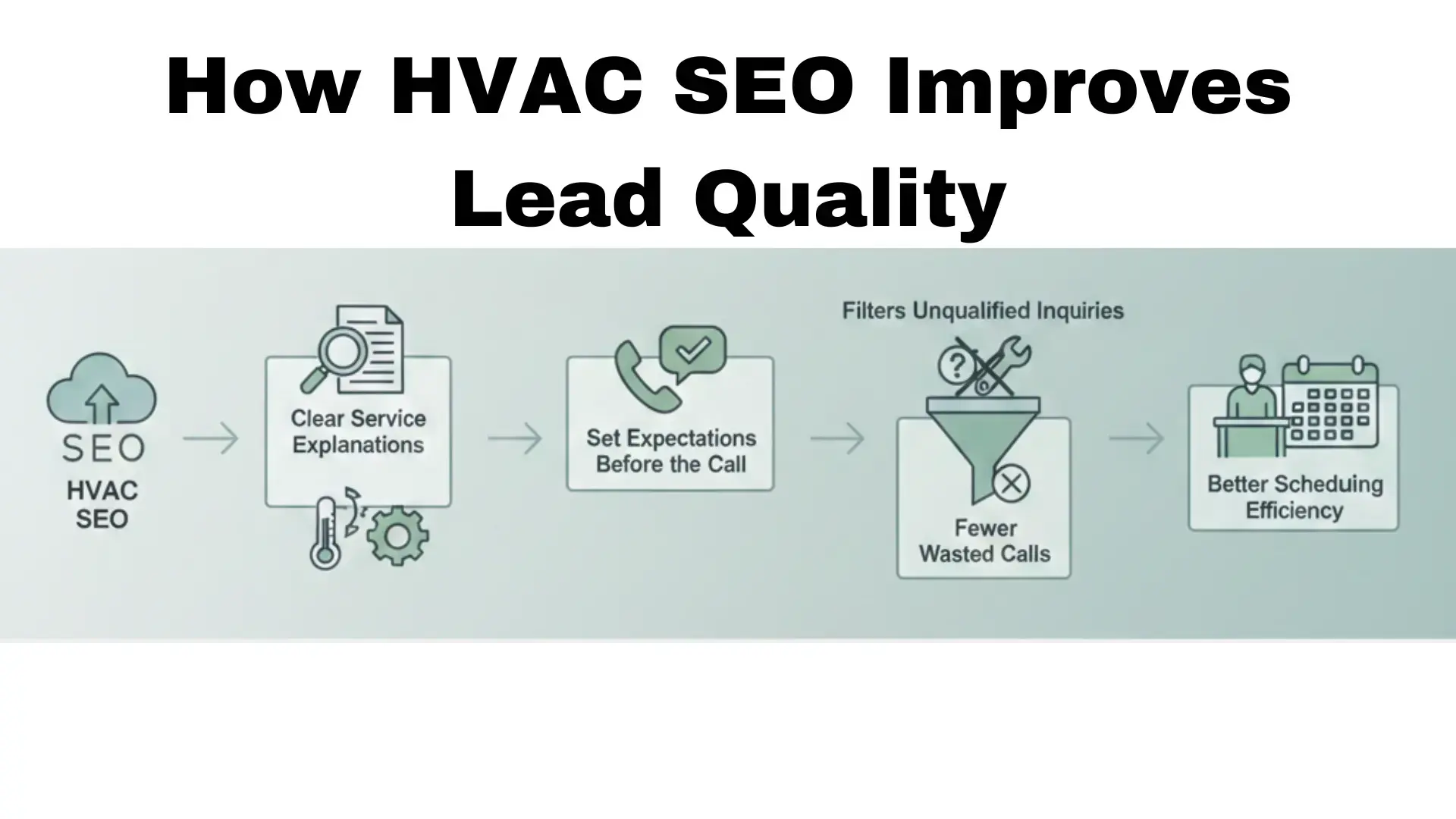
HVAC SEO improves lead quality by:
- Educating customers before they call
- Setting clear expectations
- Filtering out mismatched requests
When content explains service scope clearly, customers self-qualify. This reduces:
- Price shoppers with unrealistic expectations
- Requests outside service areas
- Jobs that don’t align with capacity
Better SEO content leads to fewer wasted calls and more productive dispatching.
The Relationship Between HVAC SEO and Online Reputation Management
SEO and reputation management are deeply connected.
Strong HVAC SEO brings visibility. Visibility brings scrutiny.
Businesses with:
- Clear processes
- Responsive communication
- Consistent follow-ups
Convert visibility into trust.
Negative experiences, even when rare, influence:
- Review sentiment
- Click-through rates
- Local rankings over time
HVAC SEO works best when reputation management is treated as part of daily operations, not a marketing afterthought.
How HVAC SEO Helps Reduce Customer Acquisition Cost Over Time
Customer acquisition cost quietly increases when businesses rely only on ads.
HVAC SEO changes this dynamic.
As organic visibility improves:
- Fewer paid clicks are required
- Brand familiarity increases
- Conversion rates improve
SEO becomes a cost-stabilising channel rather than a cost centre. This long-term financial impact is rarely discussed, but it matters for sustainable growth.
Why HVAC SEO Must Be Aligned With Service Availability
SEO can create demand faster than operations can handle.
When SEO is not aligned with:
- Crew availability
- Service priorities
- Coverage limits
It creates stress instead of growth.
Successful HVAC SEO reflects:
- Realistic response times
- Actual service capacity
- Clear service boundaries
This alignment ensures that increased visibility improves customer experience rather than overwhelming teams.
How HVAC SEO Builds Brand Recognition Before Emergencies Happen
Emergency searches feel sudden, but decisions are often influenced by prior exposure.
HVAC SEO supports brand familiarity through:
- Informational searches
- Seasonal content
- Repeated local visibility
When a system fails, customers are more likely to call a name they’ve already seen.
SEO builds trust before urgency, which improves close rates during emergencies.
HVAC SEO as a Risk Reduction Strategy
SEO is often viewed only as a growth tool.
It is also a risk-reduction mechanism.
By diversifying lead sources, HVAC SEO:
- Reduces dependency on single channels
- Protects against ad cost volatility
- Shields against referral slowdowns
This stability becomes increasingly valuable as businesses scale.
Why Long-Form HVAC SEO Content Outperforms Short Pages
Short pages can rank. Long-form pages dominate.
Comprehensive HVAC SEO content:
- Covers multiple intent layers
- Reduces bounce rates
- Earns more internal linking opportunities
Search engines reward pages that act as complete resources, not fragments.
This supports your decision to build a truly long, authoritative guide.
HVAC SEO and Internal Team Alignment
SEO success improves when teams are aligned.
When office staff, technicians, and management:
- Understand what customers see online
- Know which services are promoted
- Align messaging with operations
Customer experience becomes consistent from search to service.
This internal alignment strengthens SEO indirectly through better reviews, engagement, and retention.
HVAC SEO as a Foundation for Future Marketing Channels
SEO strengthens every future channel.
Once HVAC SEO is established:
- Email marketing performs better
- Retargeting costs decrease
- Brand campaigns convert faster
SEO becomes the base layer that improves overall marketing efficiency.
How User Experience Signals Influence HVAC SEO Rankings
Google increasingly measures how users interact with HVAC websites.
Even strong keyword targeting can fail if users:
- Leave quickly
- Struggle to find information
- Can’t navigate easily on mobile
Key UX factors that influence HVAC SEO include:
- Mobile responsiveness
- Page load speed
- Clear calls to action
- Readable layouts with short paragraphs
HVAC customers are often stressed or time-sensitive. If a site feels confusing or slow, they leave—even if it ranks well.
Good user experience supports SEO indirectly by improving:
- Time on page
- Engagement signals
- Conversion rates
SEO works best when content and usability support each other.
Why HVAC SEO Requires Separate Strategies for Residential and Commercial Services
Many HVAC businesses serve both residential and commercial clients but treat SEO as a single strategy. This limits growth.
Residential HVAC SEO focuses on:
- Emergency intent
- Local proximity
- Immediate problem-solving
Commercial HVAC SEO focuses on:
- Long-term service contracts
- Compliance and scale
- Decision-makers researching options
Search behaviour differs significantly between these audiences. A single page trying to target both usually ranks poorly for both.
Separating content and service pages by audience:
- Improves keyword relevance
- Clarifies messaging
- Increases lead quality
This distinction is often missed by competitors, making it a strong differentiator.
How Seasonal Search Trends Affect HVAC SEO Planning
HVAC demand changes throughout the year, and SEO should reflect that reality.
Search volume spikes:
- AC repair in summer
- Heating services in winter
- Maintenance before seasonal transitions
HVAC SEO performs best when content and optimization are planned ahead of peak seasons, not during them.
Smart seasonal SEO planning includes:
- Updating service pages before demand rises
- Publishing seasonal guides early
- Refreshing Google Business Profile posts regularly
This approach allows pages to gain traction before competition intensifies, resulting in stronger visibility during peak demand.
The Importance of Content Depth in Competitive HVAC Markets
In competitive cities, surface-level HVAC content is rarely enough.
Search engines favour pages that:
- Fully answer the user’s question
- Provide context and clarity
- Demonstrate experience and relevance
Depth does not mean length alone. It means covering:
- Common customer concerns
- Service expectations
- Process clarity
- Local considerations
When content reflects real HVAC operations instead of generic advice, it stands out naturally.
This section reinforces why your long-form guide matters.
How HVAC SEO Supports Long-Term Business Stability
One of the most overlooked benefits of HVAC SEO is predictability.
Paid ads stop the moment budgets pause. Referrals fluctuate. SEO compounds.
Over time, HVAC SEO:
- Reduces reliance on emergency marketing
- Creates consistent inbound demand
- Supports sustainable growth
This stability allows businesses to plan staffing, equipment, and expansion with more confidence.
SEO becomes less about rankings and more about operational reliability.
Measuring HVAC SEO Performance the Right Way
Rankings alone do not matter.
Effective HVAC SEO measurement focuses on:
- Calls generated
- Form submissions
- Map visibility
- Service area reach
Tracking meaningful actions helps connect SEO efforts to real business outcomes.
How HVAC SEO Supports Operations, Not Just Marketing
Strong SEO reduces pressure on dispatch and scheduling teams.
When lead flow becomes predictable:
- Crews are scheduled more efficiently
- Office staff react less and plan more
- Growth becomes manageable
Systems that support scheduling and operations, like those offered by Fieldified, align naturally with this stage of growth by bringing structure to daily workflows without adding complexity.
Keep your HVAC office and technicians on the same page.
Use Fieldified to schedule jobs, manage service calls, send invoices, and track customer communication.
How HVAC SEO Aligns With the Customer Decision Journey
Most HVAC marketing fails because it focuses only on the moment of purchase.
In reality, customers move through several decision stages before calling a contractor. HVAC SEO works best when it supports each stage, not just emergency searches.
Early-stage searches often look like:
- “How often should HVAC systems be serviced?”
- “Why is my AC running but not cooling?”
Mid-stage searches become more service-oriented:
- “AC maintenance cost”
- “Signs furnace needs repair”
Late-stage searches show high intent:
- “HVAC repair near me”
- “Emergency heating service”
A strong HVAC SEO strategy ensures your business appears across all three stages. This builds familiarity before urgency hits. When a breakdown happens, customers are more likely to choose a name they already recognise.
This journey-based approach reduces reliance on last-minute ads and improves conversion quality over time.
The Role of Service Area Precision in HVAC SEO
Many HVAC businesses unintentionally weaken their SEO by being too broad about where they operate.
Google evaluates service area precision, not just location mentions. Clear boundaries help search engines understand relevance.
Effective service area optimisation includes:
- Defining realistic coverage zones instead of entire states
- Aligning website content with actual dispatch reach
- Matching Google Business Profile service areas with on-ground operations
When service areas are vague, rankings become inconsistent. When they are precise, visibility improves in the exact locations where crews can actually respond.
This alignment also reduces wasted leads from areas you cannot serve efficiently.
Why HVAC SEO Needs Operational Consistency to Succeed
SEO does not operate in isolation. It reflects how the business functions.
When online promises do not match real-world execution, SEO performance suffers indirectly through:
- Poor reviews
- Missed appointments
- Negative engagement signals
Operational consistency supports HVAC SEO by ensuring:
- Accurate arrival windows
- Reliable follow-ups
- Clear communication
As lead volume grows through SEO, businesses without structured scheduling and dispatch often struggle to keep up. This is where operational platforms like Fieldified naturally support marketing growth by bringing clarity to daily execution without adding manual work.
SEO attracts demand. Operations must sustain it.
HVAC SEO for Multi-City and Multi-Branch Businesses
Scaling HVAC SEO across multiple cities requires a different mindset than single-location optimisation.
Each city functions as its own market with:
- Different competitors
- Different seasonal patterns
- Different service demand profiles
Successful multi-city HVAC SEO focuses on:
- City-specific service pages with genuine differentiation
- Localised trust signals such as reviews and citations
- Consistent branding with local relevance
Avoid copying content across cities. Instead, reflect on how services are delivered differently in each area. This improves both rankings and lead quality.
How HVAC SEO Supports Hiring and Workforce Stability
This is an often-missed advantage of HVAC SEO.
When inbound demand becomes predictable, workforce planning improves.
Consistent lead flow allows businesses to:
- Plan crew expansion instead of reacting to spikes
- Reduce burnout during peak seasons
- Offer more stable schedules
SEO indirectly supports hiring by reducing chaos. Teams work better when schedules are balanced, and demand is steady rather than unpredictable.
This long-term stability is rarely discussed in HVAC marketing conversations, but it directly impacts retention and growth.
Understanding Search Visibility Beyond Rankings
HVAC SEO success is not just about being “number one.”
Search visibility includes:
- Map pack presence
- Featured snippets
- Local service mentions
- Brand recognition across multiple searches
Many HVAC businesses rank well but still underperform because visibility is fragmented. A comprehensive SEO approach ensures customers encounter your business repeatedly during their search process, not just once.
Repeated exposure builds trust before contact happens.
HVAC SEO and Emergency Service Visibility
Emergency HVAC searches behave differently from regular service searches.
They are:
- Highly urgent
- Often mobile-based
- Short decision cycles
SEO for emergency services requires:
- Clear emergency service signals
- Fast-loading pages
- Immediate contact options
This section can expand the blog’s practical value by showing how SEO supports urgent scenarios without resorting to aggressive sales language.
How HVAC SEO Reduces Marketing Dependency Over Time
Many HVAC businesses remain trapped in a cycle of increasing ad spend.
SEO breaks this cycle gradually.
As organic visibility strengthens:
- Cost per lead decreases
- Marketing becomes more predictable
- Budget pressure reduces during off-seasons
SEO does not eliminate paid marketing, but it reduces dependency. This balance is critical for sustainable growth, especially for service businesses with fluctuating demand.
HVAC SEO as a Competitive Defence Strategy
SEO is not only about growth. It is also about protection.
When your business owns local search visibility:
- Competitors find it harder to displace you
- New entrants face higher barriers
- Brand authority strengthens over time
This defensive value becomes more important as markets become crowded. HVAC SEO helps businesses maintain position, not just chase new leads.
How Internal Linking Strengthens HVAC SEO Authority
Internal linking is one of the most underused HVAC SEO tools.
Many sites rely on navigation menus alone, missing opportunities to guide both users and search engines.
Strategic internal links:
- Reinforce service importance
- Connect related topics naturally
- Help search engines understand page relationships
For HVAC SEO, internal links should connect:
- Blog content → relevant service pages
- Service pages → related maintenance or installation pages
- Location pages → city-specific services
This creates a clear content hierarchy without adding more pages.
Strong internal linking improves crawlability, distributes authority, and keeps users engaged longer, all of which support better rankings.
Why HVAC SEO Must Account for Customer Stress and Decision Fatigue
HVAC searches often happen under discomfort or pressure.
People searching for heating or cooling services are usually:
- Uncomfortable
- Time-constrained
- Emotionally stressed
SEO content that ignores this reality underperforms.
Effective HVAC SEO considers:
- Simple language
- Short explanations
- Clear next steps
- Reassuring tone without exaggeration
When content reduces cognitive load, users stay longer and act faster. This improves engagement signals, which indirectly support SEO performance.
This human-centred approach is rarely discussed but has a measurable impact on conversions.
How HVAC SEO Benefits From Clear Pricing Expectations (Without Publishing Prices)
Many HVAC businesses avoid discussing pricing entirely.
This creates uncertainty and distrust.
HVAC SEO does not require publishing exact prices, but it benefits from setting expectations.
Content that explains:
- What influences cost
- Why pricing varies
- What customers are paying for
Helps users feel informed rather than misled.
Search engines favour content that reduces ambiguity. Customers favour businesses that explain processes transparently. This alignment strengthens both SEO and lead quality.
The Role of Schema Markup in HVAC SEO Visibility
Schema markup helps search engines understand your business more clearly.
While it does not directly improve rankings, it enhances how HVAC businesses appear in search results.
Relevant schema types include:
- Local business schema
- Service schema
- Review and rating schema
- FAQ schema
For HVAC SEO, schema can:
- Improve rich result eligibility
- Clarify service offerings
- Reinforce location relevance
Most competitors ignore this entirely, making it a quiet but effective differentiator when implemented correctly.
How HVAC SEO Supports Expansion Without Rebranding
As HVAC businesses grow, they often worry about losing local identity.
SEO helps maintain consistency while expanding.
With proper structure, HVAC SEO allows:
- New service areas to gain visibility gradually
- Existing locations to retain authority
- Branding to stay unified without dilution
This avoids the need for constant rebranding while supporting controlled expansion.
Why HVAC SEO Should Be Audited Before Scaling Marketing Spend
Many businesses increase ad budgets before evaluating SEO foundations.
This often amplifies inefficiencies.
An HVAC SEO audit reveals:
- Weak service pages
- Local visibility gaps
- Conversion blockers
- Technical issues affecting performance
Fixing these first ensures that future marketing spend works harder instead of compensating for foundational problems.
SEO becomes the stabilising layer that supports scale, not a patch for underperforming campaigns.
HVAC SEO as a Customer Education System
SEO is often treated as traffic acquisition.
In reality, HVAC SEO functions as an education system.
Well-structured content:
- Prepares customers for service visits
- Reduces repetitive questions
- Aligns expectations before contact
This leads to smoother interactions and higher satisfaction.
Search engines reward this clarity because it improves user outcomes. Businesses benefit because fewer misunderstandings occur after the call.
The Long-Term Compounding Effect of HVAC SEO
Unlike campaigns, SEO compounds.
Each improvement builds on the last:
- Content strengthens authority
- Reviews reinforce trust
- Local signals improve relevance
Over time, SEO requires less effort to maintain results compared to starting from scratch repeatedly with ads or promotions.
This compounding effect is why HVAC SEO should be viewed as infrastructure, not a marketing experiment.
Common HVAC SEO Mistakes to Avoid
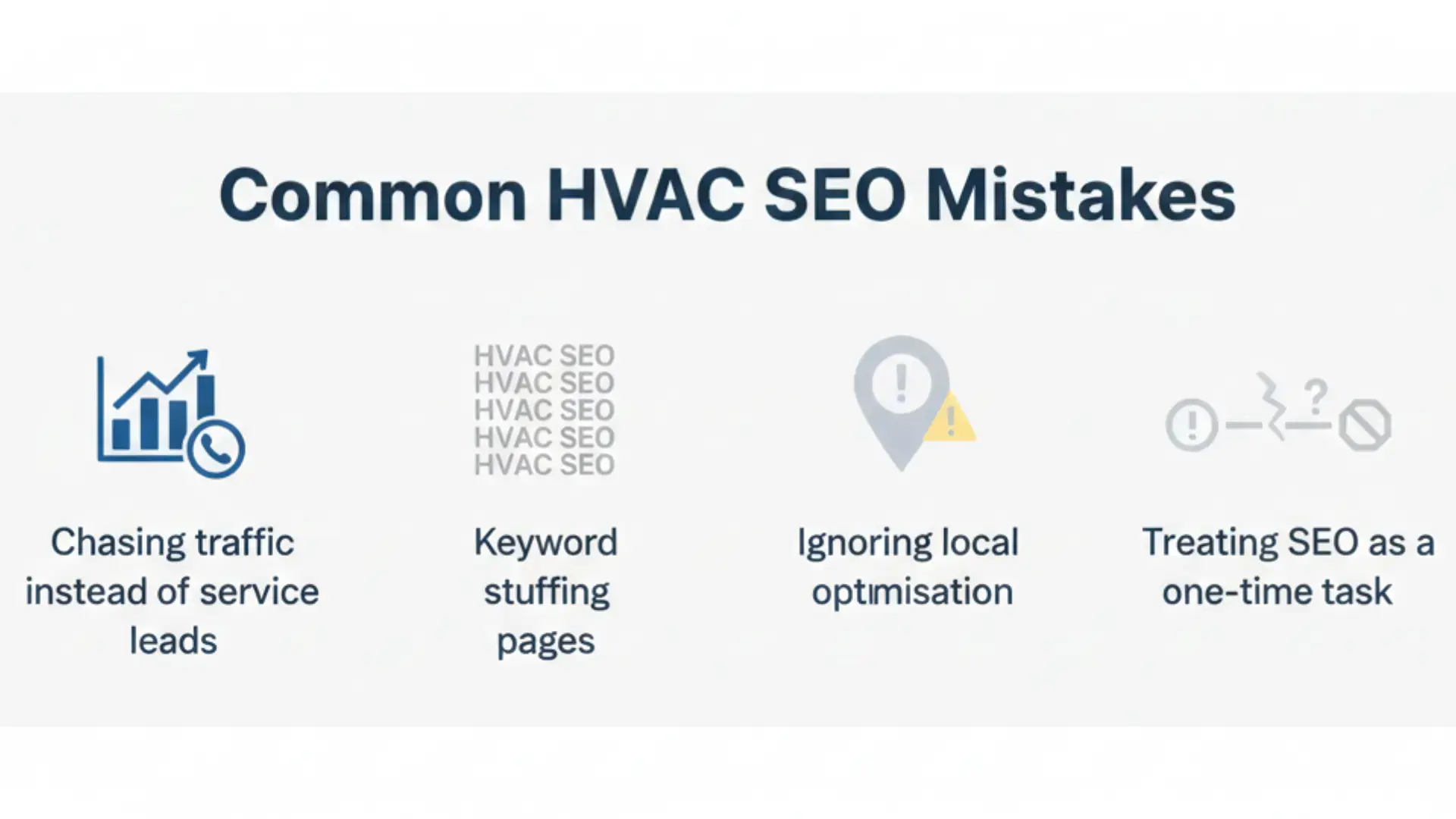
Many HVAC businesses struggle with SEO, not because the strategy is wrong, but because small, avoidable mistakes quietly undermine results over time.
Chasing traffic instead of real service leads
High traffic numbers can look impressive, but traffic alone does not grow an HVAC business. Many websites attract visitors searching for DIY fixes, equipment specs, or general information with no intent to hire a contractor.
Effective HVAC SEO prioritises:
- Local service intent
- Repair and installation searches
- Location-specific demand
When content is aligned with real customer needs, even lower traffic volumes can produce better leads and higher conversion rates.
Overloading pages with keywords
Trying to force keywords into every sentence often makes content harder to read and less trustworthy. Search engines now prioritise clarity and usefulness over repetition.
Keyword-heavy pages:
- Sound unnatural
- Confuse readers
- Reduce engagement
Strong HVAC SEO uses keywords naturally, focusing on answering real questions instead of repeating phrases. Clear explanations consistently outperform keyword-stuffed pages.
Ignoring local optimisation
HVAC services are location-based by nature, yet many businesses overlook local SEO fundamentals.
Common gaps include:
- Incomplete or outdated Google Business Profiles
- Missing service-area clarity
- Weak local signals on service pages
Without strong local optimisation, even well-written content struggles to rank where it matters most. Local visibility is what turns SEO effort into booked jobs.
Treating SEO as a one-time task
SEO is not something that can be set up once and forgotten. Search behaviour, competitors, and service demand change over time.
When SEO is treated as a checklist item:
- Rankings fluctuate
- Content becomes outdated
- Growth stalls
Consistent updates, content refinement, and local maintenance keep HVAC SEO working quietly in the background, supporting steady lead flow rather than short-term spikes.
Avoiding these common mistakes helps HVAC businesses build stable visibility, attract better-qualified leads, and maintain momentum without constantly restarting their SEO efforts.
How HVAC SEO Fits Into a Scalable Growth Strategy
SEO supports growth without burnout.
As businesses expand into new service areas, SEO helps:
- Maintain visibility
- Support new crews
- Keep marketing consistent
It becomes part of the business infrastructure rather than a marketing experiment.
Building Visibility That Lasts
HVAC SEO is not about chasing rankings. It is about creating dependable visibility when customers are actively looking for help. When done right, it replaces guesswork with consistency and turns search demand into predictable opportunities. Over time, it supports smoother operations, better-qualified leads, and steadier growth without constant marketing pressure.
As HVAC businesses mature, visibility and execution need to move in sync. Platforms like Fieldified align naturally with this stage by helping teams stay organised as demand increases. When the time feels right, exploring better systems can make growth easier to manage.
Ready to simplify HVAC scheduling, CRM, and invoicing?
Book a demo to see how Fieldified works for HVAC service businesses.
Frequently Asked Questions
What is the difference between local SEO and HVAC SEO?
Local SEO focuses on geographic visibility, while HVAC SEO specifically optimises your HVAC services, trust signals, and service-related keywords so homeowners find and contact you when they need heating or cooling help nearby.
How do online reviews impact HVAC SEO?
Online reviews help improve both rankings and conversions. Google uses review quantity and quality to assess trust, and positive reviews encourage more clicks from local customers searching for HVAC services.
Should HVAC companies use voice search optimisation?
Yes. Customers increasingly use voice assistants for local service queries. Optimising conversational language and FAQs helps your HVAC SEO capture natural voice search traffic more effectively.
How often should HVAC SEO content be updated?
SEO content should be refreshed regularly — ideally quarterly or when service offerings or search trends change — to maintain relevance, reflect new patterns, and stay competitive in local HVAC search results.
Does mobile site performance affect HVAC SEO rankings?
Yes. Google prioritises mobile-first indexing, and since most service searches happen on phones, fast loading, responsive navigation, and click-to-call support both SEO and conversions.
Can HVAC SEO help during off-peak seasons?
Absolutely. SEO content about maintenance, energy savings, and pre-season checks keeps visibility high during slower months, helping smooth out demand throughout the year.
Is schema markup necessary for HVAC SEO?
While not mandatory, schema markup helps search engines better understand your content and services, increasing the chance of enhanced listing formats like rich results and featured snippets.
How do directory listings influence HVAC SEO?
Directory listings act as citations that reinforce your business’s legitimacy and consistency across the web. Consistent NAP info across listings improves local ranking stability.
What is the role of educational content in HVAC SEO?
Useful, problem-solving content (e.g., “why AC isn’t cooling”) builds authority, answers real customer questions, and improves organic visibility while supporting conversions into service calls.
Can HVAC SEO reduce marketing costs over time?
Yes. As organic traffic and local visibility improve, reliance on paid ads often decreases, leading to a lower long-term cost per lead and more sustainable customer acquisition