
 EN
EN DE
DE ES
ES FR
FR NL
NL PT
PT





Quick Answer: HVAC Pricing Guide An HVAC pricing guide helps contractors set consistent, profitable rates by calculating true labor costs, overhead, and target margin before setting job prices. Most HVAC businesses use flat-rate pricing for standard service calls and time-and-material pricing for complex installs, with a minimum service call fee on every dispatch to ensure every job covers its real costs.
Pricing HVAC jobs off gut feel or competitor rates is one of the fastest ways to stay busy while barely making money. You win the job, your tech spends three hours on a condenser repair, and by the time you add up parts, drive time, and the diagnostic tool you used, the margin is gone.
This HVAC pricing guide walks you through how to calculate a real labor rate, when to use flat rate versus time and material, and how to price the most common service calls and installs. Every approach here is built on your actual costs, not what the contractor down the road happens to charge.
Why HVAC Pricing Is Harder to Get Right Than Most Trades
HVAC work comes with variables that other trades do not face at the same scale. Seasonal demand swings dramatically, material costs shift, and diagnostic time on complex systems can eat hours before any billable repair work begins.
During a summer heat wave, your schedule fills within hours. During a mild spring, calls slow to a trickle. If your rates are built for busy season, you may undercharge when margins are tightest. If they are built for slow months, you leave money on the table during peak demand.
Refrigerant costs have also shifted significantly over the past few years as the industry transitions away from R-410A toward newer refrigerants. Parts sourced in January may cost 20 to 30 percent more by August depending on supply and regional availability. A pricing system built on last year’s supplier costs will not survive this year’s job list.
Diagnostic time is another hidden cost. An experienced tech may spend an hour isolating a failing capacitor on an older unit before the repair even starts. That hour is real labor, and it rarely gets billed correctly when pricing is handled informally.
The Three Main HVAC Pricing Methods (and When to Use Each)
| Method | Best For | Key Risk |
|---|---|---|
| Flat Rate | Common repairs, tune-ups, standard service calls | Underpricing jobs that run longer than expected |
| Time and Material (T&M) | Complex installs, diagnostic-heavy work | Unpredictable final invoice for the customer |
| Tiered (Good/Better/Best) | Equipment replacements, full system installs | Requires more quoting time upfront |
Most profitable HVAC contractors use a combination. Flat rate covers the 80 percent of calls you do repeatedly, where you know the scope cold. Time and material handles complex installs or older-system work where estimating hours accurately is genuinely difficult.
For equipment replacements, tiered quoting gives customers a choice and raises your average job value. Offer a base-efficiency replacement at one price, a mid-efficiency option with a rebate, and a high-efficiency install at a premium. Customers who decide on price take the base option. Those who care about long-term savings often step up.
Whichever method you use, professional quote management for HVAC contractors keeps the numbers organized and gets the customer to a decision faster than emailing a PDF and waiting three days.
How to Calculate Your HVAC Labor Rate
Your labor rate is the hourly figure you need to bill to cover technician costs, overhead, and your profit margin. Here is how to build it:
- Start with the technician’s base hourly wage. According to Indeed’s salary data, HVAC technicians earn an average of $30.09 per hour in the US, based on 58,000 salary reports updated April 2026. Your actual rate varies by experience, certification, and market.
- Apply a burden multiplier. Payroll taxes, workers’ comp, health insurance, and benefits typically add 25 to 35 percent to the base wage. At $30.09 per hour, the burdened cost comes out to roughly $37.60 to $40.60 per hour.
- Calculate overhead per billable hour. Add all fixed overhead: vehicle costs, insurance, tools and equipment, software, office costs, and marketing. Divide the annual total by your estimated billable hours for the year. A two-tech operation with $80,000 in annual overhead and 2,400 billable hours adds $33.33 in overhead per hour.
- Add your target net profit margin. HVAC contractors typically target 10 to 20 percent net profit. At 15 percent, multiply your total cost per hour by approximately 1.18 to get your floor rate.
- Your floor rate is your minimum, not your market rate. Demand, specialization, and local competition all allow you to price above this floor. The calculation shows you where you cannot go below without losing money.
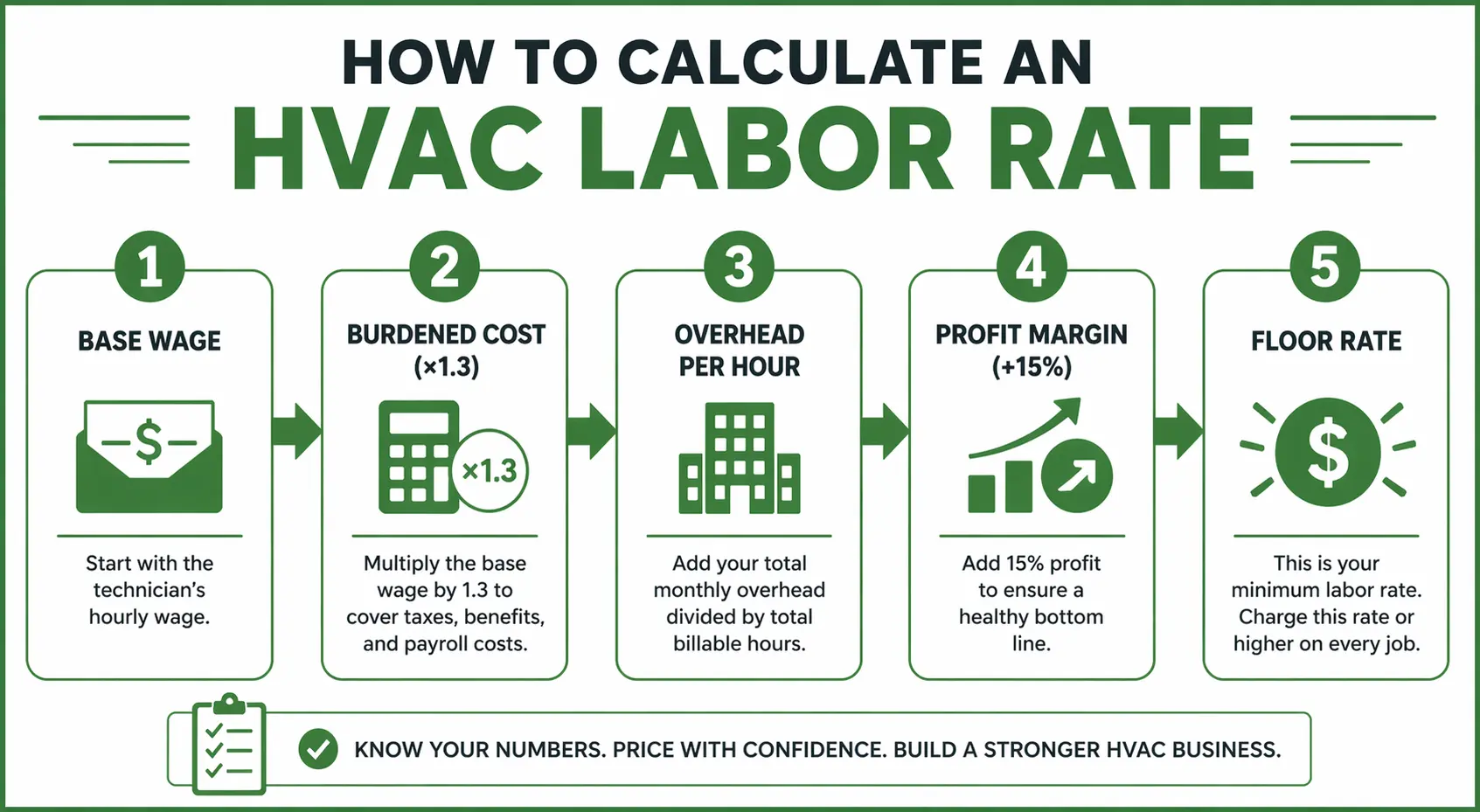
Running this with real numbers takes a few minutes. Use the Labor Rate Calculator to calculate your specific floor rate without building a spreadsheet from scratch.
Want to stop guessing whether your HVAC quotes are profitable? Fieldified helps contractors send professional quotes, track actual job costs, and get paid without the manual follow-up. Request a demo to see how it works for your operation.
HVAC Pricing by Job Type
These ranges reflect typical market rates across the US. They will vary by region, labor market, and parts costs. Use them as a reference point against your calculated floor rate, not as a substitute for it.
| Job Type | Typical Price Range | Notes |
|---|---|---|
| AC tune-up or maintenance visit | $80 to $150 | Flat rate; common upsell opportunity |
| Refrigerant recharge | $150 to $450 | Parts cost plus labor; depends on refrigerant type and quantity |
| Thermostat replacement | $100 to $300 | Smart thermostat installs at the higher end |
| Capacitor replacement | $120 to $250 | Common summer call; typically 30 to 60 minutes |
| Furnace tune-up | $80 to $150 | Flat rate; filter and IAQ upsell opportunity |
| Heat exchanger inspection and repair | $600 to $1,500+ | Labor-intensive; T&M or tiered works best |
| Central AC unit replacement | $3,500 to $8,000+ | Equipment plus install; use tiered quoting |
| Ductwork repair or sealing | $300 to $1,200 | Varies significantly by scope and access |
| Mini-split installation (single zone) | $1,200 to $3,500 | Equipment, line set, and electrical vary widely |
One rule that applies across every row: never quote parts at cost. Sourcing, storing, delivering, and warranting parts all carry real overhead. A standard 25 to 40 percent parts markup is industry-accepted and expected by experienced customers.
Check how your current job margins compare using the Profit Margin Calculator before you adjust your pricing book.
Seasonal Pricing and Demand Surges
Summer emergency calls and winter furnace failures fill schedules fast, stretch technician time, and bring customers who need service today. These are the moments where your pricing system either holds or falls apart.
Two approaches work for managing peak demand. The first is a seasonal rate review: check your flat-rate book twice a year, before cooling season and before heating season, and update rates to reflect current parts costs, labor market changes, and demand levels. This keeps your pricing current without constant manual adjustments.
The second is a priority fee added on top of standard rates for after-hours calls, same-day emergency response, or weekend dispatches. Customers calling at 10 PM in July already know they are paying extra. The bigger mistake is not charging one and burning your techs’ overtime at standard rates during the busiest week of the year.
Maintenance agreements smooth seasonal revenue year-round. An annual plan covering spring and fall tune-ups, priority service, and a repair discount gives customers real value and gives you predictable recurring income. See how HVAC businesses use software to manage scheduling and invoicing across seasonal demand shifts without the manual calendar juggling.
Common HVAC Pricing Mistakes That Cost You Profit
Most HVAC pricing problems come from the same small set of habits. If any of these sound familiar, the fix is in your calculations, not your confidence.
- Not charging for drive time. Your technician’s cost clock starts the moment they leave the shop. Drive time is not free labor.
- Quoting parts at cost. Every part you source carries handling, storage, and warranty overhead. Apply your markup on every job without exception.
- Using last year’s rates. Refrigerant costs and labor market rates shift year over year. Stale pricing means shrinking margins on every job.
- No minimum service call fee. Every dispatch has a real cost regardless of job size. A minimum fee ensures you recover it even when a customer declines.
- Sending invoices on Friday. The longer an invoice sits unsent after a job, the harder it is to collect. Send it the moment the job is marked complete.
- Copying competitor pricing. Their cost structure is not yours. Their overhead, wages, and efficiency levels may be entirely different from your operation.
Frequently Asked Questions
What is a good labor rate for an HVAC contractor?
A good HVAC labor rate covers your technician’s burdened wage, a share of your overhead costs, and your target profit margin. Most HVAC businesses operate profitably with billable labor rates between $85 and $150 per hour depending on market, experience level, and overhead load. Running the calculation with your actual numbers gives you a more accurate floor rate than copying a competitor.
Should I use flat rate or time and material for HVAC pricing?
Most HVAC contractors use flat-rate pricing for standard service calls and common repairs, and time-and-material pricing for complex installs or diagnostic-heavy jobs where scope is uncertain. Flat rate protects your margin when experienced technicians finish faster, and gives customers a clear price upfront. Time and material works better when you genuinely cannot estimate job time in advance.
What should I charge for an HVAC service call?
A typical HVAC service call fee covers dispatch, drive time, and the first 30 to 60 minutes of diagnosis. Market rates range from $75 to $150 for a diagnostic or service call fee. Setting a minimum service call charge ensures you recover your true dispatch cost on every job, even when a customer declines the repair.
How much should HVAC contractors mark up parts?
Most HVAC contractors apply a 25 to 50 percent markup on parts, depending on part cost and regional market. Lower-cost parts often carry a higher percentage markup because the handling and warranty overhead is proportionally larger. Never sell parts at cost because every part you source, store, and warranty has real overhead attached to it.
How do I price HVAC maintenance agreements?
HVAC maintenance agreements are typically priced as a flat annual fee or monthly payment covering one or two tune-ups per year, priority service, and a discount on repairs. Common pricing runs from $150 to $400 per year for residential systems. Calculate the actual cost of the included visits and add a margin rather than pricing by what feels competitive.
What is the average HVAC technician wage in the US?
According to Indeed, HVAC technicians earn an average of $30.09 per hour in the United States. When calculating your labor rate, use the burdened wage, which adds payroll taxes, workers’ comp, and benefits, typically 25 to 35 percent above the base hourly rate.
Build Your Pricing System and Start Knowing Your Numbers
Consistent pricing is not about charging more than your competition. It is about knowing your actual costs so you can stop guessing and start making deliberate decisions on every job.
When you have a calculated labor rate, a flat-rate book for your most common calls, and a parts markup built into every quote, you stop losing money silently on jobs that feel profitable but are not. You also stop hesitating to send a quote because you are not sure what to charge.
The HVAC contractors who grow profitably are not necessarily the ones with the highest rates. They are the ones who know their numbers, send a professional quote before the customer calls the next name on their list, and follow up before the window closes.
Fieldified helps HVAC businesses manage quotes, track job costs, and send invoices the moment a job is complete. Request a demo to see the full quote-to-payment workflow in action.